Quick Take
- Narration: Dr. Vonda Wright narrates with the directness of an orthopedic surgeon who has watched patients suffer preventable bone loss, conviction without alarmism
- Themes: Musculoskeletal health, perimenopause and bone density, resistance training for longevity
- Mood: Urgent and motivating, backed by clinical authority
- Verdict: A New York Times bestseller that earns its place on that list, the six-week exercise protocol and anti-inflammatory nutrition section make this a genuinely actionable listen for any woman who wants to fight muscle and bone loss before it becomes a crisis.
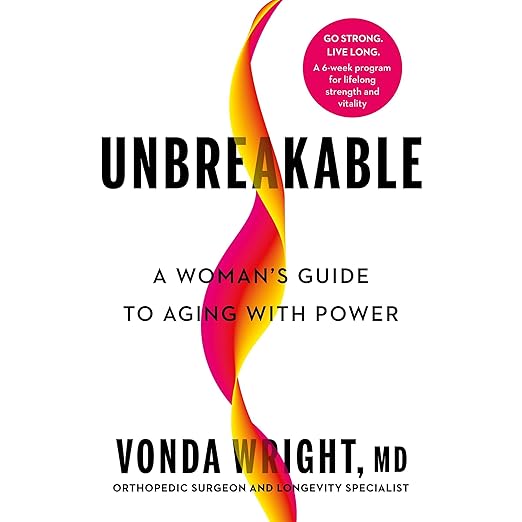
I was on a walk when I started Unbreakable, and by chapter three I had stopped walking to take notes on my phone. That is, I’ll admit, a slight irony given the book’s subject matter, but Dr. Vonda Wright had just explained that more than 70 percent of women experience musculoskeletal symptoms including joint pain, muscle loss, and reduced bone density as they enter perimenopause, and that these are not incidental discomforts but early signals of conditions that compound significantly over decades. I needed to write some of that down.
Wright is a pioneering orthopedic surgeon whose clinical career has centered on helping women at all fitness levels repair bones and regain strength. Unbreakable is her translation of decades of surgical and clinical experience into a preventive framework, a book arguing that the musculoskeletal syndrome of menopause is not a fate to be managed but a trajectory to be redirected, and that the tools for doing so are available to most women right now.
The Musculoskeletal Syndrome of Menopause, Naming What Was Unnamed
One of the most immediately useful things Wright does in the opening chapters is give a name and a mechanism to a cluster of symptoms that many women have experienced without a coherent framework for understanding them. The musculoskeletal syndrome of menopause, joint pain, muscle loss, reduced bone density, tends to be treated as a collection of separate problems rather than as a systemic response to the same hormonal shift. Wright explains the biochemistry of why estrogen loss triggers each of these changes, connecting the dots in a way that transforms vague awareness into actionable understanding. A reviewer who had lost 70 pounds over 18 months described feeling that almost everything Wright addresses was specific to her situation, that quality of addressed specificity is the result of Wright organizing the science around the lived experience rather than the clinical category.
The Six-Week Protocol and What Actually Changes
The structural center of Unbreakable is a six-week master exercise protocol designed to jumpstart skeletal and muscular strength. Wright is a surgeon rather than a fitness coach, and the protocol reflects that background, it is calibrated around the physiology of tissue regeneration and metabolic function rather than around aesthetic goals, and it includes specific guidance on the combination of cardio and resistance training that research suggests is optimal for the menopausal transition. The protocol comes with baseline tests for blood work and mobility that let listeners understand their current state before beginning, which gives the whole program a clinical grounding that differentiates it from general fitness advice.
The downloadable PDF is essential here, the protocol involves charts, exercise illustrations, and test benchmarks that cannot be absorbed through audio. Wright’s narration walks you through the logic and the motivation; the PDF is the actual implementation tool. Plan to use both.
Nutrition, Supplements, and the Zombie Cell Problem
The nutritional section covers anti-inflammatory eating with specific attention to gut microbiome support and bone-building nutrients, territory that overlaps with Dr. Amy Shah’s Hormone Havoc but is approached here from the orthopedic rather than the hormonal angle, which gives it a different emphasis. The twenty anti-inflammatory recipes follow the same format as Shah’s book, and the same caveat applies: they’re better accessed through the PDF than retained through listening.
More distinctive is Wright’s chapter on senescent cells, what she calls zombie cells, and the role of specific supplements in targeting their elimination. This is cutting-edge research that hasn’t yet made it into most popular health books, and Wright explains it clearly without overstating its clinical certainty. The lifestyle section on sleep, stress management, and systemic inflammation rounds out a comprehensive four-category approach that Mel Robbins, quoted in the book’s endorsement, summarized well: the science here proves that your best years can still be ahead.
Who Should Listen and Who Should Skip
Unbreakable is best suited to women in their 40s through early 60s who are looking for a fitness-and-nutrition framework specifically designed for the musculoskeletal dimensions of menopause. It will also be useful for women who have already engaged with the hormonal and nutritional literature on menopause and want the exercise and bone health angle covered in depth. The endorsement by Mary Claire Haver, author of The New Menopause, signals that these two books are complementary, Haver covers clinical breadth, Wright covers the musculoskeletal protocol.
Skip if you’re looking for HRT guidance or a broad survey of menopause symptoms, this book has a deliberate and narrow focus on muscle and bone health. Also skip if you will not use the PDF companion; the exercise protocol and charts are not well-served by audio alone.
Frequently Asked Questions
What is the ‘musculoskeletal syndrome of menopause’ that Dr. Wright describes, and why hasn’t my doctor mentioned it?
Wright uses this term to describe the cluster of joint pain, muscle loss, and reduced bone density that more than 70 percent of women experience as they enter perimenopause, symptoms often treated as separate problems rather than as a single systemic response to estrogen decline. The term is not yet widely used in standard clinical practice, which is part of Wright’s argument for why women need to be better informed advocates for their own musculoskeletal health.
Is the six-week exercise protocol accessible to women who are not already regular exercisers?
Wright designed the protocol for women at all fitness levels, not just existing athletes. It includes baseline mobility and blood work tests to establish your starting point, and the combination of cardio and resistance training it prescribes is calibrated to the physiology of tissue regeneration rather than to athletic performance. That said, the PDF companion is essential for following the program, the audio narration covers the principles but not the specific exercises and chart references.
How does Unbreakable position itself relative to the menopause audiobooks by Dr. Haver and Dr. Shah?
The three books occupy different lanes. Unbreakable focuses specifically on musculoskeletal health, bone density, muscle retention, and resistance training. Haver’s The New Menopause is the broadest clinical reference covering all symptoms and HRT. Shah’s Hormone Havoc focuses on nutritional protocols and gut-brain health. Reading all three gives a comprehensive view; Unbreakable is the right choice if physical fitness and bone health are your primary concern.
The book mentions ‘zombie cells’ and senolytic supplements. Is that science credible?
Wright is referring to cellular senescence research, the study of cells that stop dividing but remain metabolically active in ways that promote inflammation and tissue damage. This is a legitimate and active field of research, and the senolytic approaches she describes (compounds that may selectively clear these cells) are being studied in clinical trials. Wright is careful to present this as emerging science rather than established treatment, which is the appropriate framing for where the research currently stands.