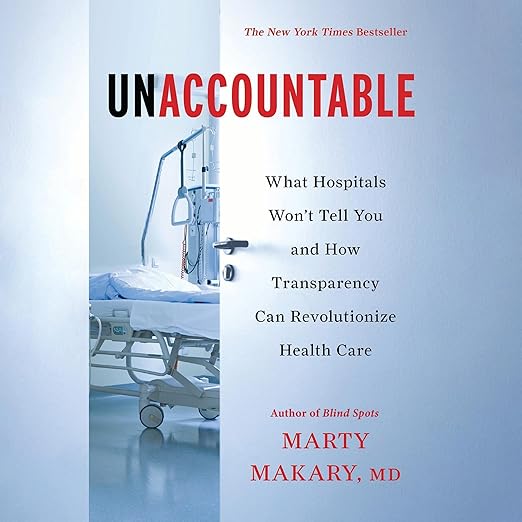
Quick Take
- Narration: Ian Porter delivers Makary’s urgent, no-nonsense register with clarity and conviction.
- Themes: Healthcare transparency, medical error culture, patient empowerment and systemic accountability
- Mood: Direct and unsparing, written with the controlled frustration of someone who works inside a broken system and can no longer stay quiet
- Verdict: Makary’s insider account of American hospital culture’s transparency problem is as relevant now as when it was published, and Ian Porter’s narration gives it real authority.
I listened to most of Unaccountable during a week when several people I know were navigating the American hospital system simultaneously, which is not a coincidence in a country where most adults will need critical care at some point in their lives. Marty Makary is a surgeon at Johns Hopkins and the co-developer of the surgical checklist that Atul Gawande famously describes in The Checklist Manifesto. He is not a journalist or a policy advocate. He is a working surgeon who spent years watching a culture protect its failures rather than correct them, and this book is what happens when that accumulation of observation finally overflows.
The New York Times bestseller tag is accurate but slightly misleading as a signal, because Unaccountable is not a popular health book in the conventional sense. It is a specific, evidenced, and sometimes uncomfortable argument about the structural problem at the heart of American hospital culture: that hospitals are not accountable to patients, that outcomes data is systematically protected from public view, and that the resulting information asymmetry enables bad doctors and systemic flaws to persist in ways that would not survive exposure.
The Black Box Problem in American Medicine
Makary’s central metaphor is the black box. Patients enter the healthcare system at moments of vulnerability and make decisions, or have decisions made for them, with almost no access to the kind of comparative outcome data that would allow them to evaluate hospitals and physicians the way they evaluate other services. A hospital’s rate of surgical infections, its frequency of wrong-site operations, its outcomes for specific procedures compared to regional or national benchmarks: none of this is routinely available to the public in a form that enables real comparison.
He documents this failure with the specificity of someone who has worked inside the system for years. Surgical sponges left inside patients. Amputations of wrong limbs. Medication errors driven by illegible handwriting that continued years after electronic prescribing systems were available. These are not hypotheticals. They are documented cases that recur because the system that should identify, address, and publish information about them instead treats disclosure as a liability risk. The incentive structure, Makary argues, actually rewards medical errors by generating additional billable procedures to address them, a point that is uncomfortable to hear and harder to dismiss because he makes it with specific institutional logic rather than conspiracy framing.
What Real Transparency Would Actually Require
One of Unaccountable’s virtues is that it does not simply diagnose the problem. Makary spends significant time on what meaningful transparency would look like: published outcome data by physician and by procedure, mechanisms for patients to verify surgeon experience with specific operations, culture change in hospitals around reporting near-misses rather than suppressing them. He points to aviation, as Gawande also does in The Checklist Manifesto, as a field that normalized error reporting and near-miss disclosure and became substantially safer as a result.
His tone throughout is not performatively outraged. It is the controlled frustration of someone who has been trying to change things from the inside for years and recognizes that external pressure is necessary for institutional change. Ian Porter’s narration serves this register well. Porter reads with the authority the subject demands, moving through Makary’s arguments cleanly and giving the more disturbing cases space to land without theatrical amplification. At eight hours and twenty-five minutes, the book does not waste the listener’s time.
What the Review Base Tells You
The review base for this audiobook is notable. A reviewer who lost a child to medical errors. A reviewer who witnessed the cover-up culture Makary describes from inside a hospital. These are not people engaged by an interesting argument. They are people for whom the book is documentation of something they experienced. The 4.7 rating across 771 reviews reflects a genuine audience. The reviewer who noted that everyone is going to be in a hospital at some point in their lives is simply stating a fact, and that fact is the book’s most unignorable argument for its own existence.
Who Should Listen and Who Should Skip
Unaccountable is essential listening for anyone who is or will be a patient in the American healthcare system, which is everyone. It is also particularly valuable for healthcare workers who suspect the culture Makary describes is real and want to understand it systematically. Those who want specific guidance on how to navigate the system as an informed patient will find it immediately actionable. Those in hospital administration comfortable with the status quo will find this challenging.
Frequently Asked Questions
Has anything changed in American hospital transparency since Unaccountable was published?
Some progress has occurred, including expanded public reporting requirements and CMS hospital quality initiatives. Makary himself has continued advocating for transparency reforms. But the fundamental structural problems he identifies, including the protection of outcome data and the liability-driven suppression of error reporting, remain significant concerns in the US healthcare system.
How does Unaccountable relate to The Checklist Manifesto, given that Makary co-developed the surgical checklist Gawande describes?
The books are complementary. The Checklist Manifesto focuses on building systems that prevent errors in the first place. Unaccountable focuses on the cultural and structural factors that protect those errors from accountability when they occur. Reading both provides a fuller picture of what systemic safety improvement in medicine would require.
Is the book specific to American healthcare, or does it apply internationally?
Makary’s examples, data, and policy arguments are focused on the United States. The transparency deficit he describes is not unique to American medicine, but the specific institutional incentive structures he analyzes, including the liability culture and for-profit dynamics, are most directly applicable to the US context.
Does Makary include guidance for patients on how to protect themselves within the current system?
Yes. He provides specific advice on questions to ask before undergoing procedures, how to research a surgeon’s experience and outcomes, what to do when you suspect an error has occurred, and how to use the limited public data that is available. The practical sections are specific enough to be actionable.