Quick Take
- Narration: Marguerite Vine brings a contained, precise quality to Annette Herfkens’s account, appropriate for a narrator whose subject has a Dutch banker’s discipline and a survivor’s hard-won economy of feeling.
- Themes: Plane crash survival, motherhood and autism caregiving, optimism as practice rather than temperament
- Mood: Harrowing in places, but consistently forward-leaning, grief processed rather than performed
- Verdict: A survival memoir that earns its second half by delivering a genuinely unexpected story about what comes after surviving, centered on raising an autistic son with the perspective of someone who has already lost almost everything.
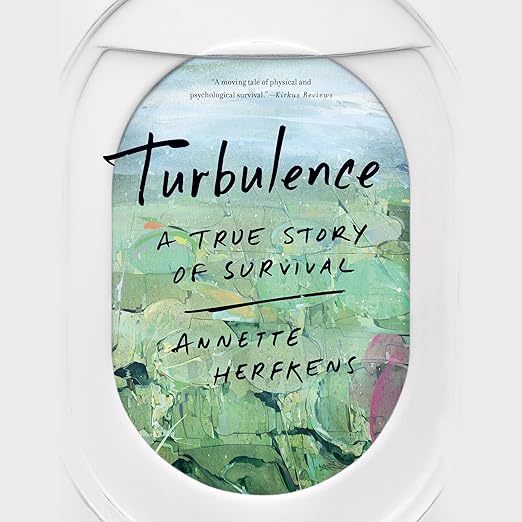
I don’t read survival memoirs as a rule. The formula tends to be familiar: disaster, endurance, transformation, gratitude. The disaster is usually the climax; everything after is denouement. Turbulence is structured differently, and the structure turns out to be the point. Annette Herfkens’s eight days alone in a Vietnamese jungle after a plane crash that killed everyone else on board is not the story. It is, as she frames it, the preparation for the story that came later.
I was driving through an unremarkable stretch of highway when Marguerite Vine began narrating the morning of November 14, 1992, Herfkens packing for a romantic getaway with her fiance Willem, boarding Vietnam Airlines Flight 474 out of Ho Chi Minh City. Six minutes from landing, the plane lost altitude and crashed along a mountain ridge. Of the thirty crew and passengers, Herfkens alone survived. She lay injured in the jungle for eight days, sustained only by rainwater, while her obituary appeared in local newspapers. The sequence of those facts, the banality of the morning, the brevity of the flight, the length of the waiting, is delivered with an economy that makes it more affecting than if it had been dramatized.
Eight Days, and What They Actually Taught
What Herfkens refuses to do with her survival is to extract easy lessons from it. She doesn’t claim that eight days alone in a jungle gave her a philosophy. She claims it gave her a calibration, a way of measuring subsequent difficulty against a reference point of extremity that most people don’t have. When the book pivots to her son Maxi’s autism diagnosis, it becomes clear why she needed that calibration, and why a book about a plane crash is actually a book about parenting.
The autism strand of Herfkens’s story is the more quietly demanding one. She describes the joys and challenges of raising Maxi with a specific honesty about both halves of that phrase. The joys are real and rendered specifically, not as consolation prizes but as genuine pleasures of a particular kind of presence that Maxi brings to the world. The challenges are not softened. The autism caregiving landscape involves its own versions of isolation, misunderstanding, and systemic inadequacy. What Herfkens brings to that landscape is the ability to recognize real difficulty without being destroyed by it, a skill she developed in a context where the stakes of that skill were literally mortal.
The Fiance’s Absence and What It Costs
Willem’s death in the crash is handled with a restraint that some readers have found moving and others have found insufficient. He is present in the opening chapters and then gone, and the grief of his absence is largely processed offstage, we see its outline in what Herfkens does next rather than in extended scenes of mourning. One reviewer described the book as amazingly hard, sad but beautiful, which captures this quality well. The hardness is real; the sadness is permitted; the beauty is not purchased by denying either of the other two. For readers who want more explicit grief processing, the book’s forward momentum will sometimes feel like a deflection. For readers who find that quality authentic rather than evasive, it will feel like the most honest possible response.
Marguerite Vine’s narration maintains this restraint throughout. She does not push for emotional effect in scenes that have already earned it. The result is a listen that trusts you to feel what the material calls for without being directed to feel it, a significant and undervalued quality in memoir narration.
What Changes and What Doesn’t
The book is categorized under Children’s Health in some listings because of the autism content, but it’s worth being clear that this is an adult memoir, not a parenting guide. There is no framework for autism caregiving strategies, no professional guidance on navigating services, no structured advice for parents. What there is, is an account of how one person found a way to bring meaning and resilience to an experience that might otherwise be consumed by its difficulties. That’s a different kind of usefulness than a clinical guide, and it requires a different kind of reading.
One reviewer made the mistake of listening while flying, which they described with a certain dry humor. It is indeed not ideal plane-trip listening. But on a long drive or a quiet evening, at nine hours and fourteen minutes, it is a thoughtful and specifically unusual piece of work, a survival memoir whose survival is almost beside the point.
Who Should Seek This Out
Readers drawn to resilience memoirs that don’t offer false comfort will find this satisfying. Parents of autistic children, particularly those who have had to develop their own frameworks for sustaining energy and perspective over years of demanding caregiving, will likely find Herfkens’s approach resonant even if her circumstances are extreme. Skip it if what you’re looking for is an autism parenting guide with practical strategies, that is genuinely not what this book is.
Frequently Asked Questions
Is the plane crash content graphic or sustained, would it be difficult for anxious flyers?
The crash and the eight days of survival are described with considerable specificity, including physical injury, isolation, and the deaths of the other passengers. It is not gratuitously graphic, but it is honest. One reviewer specifically noted making the mistake of listening while flying. If you have significant flight anxiety, the first third of the book will require some management. The later sections are unrelated to aviation.
Does the book provide practical insight into autism caregiving, or is it primarily Herfkens’s personal experience?
Primarily personal experience. Turbulence is a memoir, not a guide. The autism caregiving sections are honest about the challenges but do not offer frameworks, strategies, or resource guidance. Readers looking for practical autism parenting support should supplement this with dedicated resources. What this book offers is a particular way of holding difficulty, a perspective rather than a protocol.
How does Herfkens handle the death of her fiance Willem, who died in the crash?
With restraint. The book does not dwell at length on the grief of his death, it is acknowledged, present in the structure, and visible in the shape of what follows, but it is not processed in extended emotional scenes. Some readers will find this authentic; others may find it insufficient. The forward momentum of the narrative is a consistent quality of Herfkens’s voice.
Is this categorized as a Children’s Health book because of the autism content, and is it appropriate for that audience?
The categorization appears to reflect the autism caregiving content, but Turbulence is an adult memoir by every measure, it involves a plane crash, adult relationships, bereavement, and professional life. It is not written for young readers or as a resource for children. Parents and caregivers of autistic children are the appropriate audience for the autism-related sections.