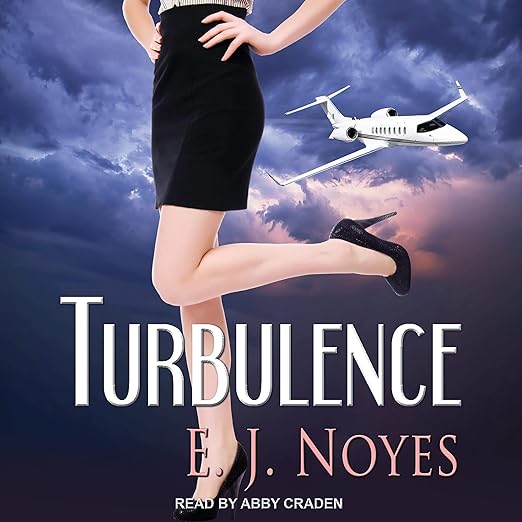
I finished Turbulence on a Friday evening with the kind of pleasant, low-key satisfaction that some books produce better than others, not the feeling of having been through something, but the feeling of having been well accompanied for nine hours. E. J. Noyes has a following in the WLW romance space that began with Ask, Tell, and this second novel was clearly anticipated by readers who found that debut's emotional intelligence worth returning to. The setup here is lighter in premise but no less attentive in execution.
Isabelle Rhodes is a stockbroker with money, self-awareness about her relational failures, and a freshly completed bucket list item: her first one-night stand. The problem arrives the next morning at the airport, when the woman she slept with turns out to be her newly hired company pilot. Ms. Never-See-You-Again is now Ms. See-You-Constantly, and the premise is cheerfully constructed around the comedy of that situation and the more serious question of what Isabelle is actually afraid of.
What distinguishes Noyes's approach is her commitment to emotional realism within a light framework. Isabelle's trust issues are not backstory decoration, they are the actual engine of the plot, and the book does not resolve them quickly or cheaply. The no-strings arrangement that slowly becomes something else is a familiar romance architecture, but Noyes populates it with characters whose reactions to each moment feel specific rather than generic. Audrey is persistent in the way of someone who knows what she wants and is patient with someone who does not yet know the same, and that dynamic does not tip into pressure in a way that might read differently if handled less carefully.
One criticism that surfaces occasionally is that the book feels too uncomplicated, one reviewer used the phrase "too happy" as a mild complaint. That is a matter of taste. There is no third-act misunderstanding manufactured for drama, no antagonist introduced to create external stakes. The conflict is entirely internal to Isabelle, and if that kind of obstacle does not generate enough tension for you, the book will feel thin. For readers who find manufactured drama more exhausting than engaging, this is a feature rather than a bug.
What Makes Turbulence Worth Hearing
Abby Craden handles Isabelle's narration with a light, dry quality that suits the character's habit of observing herself from a slight ironic distance. The humor lands as humor rather than as line delivery, which is not a guaranteed thing. The romance's physical dimension is more present than some WLW readers expect, and at least one reviewer felt a few scenes could have been cut without loss, though the same reviewer finished the book and called it enjoyable overall. The workplace complication, the power differential between employer and employee, the professional exposure if things go badly, creates a friction that Noyes uses for genuine tension rather than just titillation, and Craden conveys Isabelle's professional anxiety in those moments with appropriate weight.
Things to Know Before Starting Turbulence
This is E. J. Noyes before her longer, more structurally ambitious novels, and some of her later readers who come to Turbulence after those works find it feels slight by comparison. The emotional range is present but not stress-tested, we never see Isabelle in genuine crisis, only in prolonged reluctance. The relationship timeline spans enough months that the transition from physical arrangement to genuine attachment feels earned, but listeners looking for dramatic turning points should not expect them in the usual places. The satisfaction here is cumulative and quiet.
Who E. J. Noyes Is Writing For
Listeners looking for WLW romance with genuine character interiority and a protagonist whose emotional intelligence arrives late and authentically will find this satisfying. It works well for long commutes or evenings when you want company rather than suspense. It is less suited to readers who need external plot to carry the middle third of a romance, or those who come specifically for the kind of high-conflict dynamic that Noyes's Ask, Tell delivers. As an introduction to the author, it is welcoming. As a follow-up to her earlier work, it reads as a lighter counterpart rather than an escalation.
The Short Version
- Performance: Abby Craden gives Isabelle's anxiety and dry humor equal weight, making the internal monologue feel lived-in rather than performed, she is well-cast for a protagonist whose guard only drops in increments.
- What it covers: Trust as the real obstacle to love, workplace power dynamics, chosen vulnerability
- Feel: Warm and witty with an undercurrent of real emotional stakes
- Our call: A solid WLW workplace romance that earns its emotional payoff through character consistency rather than manufactured drama, best suited to readers who prefer slow-burn over angst.
Frequently Asked Questions
Is Turbulence connected to E. J. Noyes's other books, or does it stand alone?
It is a complete standalone. Some readers came to it after Ask, Tell and noted the tonal difference, Turbulence is lighter and more comedic in premise, while Ask, Tell carries more emotional weight. No prior Noyes reading is required.
Does Abby Craden's narration handle both the humor and the emotional weight effectively?
Reviews suggest yes, she is particularly noted for handling the comedic early sections with a dry, unforced quality. The emotional escalation in the later chapters has less material to work with, but her performance stays consistent throughout.
Is the workplace power dynamic handled thoughtfully, or does it become uncomfortable?
Most readers felt Noyes handled it carefully, Audrey is an employee but not in a dependent or vulnerable position, and the dynamic is addressed explicitly within the story rather than ignored. The consent framework is clear throughout, though readers with strong objections to any employer-employee romance may want to factor that in.