Quick Take
- Narration: Luke Daniels brings the same energetic, reliable performance he delivers across the Minecraft genre, keeping the nether run and mob encounters moving at a convincing clip.
- Themes: Friendship and rescue, courage in unfamiliar terrain, the value of asking for help
- Mood: Breezy and kinetic, with a light sense of jeopardy that never tips into genuine menace
- Verdict: A short, cheerful listen for established fans of Winter Morgan’s Minecraft world, best suited as a series installment rather than a standalone introduction.
I was listening to a batch of Minecraft-themed children’s audiobooks one weekend afternoon, working through the pile with a cup of coffee and, eventually, a borrowed eight-year-old who sat down to listen for the last forty minutes. Treasure Hunters in Trouble held her attention without any prompting from me. At just under two hours, the story does its job and gets out cleanly.
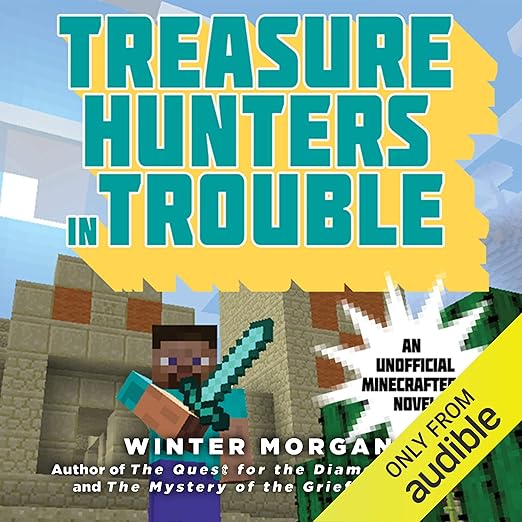
This is the fourth entry in Winter Morgan’s Minecraft Gamer’s Adventure series, built around Steve, a protagonist familiar to readers who’ve followed from the beginning. Here, Steve receives a distress call: his friends Max, Lucy, and Henry are trapped inside a desert temple surrounded by treasure they can’t extract. Steve sets out to rescue them, recruiting his neighbor Kyra for the journey. What unfolds is a classic rescue-quest structure: a trip through the nether, a stint at sea, encounters with chicken jockeys, and a spider cave, all before the group can reach the temple. The treasure, it turns out, is almost beside the point by the time they get there.
The Rescue Quest as Series Engine
Winter Morgan returns reliably to the rescue structure across her Minecraft books, and it’s easy to see why. The premise is instantly legible to young listeners: someone is in trouble, someone else goes to help, danger intervenes. There are no moral complications, no ambiguous villains who might have a point. The world works by game logic, and game logic is satisfying because it rewards effort and persistence. Steve’s journey through the nether and out to sea maps cleanly onto the kinds of challenges Minecraft players already know how to think about, which gives young listeners the pleasure of recognizing and anticipating the obstacles before they arrive.
Why These Books Work for Reluctant Readers
The reviews for this series tell a remarkably consistent story. Parents describe children who resisted reading until Minecraft books appeared, then consumed the series in weeks. One parent described her eight-year-old asking to take a book to his grandmother’s, not a toy, not a device, a book. Another got her eleven-year-old through the whole set in a single summer by pairing reading with screen time. The audiobook format serves a slightly different function: it works for kids who find decoding print frustrating or slow, delivering the same story without the barrier. Luke Daniels’ narration is well-suited to this purpose. He reads with clarity and animation, treating the material seriously enough that children feel the story is worth their attention.
What Two Hours Can and Cannot Do
The brevity of Treasure Hunters in Trouble is both its main appeal and its primary limitation. The story moves efficiently from setup to rescue without detours for character development or emotional depth. Kyra, Steve’s neighbor and companion for most of the journey, functions as a practical ally rather than a fully realized character. The friendship between Steve and his trapped companions is asserted rather than shown, which means the emotional payoff of the reunion is modest. For a young listener working through the series in order, that context is already built from earlier books and the reunion carries weight. Coming to this one first, the stakes feel lighter.
Chicken Jockeys and Other Joys
What the book does exceptionally well is commit to the absurdity of the Minecraft world with a straight face. Chicken jockeys, baby zombies riding chickens, one of the game’s genuinely chaotic mob types, appear here as a genuine hazard, and Morgan writes the encounter without winking at the reader about how ridiculous it is. That straight-faced treatment is exactly right for the audience. Children don’t want their story worlds mocked; they want adults to treat the things they care about as worthy of narrative attention. Morgan, consistently across her books, extends that courtesy to her readers.
Who Should Listen: Solid series installment for existing Minecraft Gamer’s Adventure fans, particularly ages seven to eleven. Who Should Skip: For families starting fresh with Minecraft fiction, there are more complete entry points. The two-hour runtime makes it ideal for a single listening session, but new listeners will miss the context for Steve’s established friendships.
Frequently Asked Questions
Can Treasure Hunters in Trouble work as a first listen, or does it depend on the earlier Minecraft Gamer’s Adventure books?
It functions as a standalone adventure on a plot level, but Steve’s friendships and the world’s established dynamics carry more emotional weight if you’ve followed the series from the beginning. Starting with book one is the better path for new listeners.
How does Luke Daniels’ narration compare across his other Minecraft audiobook work?
Daniels is consistent and reliable throughout the Minecraft genre. He delivers action scenes with kinetic clarity and differentiates characters enough to keep younger listeners oriented without theatrical excess. His work here is comparable in quality to his narration on Cheverton’s books in the same batch.
My child loves Minecraft but has never tried an audiobook before. Is this a good starting point?
For a complete series introduction, book one of the Gamer’s Adventure series would give more context. But if your child is already a fan of Steve’s world and you want to test the audiobook format, the short runtime here makes it a low-stakes trial run.
Are the mob encounters in this book, the nether, the spiders, the chicken jockeys, described in a way that might frighten younger listeners?
The tone throughout is adventure rather than horror. Mob encounters are described with Minecraft-specific vocabulary and treated as tactical challenges rather than threats. The nether and spider cave sequences are tense but brief, and the overall register stays light and encouraging for ages seven and up.