Quick Take
- Narration: Virtual Voice narration is a significant limitation; one reviewer explicitly sought a version in Tam Watts’ own voice after hearing social media clips. The AI narrator undercuts the book’s culturally specific register.
- Themes: Biblical understanding through AAE vernacular, contextual scripture study, faith for skeptical believers
- Mood: Conversational and direct, though the narration gap prevents the intended voice from fully landing in audio
- Verdict: The written content earns its five-star reviews, but the Virtual Voice narration is a real barrier for a title whose entire identity depends on a specific cultural voice.
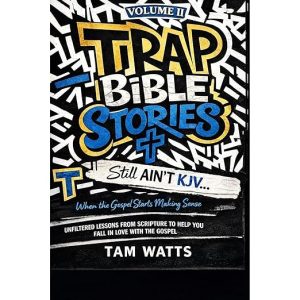
I want to engage with Trap Bible Stories Volume 2 as fairly as I can, because what Tam Watts is doing here is more interesting than the format might initially suggest, and because the narration situation is worth addressing head-on before anything else. One reviewer discovered the book through social media clips of Watts reading the material in his own voice, found the audio version after purchasing, and encountered a Virtual Voice AI narrator instead. That reviewer describes the slang terms as not hitting right with a computer-generated voice, which is a precise and honest critique. The entire premise of this series, using African American English vernacular to make biblical narrative accessible and immediate, depends on the authenticity of the voice delivering it. A Virtual Voice narrator cannot carry that.
With that acknowledged: the written content has earned its reviews. The second volume of the Trap Bible Stories series picks up where Volume 1 left it and moves deeper into contextual biblical analysis. Watts is not rewriting scripture; he is translating the logic and consequence of biblical stories into a register that makes them legible to people who find King James English alienating or who have heard scripture quoted without explanation enough times to feel excluded by the church’s standard interpretive vocabulary.
Our Take on What Watts Is Actually Doing
The synopsis is unusually direct about the purpose: this volume is for the person who loved God but had questions, for the believer who tired of hearing scripture with thee and thou and no explanation, for the reader who wants to understand rather than simply memorize. That is a real gap in the devotional publishing landscape, and Watts fills it with a specific cultural authority that cannot be replicated by a format change. Reviewers describe the experience of reading it as finally understanding stories they thought they knew, of recognizing biblical figures as comprehensible human beings with motives and consequences rather than as symbols to be venerated without inquiry.
One reviewer mentions specifically understanding Tamar’s story, Joseph’s story, and the circumstances around divine judgment in a way that previous study had not achieved. That is not a minor accomplishment. Biblical narrative is frequently stripped of its human context in popular devotional treatment, and Watts restores that context in a register designed for readers who have not found traditional commentary accessible.
Why the Narration Issue Matters More Here Than Elsewhere
Many audiobooks with AI narrators suffer from flatness of delivery but retain most of their value, because the content is the primary asset. Trap Bible Stories Volume 2 is different. The vernacular register, the specific cadence of AAE, the humor and directness that Watts uses to make ancient narrative feel present: these are not decorative qualities of the text. They are the text’s method of achieving its purpose. A Virtual Voice narrator delivering this material is, as the reviewer correctly identifies, a fundamental mismatch. The slang does not hit right. The personality the writing assumes as its delivery vehicle is absent. Listeners who are buying this expecting the experience they saw previewed on social media in Watts’ own voice will find themselves listening to something substantially different.
What to Watch For in the Volume 2 Depth
Volume 2 frames itself explicitly as a step past Volume 1: not just waking the reader up to scripture, but sitting them down and walking them through the context, motives, patterns, and spiritual truths that do not always get explained from the pulpit. The added notes section and coloring pages mentioned by one reviewer indicate that the book functions as a study resource as well as a narrative retelling, which is a more ambitious structural goal than most popular scripture commentary attempts. For Bible study groups, youth ministries, or individual readers working through the series, that supplementary material adds value that the audio format cannot fully capture.
Who Should Listen to Trap Bible Stories Volume II
Listeners who understand the narration situation going in and are primarily interested in the content as an audio companion to the print or digital book will find value here. Those who want the full experience Watts intends should seek out the written version or wait for a narrated version with Watts’ own voice. For new believers, people who have felt excluded from traditional biblical commentary, and anyone whose prior scripture study has left them with more confusion than clarity, the underlying material is genuinely worthwhile. The audience Watts describes in his synopsis, ages 13 to 99 who enjoy learning through stories, is well-served by the content even when the current audio format cannot deliver the cultural specificity the project deserves.
Frequently Asked Questions
Why is there a Virtual Voice narrator instead of Tam Watts reading his own book?
The audiobook was produced with an AI narrator rather than the author. This has generated specific criticism from listeners who discovered the title through social media clips of Watts reading the material himself. The mismatch is significant given the book’s culturally specific register.
Is this a direct replacement for the Bible, or is it a companion study tool?
Watts is explicit that this is not a replacement for scripture. The series synopsis describes it as something that makes the reader want to open their Bible rather than a substitute for it. It functions as a contextual commentary in vernacular rather than an alternative text.
Do you need to have read Volume 1 before starting Volume 2?
Volume 2 builds on the premise established in Volume 1 and frames itself as a deepening of that experience, but the individual stories covered do not require previous volume knowledge. Watts provides enough context within each section to make the material accessible to new readers.
Is this audiobook suitable for use in Bible study group settings despite the Virtual Voice narration?
For group settings, the print or digital version would serve the study purpose better, particularly because the book includes a notes section and coloring pages that the audio cannot convey. The audio works best as personal supplementary listening alongside the written material.