Quick Take
- Narration: Rick Adamson brings a measured, thoughtful quality to Masters’s dense psychological prose, steady and credible without being stiff.
- Themes: Mature monogamy, shadow integration, relational self-awareness
- Mood: Challenging and introspective, with occasional warmth
- Verdict: A rigorous, genuinely original framework for people willing to do hard self-examination inside long-term relationships.
I came to this book in the middle of a long Sunday and left it three days later, having listened to the last two hours twice. That is not a common experience for me with relationship psychology titles, a genre that tends to recycle the same five insights about communication styles and attachment theory. Robert Augustus Masters is doing something substantively different here, and while it requires more from the listener than most books in this space, the return on that investment is real.
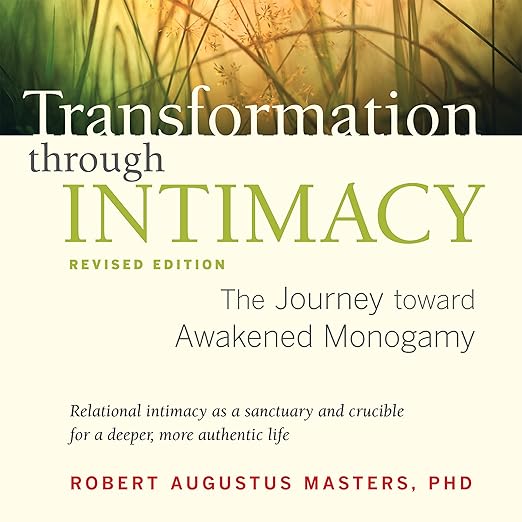
The revised edition of Transformation through Intimacy opens with a premise that is worth sitting with: that intimate relationship has historically been treated as a lesser alternative to spiritual life, something to be managed and minimized rather than inhabited as a path of genuine transformation. Masters challenges that hierarchy directly. His argument, developed across nine hours of dense and carefully structured content, is that the difficulties of long-term intimate relationship, the reactivity, the shame, the conflict, the fear, are not obstacles to spiritual and psychological growth. They are the curriculum.
The Four-Stage Architecture
The structural spine of the book is Masters’s four-stage model for how intimate relationships evolve: me-centered, we-centered codependent, we-centered coindependent, and being-centered. This taxonomy is not especially unusual on its own; developmental frameworks for relationship maturity have a long history in psychotherapy literature. What sets Masters’s version apart is the precision with which he maps the interior experience of each stage, what each one feels like from the inside, what shadow dynamics are operating beneath the surface, and what it actually takes to move from one stage to the next rather than simply convincing yourself you have.
The section on we-centered codependency is the sharpest in the book. Masters resists the temptation to frame codependency as a simple problem to be solved and instead treats it as a developmental stage with its own logic and its own gifts. The movement from codependency to coindependency, his term for mature interdependence, is described not as a liberation but as a loss, one that requires genuine grieving before genuine growth becomes possible. This is the kind of nuance that earns the trust of readers who have done real therapeutic work and found most popular relationship books too thin to hold their experience.
Shadow Work in the Relational Context
Reviewer Susan Moore-Jones described the book as having a fearless confrontation of the games we all play, and that characterization is accurate. Masters draws heavily on his background in psychotherapy and shadow work, the Jungian concept of the disowned or unconscious aspects of personality that surface, often destructively, in intimate contexts. He does not frame shadow qualities as problems to be eliminated but as aspects of the self that require integration. The relationship, in his model, is the container in which that integration most powerfully occurs, precisely because it creates the pressure and provocation that makes avoidance harder to sustain.
Reviewer Alan noted that he immediately started the book a second time upon finishing it, taking notes and highlighting. That experience makes sense. This is not a book that yields all its meaning on a single pass. It is dense, sometimes deliberately uncomfortable, and written by someone who clearly trusts that his readers can handle complexity rather than needing everything smoothed into reassuring summaries.
A Note on the Narration and Format
Rick Adamson’s narration is well-suited to this material. Masters writes in long, layered sentences that carry philosophical weight, and Adamson handles them with care, not rushing, not performing emotion, but conveying the intellectual seriousness of the text without making it feel inaccessible. At nine hours, this is a substantial commitment, and the density means that passive listening while commuting will not get you far. This is a book that asks for attention. Those willing to give it will get considerably more back.
One practical note: Masters occasionally uses terminology that will be more immediately accessible to listeners with some background in Jungian psychology or integral theory. For those without that background, the concepts are explained, but sometimes with the assumption that the listener can hold multiple new ideas simultaneously while still absorbing the argument. If you find yourself losing the thread, backing up by a few minutes is usually sufficient.
Who Should Listen, Who Should Skip
This book is for people who are in or have been in long-term committed relationships and who sense that their patterns in those relationships are connected to deeper psychological material they have not fully examined. It is particularly valuable for anyone who has found standard communication-focused relationship advice insufficient, who already knows how to use I-statements but still finds the same dynamics recurring.
Skip it if you are looking for practical scripts or quick behavioral tools. Masters explicitly resists that kind of prescriptive simplicity. This is a book about transformation at the level of identity and awareness, not at the level of technique, and that distinction is its greatest strength and its primary limitation depending on what you need.
Frequently Asked Questions
How does this revised edition differ from the original version of the book?
The synopsis does not specify the precise changes, but revised editions of Masters’s work typically update the case material and refine the theoretical framing. The four-stage developmental model and the shadow work emphasis appear consistent across editions. If you have read the original, the revised edition is likely worth revisiting for the updated clinical examples.
Is this book useful for people who are single or between relationships, or is it specifically for couples?
Masters writes primarily for people in existing partnerships, but the self-examination framework, particularly the shadow work and the four-stage developmental model, has significant value for anyone doing serious reflection on their relational patterns regardless of current status.
Does the book address specific issues like infidelity, conflict resolution, or communication breakdowns?
Not in a prescriptive, technique-based way. Masters addresses infidelity and conflict as symptoms of deeper developmental dynamics rather than as problems to be managed with specific tools. His focus is on the psychological and spiritual roots of these experiences rather than surface-level interventions.
Does the audio format work for such a dense psychological text, or would the print version be preferable?
It depends on your listening style. Adamson’s narration is strong, but the density of Masters’s prose means this is not background listening. Several reviewers noted returning to sections multiple times, which is easier in print. The audio is fully functional for attentive listeners; those who prefer to annotate or highlight may want the text as a companion.