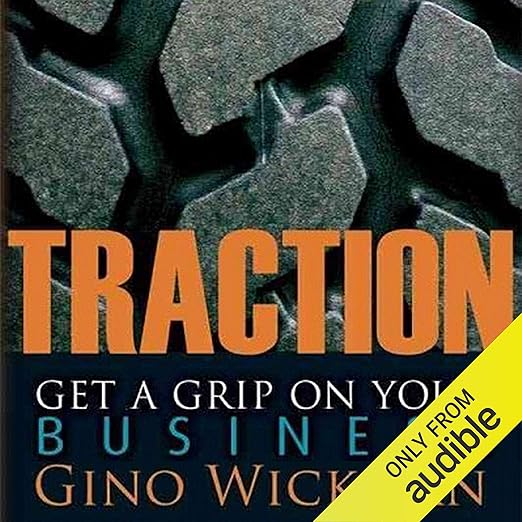
"My CFO recommended Traction", one buyer writes, and those four words explain how this audiobook has traveled for more than a decade. Gino Wickman's book does not move through advertising. It moves through somebody inside a company who has run out of patience with the same meeting, the same unresolved decision and the same conversation about why growth stopped. The opening question in the publisher's copy is blunt about the audience it wants: do you have a grip on your business, or does your business have a grip on you? Anyone who flinched at that sentence is the intended buyer.
The Flatness Here Is Entirely Deliberate
At the center sits the Entrepreneurial Operating System, a method organized around six key components of a company and presented as tools rather than as theory. Wickman is not selling a philosophy of business and does not appear interested in one. The description claims more than 2,000 companies had adopted it by the time of writing, and the chapters are arranged by component so the book doubles as a sequence of implementations rather than a single argument. That structure is why it gets handed around. You can start using one component without accepting the whole system.
Honesty runs through the pool's most interesting notice, a five-star response that opens by warning you off. It calls the book not particularly entertaining, notes that many of the ideas will already be familiar and that nothing in it is shocking or exceptional, and concedes you might even call it boring. Then it turns: the flatness is deliberate, because this is an owner's manual for a business, and owner's manuals are not designed to be entertaining. That is the single most useful sentence written about this title anywhere on the page.
Another buyer sizes the audience precisely, addressing growth-oriented entrepreneurs running organizations between two and fifty million dollars in revenue with ten to two hundred and fifty employees, then listing the symptoms: no control over your time, frustration with employees and partners, insufficient profit, growth that has stopped no matter what you try. If none of that describes your situation, the book will read as a set of solutions to problems you do not have.
A Shared Label Ends the Argument Faster
Plainness is the format argument, and it is a stronger one than it sounds. The same buyer whose CFO handed this over praises the writing as straightforward with no beating around the bush, and that is exactly the property that survives being heard rather than read. Nothing here builds long chains of reasoning that require holding three variables in your head at once. The pattern repeats: name a problem, name a tool, describe how the tool gets used. A listener can follow that while doing something else, which is not true of most management writing.
Under seven hours is short for a system book, and the brevity is functional. You can hear the whole thing twice before a leadership meeting, which is roughly how it is meant to be used. Nobody consumes this once and shelves it. The people who get value from it return to a component when a specific thing breaks, and repeat listening is cheaper in every sense than repeat reading.
Shared vocabulary is the underrated benefit. Because the components are named and the meetings are scripted, a leadership team that has all heard the same book can argue about the right things quickly. That works better when everyone has taken it in the same way, and a recording is easier to distribute across a team than a promise to finish a book by the end of the month. Whether the naming is genuinely useful or merely branded is a fair question, and the answer in practice is that a shared label ends an argument faster than a shared instinct does.
Nobody Discusses Kevin Pierce's Actual Recording
Nobody on this page discusses the recording. Five people have written at length about the system, about whether the ideas are original, about whether the book is boring and about which company size it fits, and the reading itself goes entirely unmentioned. That is normal for a business title, where buyers grade the method rather than the delivery, but it does leave a sample as your only evidence about Kevin Pierce's work here.
A bigger practical problem is that the tools themselves are forms rather than ideas. One comment, written in German, names core values, the V/TO and the meeting structures as the components that actually get implemented, and every one of those is a document you fill in. A listener hears the rationale for an instrument and then has to obtain the instrument separately. If you intend to run this system rather than simply understand it, budget for a printed copy or the worksheets alongside the file.
A December 2012 Recording, a Dated Number
This listing has rough edges worth flagging. Its counter shows nine ratings behind a 4.6 average while five people have written comments on the same page, so nine describes a handful of votes rather than a readership. Because that German-language comment was filed in Germany, only four English-language responses remain to work from. And the description carries a typographical fault, running two words together as InTraction, in the very sentence that introduces the six key components.
A final caveat, about vintage, because it changes how you should read one number. This recording dates from December 2012, and the adoption figure quoted in the description belongs to that moment rather than to now. Treat the number as a snapshot rather than a current count, and assume the examples reflect the business landscape of that period rather than this one.
The Buyers Have Already Warned You
This is for owners and leadership teams of small to mid-sized companies who recognize the symptoms in the description and want a named process rather than principles. It works particularly well as a shared listen, where a whole leadership team acquires the same vocabulary before deciding what to adopt. It also suits somebody two years into running a company who suspects the problem is structural and has been treating it as a personnel issue.
Steer clear if you want ideas rather than procedures, if you are a solo operator or very early stage, or if you are allergic to systems with proprietary names and trademarked acronyms. Plenty of good management writing exists for people who would rather think than implement, and this is very deliberately not that book.
And if you were hoping for an entertaining business book, the buyers have already warned you. This is not one, and it is not trying to be.
At a Glance
- Performance: Kevin Pierce is credited on a text built from component names and checklists, which is a reading job rather than a performance.
- What it covers: The Entrepreneurial Operating System, leadership team accountability, meeting discipline, growth bottlenecks.
- Feel: Deliberately unexciting, procedural, clear.
- Our call: A genuinely useful owner's manual for a ten-to-250-person company, provided you get the printed tools to go with it.
Can you implement EOS from the audiobook alone?
Only partially. Every component reviewers describe adopting turns out to be a worksheet rather than an idea, and a worksheet has to be filled in somewhere. The recording explains why each instrument exists and how it gets used, which is genuinely useful, but running the method needs the printed materials in front of you.
Is the Traction audiobook boring?
A five-star buyer says yes and means it as praise, calling the book not particularly entertaining before concluding that an owner's manual is not supposed to be. The prose stays plain and instructional throughout, which is also what makes it easy to follow while your attention is partly elsewhere.