Quick Take
- Narration: Roger Wood delivers a straightforward, serviceable performance, functional and clear, without the personality that would lift an 80-minute biography into something memorable.
- Themes: Underdog determination, athletic legacy, the mythology of quarterback greatness
- Mood: Brisk and fact-forward, closer to an extended highlight reel than a portrait
- Verdict: A quick, accessible career overview for young football fans already invested in Brady, useful as a reluctant-reader entry point, limited as a literary experience.
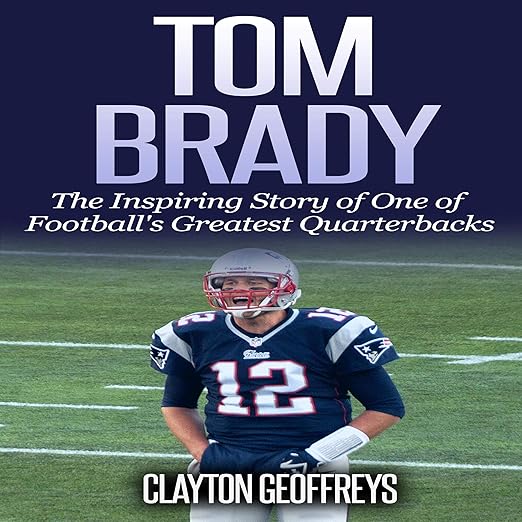
I want to be upfront about the context here. I listened to this one on a Tuesday morning run, which is exactly the right setting for it. At 79 minutes, Tom Brady: The Inspiring Story of One of Football’s Greatest Quarterbacks is structured like a well-organized Wikipedia entry read aloud at a brisk walk, comprehensive enough to satisfy a curious young reader, brief enough to finish in a single session, and about as stylistically distinctive as a sports almanac.
Clayton Geoffreys’s unauthorized biography covers the terrain its title promises: Brady’s childhood, his high school years, Michigan, the NFL draft, the New England Patriots dynasty, Deflategate, and what the author frames as Brady’s legacy. The book is part of the Football Biography Books series, which produces similar entries on other notable players. The formula is consistent across the series: accessible prose at roughly middle school reading level, emphasis on statistics and career milestones, and a tone that is admiring without veering into hagiography.
What an Unauthorized 80-Minute Biography Can and Cannot Do
The honest answer to most questions about this audiobook is: it depends on your expectations. One reviewer’s seventh-grade reluctant reader chose this for a nonfiction assignment, finished it, and then read it again. That’s the audience this title was designed for, not the listener who wants psychological depth or an examination of Brady’s complex public persona, but the 11-year-old who is already a fan and wants the facts organized into a coherent shape.
The unauthorized nature of the biography means there is no insider access, no new revelations, and no personal reflection from Brady himself. Geoffreys works from public record, and the result is a serviceable career summary rather than a biographical portrait. This distinguishes it sharply from something like Becoming Kareem, which functions as genuine memoir, or The Boys in the Boat Young Readers Adaptation, which is narrative nonfiction built with real literary craft. The Brady book is closer to reference material in audio form.
Roger Wood and the Narration Question
Wood’s narration is competent. He reads clearly, paces reasonably, and handles the statistics without turning the chronology into an accounting exercise. But the performance has no distinguishing quality, nothing that makes you feel you’re in the hands of someone who cares deeply about this material or who brings a specific interpretive intelligence to the text. For a young listener who is primarily interested in the information, this is fine. For a listener who wants the audiobook format to add something to the text, there isn’t much here beyond clean delivery.
The contrast with Dion Graham’s work on We Are the Ship, or Abdul-Jabbar’s self-narration of Becoming Kareem, clarifies what’s missing. Those narrators transform the act of listening into an experience that exceeds the words on the page. Wood delivers the words on the page. That’s not nothing, but it’s the baseline rather than a selling point.
The Deflategate Section and Editorial Balance
One reviewer noted that the book gave a personal glimpse into Brady’s life alongside the career statistics, and the Deflategate section is where the most adult complexity enters the text. The young readers format doesn’t ignore the controversy, but handles it briefly and without deep analysis. For parents with strong opinions about Brady, either for or against, the treatment is measured enough not to generate friction. The book ultimately frames Brady’s legacy as largely determined, which is the kind of clean resolution that authorized and unauthorized sports biographies alike tend toward.
Who Should Listen and Who Should Skip
This works well for: reluctant middle school readers looking for a short nonfiction entry point, young football fans who want Brady’s career in an organized audio format, and classrooms using sports biography as a bridge to more demanding nonfiction. Skip this if you want depth, literary craft, or insider perspective, the 80-minute format and unauthorized sourcing put those things out of reach. For a parent looking for something that will hold a football-obsessed 10-year-old’s attention for one afternoon, it serves its purpose cleanly.
Frequently Asked Questions
Does the audiobook cover Tom Brady’s Tampa Bay Buccaneers years and Super Bowl LV win?
Given the publication timeline and the focus on the Patriots dynasty, coverage of Brady’s Tampa Bay period and subsequent Super Bowl win may be partial or absent. Reviewers reference the Patriots era as the book’s primary focus. Prospective listeners should check the publication date to confirm what career period is covered, particularly given how significantly Brady’s legacy continued to develop after leaving New England.
Is this part of a series, and are other NFL player biographies available in the same format?
Yes, the Football Biography Books series by Clayton Geoffreys covers multiple NFL players in the same format. This Brady entry follows the same template as other volumes: unauthorized, statistics-forward, career summary structure at middle-school reading level. It is not a premium standalone biography but part of a consistent series formula.
Is Roger Wood’s narration appropriate for young listeners, and how does the pacing work for the short runtime?
Wood’s narration is clear and appropriately paced for the material. At under 80 minutes, the audiobook moves efficiently through the career timeline. There are no significant production issues. The narration is functional rather than distinctive, it delivers the content cleanly without adding interpretive depth.
What age range is this best suited for, and is it appropriate for classroom use?
The book targets roughly ages 10-14, with its strongest demographic being middle school sports fans. Its short runtime and accessible prose make it practical for classroom reading assignments or independent nonfiction reading. One classroom reviewer noted strong engagement from male students using it as a nonfiction reading assignment, which suggests genuine utility in that setting.