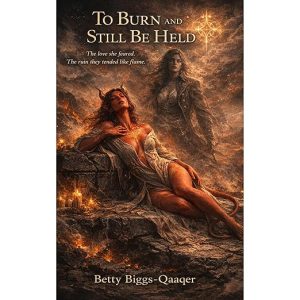
Quick Take
- What it covers: sapphic romantasy, sacrifice and divine mythology, a fourth-book covenant between two women bound by war
- Feel: Intense, mythic, and explicit by design
- Our call: A committed entry for existing Tideborne readers, delivered by a synthetic voice with no reviews yet to confirm how it lands.
No reviews have been left yet for this audiobook, so everything here comes straight from Betty Biggs-Qaaqer's own synopsis for To Burn and Still Be Held, the fourth entry in the Tideborne series.
The Verdict, Briefly
Betty Biggs-Qaaqer's synopsis leans hard into its own mythology: Liora Kynthos is described as a storm-branded heretic who has survived gods, ledgers, and the deep, though the synopsis is careful to note that survival is not the same as salvation, not while the brand still burns and the chorus inside her keeps singing of pyres. Maura Skerrett, a captain bound by vow, was never meant to love a saint, and the two of them have, per the synopsis, rewritten hymns, razed prisons, and buried gods together in defiance of what is expected of them. The plot turns on the Flarewind sailing into a final caldera and the Basilica baring its teeth, with the synopsis promising a last verse lit by wildfire, sealed in kiss, and chosen freely.
This is billed explicitly as a sapphic romantasy, and the synopsis does not soften what kind of book it is, listing volcano vows, tether scars, sex rites, and what it calls sacrificial love that refuses martyrdom among its ingredients.
The imagery throughout leans heavily on fire and burning as a unifying metaphor, present even in the title itself, and the synopsis repeats the motif deliberately: a brand that still burns, a chorus that sings of pyres, a covenant sealed by wildfire. For a series called Tideborne, the shift toward volcanic and fire-based imagery in this fourth installment suggests the elemental stakes have escalated from whatever water-based mythology the series name implies toward something closer to open warfare between gods.
As the fourth book in the Tideborne series, this is written for readers already invested in the relationship between Liora and Maura, and the synopsis signals real narrative stakes rather than a simple happy resolution, framing the ending around a covenant that, in its own words, rewrites its own flame. The one rating currently on the listing totals a perfect 5, though with no written review behind it yet to say what specifically earned that score.
The synopsis is explicit about tone and audience, closing with a direct pitch to readers who crave sacred smut, holy war, and heroines who would rather burn than bow, language specific enough to know exactly what register the book is aiming for before pressing play. At eight hours and forty-four minutes, the runtime sits comfortably mid-length for the genre, long enough to develop the mythology without stretching the central relationship thin. The synopsis also makes a point of naming its tropes directly rather than leaving them implicit, canon-divergent saints, ink-bound captains, a covenant that rewrites its own flame, a level of specificity that reads as written for readers who already track romantasy subgenres closely enough to shop by trope list.
What to Watch For in To Burn and Still Be Held
Amazon's synthetic Virtual Voice system handles the reading here rather than a trained performer. In a book this dependent on emotional intensity, tether scars, sacrificial love, a covenant sealed in kiss, a computer-generated track is a meaningfully different experience from a human narrator's choices, and that gap is worth weighing before committing eight and a half hours.
With zero written reviews, there is no independent account yet of how the book's fourth-installment plot threads land for readers, or how the audio handles a synopsis this dense with invented terminology, Flarewind, Basilica, tether scars, without a human reader's vocal choices to help a listener track it. The listing carries no page count and no ISBN, typical for a title this new, so a listener weighing whether a print or ebook companion exists will need to search beyond this particular page to find out.
The Basilica, mentioned repeatedly in the synopsis as bearing its teeth by the story's climax, functions as the organized religious authority standing against Liora and Maura, and the synopsis frames the entire final act around the Flarewind sailing directly into conflict with it. Readers hoping for a quieter, lower-stakes romance should recalibrate expectations accordingly; this is a book built around open confrontation with an institution, not a private relationship kept separate from larger events.
The series name Tideborne itself carries a promise of continuity worth flagging for anyone tracking a long series: four books in, the synopsis still assumes the reader already knows who Liora and Maura are and what the Flarewind means to them, never pausing to reintroduce the basics, a structural choice that rewards loyalty over accessibility for anyone arriving here first.
Who Will Get the Most From It
Readers already following the Tideborne series, and anyone specifically seeking explicit sapphic romantasy with heavy mythological and religious imagery, gods, saints, a Basilica, will find a book that, per its own synopsis, delivers exactly that without apology.
Steer away if new to the series and looking for an entry point, since this is book four with all the accumulated history that implies, and the same goes if synthetic narration is a dealbreaker for a book this emotionally pitched, or if a purchase decision needs at least one written review to lean on first. Readers who prefer a series to wrap up neatly rather than escalate into open conflict with a religious authority should also weigh the Basilica's role here before committing.
Does this audiobook use a human narrator?
No, it does not. The listing credits Virtual Voice, Amazon's synthetic narration system, rather than a trained performer. For a book this dependent on emotional intensity and invented mythology, that is a meaningfully different listening experience from a human reader's own performance choices.
Do I need to read the earlier Tideborne books before this audiobook?
Yes, almost certainly. This is the fourth entry in the series, and the synopsis assumes familiarity with Liora Kynthos and Maura Skerrett's relationship built across the prior books. It is not written as a standalone entry point for new readers.
Are there written reviews for this audiobook yet?
Not currently. The lone vote on the page totals a flat 5, without any accompanying text to explain it. That leaves no independent account yet of how the plot, the invented mythology, or the synthetic narration actually land for listeners choosing this one.
How explicit is this audiobook's content?
Very direct, by the synopsis's own admission. It closes on a pitch aimed squarely at fans of unapologetically explicit romantasy, and lists sex rites and tether scars among its stated ingredients, alongside a covenant sealed in a kiss, without softening any of it for a broader audience.