Quick Take
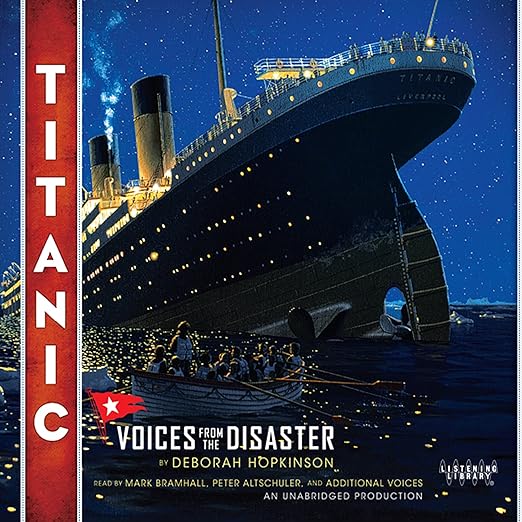
- Narration: Mark Bramhall handles a text built from real voices with careful tonal variation, giving the survivor testimony the gravity it requires.
- Themes: Survival and loss, class division at sea, bearing witness to catastrophe
- Mood: Measured and haunting, with the weight of real events carried throughout
- Verdict: Hopkinson’s approach, weaving together actual survivor testimony, produces something closer to oral history than narrative nonfiction, and Bramhall does it justice.
I came to this one having recently listened to the History Smashers entry on the Titanic, which is a book about dismantling the myths. Deborah Hopkinson’s approach could not be more different. Where Messner aims to correct the record, Hopkinson aims to humanize it. She weaves together the actual voices of survivors, nine-year-old Frankie Goldsmith, stewardess Violet Jessop, high school senior Jack Thayer, Colonel Archibald Gracie, young mother Charlotte Collyer, and several others, into a narrative that moves between the mundane details of a first-class crossing and the catastrophic night that ended it. The effect is something between oral history and documentary nonfiction, and in audio, it is quite remarkable.
The book was designed around its sources. Hopkinson’s primary contribution is selection and assembly, she curates recollections and testimony from across the class divide, from the well-to-do colonel to the young stewardess to the nine-year-old traveling in steerage, and she frames them within the historical narrative without allowing the historical framing to swallow the human voices. That structural choice is what makes this different from a standard nonfiction Titanic account. You are not reading about the iceberg from a safe documentary distance. You are reading about it through the eyes of specific people who were on the ship when it happened.
The Voices Hopkinson Selected and Why They Matter
The selection of perspectives here is deliberate. Jack Thayer was a first-class passenger with the social standing to move freely through the ship; Charlotte Collyer was a young mother in second class heading to America to start a new life. Violet Jessop occupied a uniquely strange position as a professional stewardess who had also survived the sinking of the Britannic. Frankie Goldsmith was nine years old and traveling in steerage, the class that had the worst survival odds by design. By threading all of these voices together, Hopkinson gives a complete picture of the social geography of the ship, and of how differently the disaster played out depending on where you were standing. One listener mentions that her entire family, from young children through adults, was captivated. The cross-generational appeal makes sense: younger children respond to the human specificity of Frankie’s nine-year-old perspective, while older listeners and adults engage with the larger structural and historical questions the book raises without quite stating them.
What Mark Bramhall Contributes to Oral History
Mark Bramhall is a careful, precise narrator who does not impose himself on material that belongs to its subjects. That restraint is exactly right for a book built around real testimony. The temptation with Titanic material, there is so much cultural weight attached to it, might be to perform the tragedy. Bramhall does not. He delivers Thayer’s recollections with the same measured clarity as Jessop’s professional observations, and when he arrives at the testimony of survivors describing the sounds of the water, he does not reach for drama. The drama is already there. Several reviewers mention that the audio format enhanced rather than diminished their experience of a book they had previously read in print, which is a meaningful endorsement of Bramhall’s choices.
The Century-Later Haunting
The synopsis notes that the Titanic continues to haunt and intrigue us even a century on, and Hopkinson is clearly interested in why that is. Part of the answer is in the scale of the mythology. But part of it is in the specific human scale of the testimony she assembles. These were not anonymous victims of a historical event. They were a nine-year-old from a particular family, a stewardess with a professional habit of calm, a well-to-do colonel who believed in decorum until the end. The specificity is what keeps the story alive. Hopkinson understands that, and the audio format, which requires everything to be carried in language rather than supported by photographs, actually amplifies that specificity.
Who Should Listen and Who Should Pass
Reviewers suggest grades three and up as a starting point, with a caveat that younger children will need adult context for the death and loss involved. The book has been used alongside Titanic museum exhibitions, and that combination, immersive visual context plus the audio testimony, is an excellent approach. Adults with existing interest in the Titanic will find this a genuinely moving experience. For a companion that focuses on myth-busting rather than witness testimony, pair it with Messner’s History Smashers entry on the same subject.
Frequently Asked Questions
Is Titanic: Voices From the Disaster too upsetting for younger children?
It deals with death and loss directly, this is a disaster memoir built from real testimony, not an adventure story. Several reviewers suggest grades three and up, and adult accompaniment is helpful for children on the younger end of that range. The testimony is sometimes graphic in its emotional honesty.
Does the audiobook include photographs or visual materials from the print edition?
No. The audio version is narration only, and the print book contains images that enhance the documentary quality of the sources. Families who want the full visual experience should use the print or ebook edition alongside the audio.
Is this appropriate for a family road trip with listeners of different ages?
Yes, with caveats about the subject matter. Multiple reviewers specifically mention that the book works for families spanning young children through adults, which is unusual for children’s nonfiction. The survivor voices give everyone something to latch onto regardless of age.
How does this differ from adult Titanic nonfiction in scope and approach?
Hopkinson’s prose is clear and accessible, but the research and sourcing are solid. The main distinction from adult Titanic nonfiction is tonal, she prioritizes the human scale and individual testimony over technical and structural analysis. Adults who want engineering details will need a different title.