Quick Take
- Narration: Lesley Ewen delivers Kate Brown’s sweeping historical prose with warmth and clarity, holding the emotional register consistent across centuries and continents.
- Themes: Urban food sovereignty, gardening as political resistance, community across displacement, ecological intelligence
- Mood: Hymn-like and quietly radical, scholarly in texture but deeply human in focus
- Verdict: An ambitious and original work of environmental history that reframes the small urban garden as a site of survival, ingenuity, and resistance across three centuries.
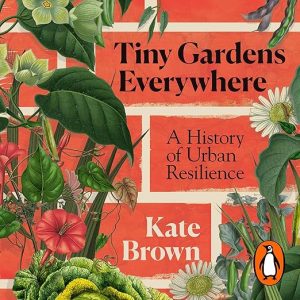
There is a moment about an hour into Tiny Gardens Everywhere when Kate Brown is describing the allotments of pre-war Berlin, a neighborhood called Barackia that housed displaced workers who grew food in plots on land they did not own, and I had to stop walking and sit down. It was not that the material was shocking exactly; it was that Brown had reframed something I thought I understood. Urban gardens are not retreats from history. They are where history happens to people who have been pushed to the edges of it.
That reframing is the engine of this book. Brown, a historian whose previous work has addressed environmental catastrophe at the largest scales, turns here to something small and close: the garden plot. She follows these tiny spaces from pre-industrial England through the Paris Commune, the Soviet allotments of Estonia, the orchards tended by Black migrants in Washington DC, and food forests in contemporary Amsterdam. What connects all of these across three centuries and multiple continents is a consistent pattern: people facing precarity, immigration, environmental crisis, or political displacement have turned to small-scale food production as a form of survival, community, and quiet resistance.
Our Take on Tiny Gardens Everywhere
Brown’s central argument is both environmental and political. The tiny garden, she contends, represents the most fertile agriculture in recorded human history, more productive pound for pound than industrial farming, and it accomplished this with minimal external inputs by deploying inherited knowledge, local adaptation, and communal care. That is not nostalgia; it is a historical claim with genuine empirical backing. Brown supports it with enough specificity that the argument lands as scholarship rather than sentiment.
What elevates the book above environmental history of the usual kind is its attention to the human stories within each setting. The Paris Commune gardeners who fed a besieged city are here. The Soviet Estonian allotment holders who maintained cultural memory through what they grew are here. The Washington orchards that sustained Black migrant communities amid hostility are here. Brown is not writing about gardens as symbols; she is writing about what people actually did with them, and why that matters for how we understand both the past and the present.
Why Listen to Tiny Gardens Everywhere
Lesley Ewen’s narration is a strong fit for the material. Brown’s prose can be lyrical when it needs to be and analytical when it needs to be, and Ewen does not flatten either register. The sweeping scope, from 18th-century England to contemporary Amsterdam, requires a narrator who can hold emotional consistency across very different settings, and Ewen manages that throughout the 8-hour-and-53-minute runtime.
The blurb from Isabella Tree, who wrote Wilding, describes the book as absolutely riveting. Chris Fitch calls it a fascinating history into the quietly radical role of allotments and gardening. Both endorsements point at the same quality: Brown has written a book that is more urgent than it initially appears. The historical record she assembles speaks directly to contemporary questions about food sovereignty, urban planning, displacement, and ecological resilience that remain unresolved.
What to Watch For in Tiny Gardens Everywhere
No listener reviews are available yet, which means this assessment draws entirely on the text and production information. The lack of reviews reflects the February 2026 release date rather than any quality signal. The book’s geographical and temporal scope is wide, and some listeners may find Brown’s movement between very different historical periods slightly demanding to track in audio without visual signposts. The chapter structure will help, but listeners who prefer tightly focused narratives may find the sweep ambitious. This is also not a practical gardening guide; anyone looking for plant care advice will need to look elsewhere.
Who Should Listen to Tiny Gardens Everywhere
Environmental history readers, urban gardeners interested in the politics of their practice, food sovereignty advocates, and anyone drawn to big-picture books that find world history in overlooked small things will find this essential. It sits naturally alongside Wilding and Braiding Sweetgrass as environmental writing with genuine scholarly depth. Those looking for practical horticulture content will be better served by a different kind of book. Listeners who appreciated histories of the everyday, of the kind that look at bread, salt, or cod and find civilization inside them, will recognize what Brown is doing here and respond to it.
Frequently Asked Questions
Is Tiny Gardens Everywhere primarily a gardening guide or a history book?
It is a work of environmental and social history. It does not offer gardening advice; it traces the political and ecological history of small urban gardens across three centuries and multiple continents.
How does Brown connect such different historical periods and places?
Through a consistent pattern she traces across all settings: people facing displacement, precarity, or environmental crisis turn to small-scale food production as a form of survival and community. Brown argues this pattern reveals something fundamental about human ecological intelligence.
Which countries and time periods does the book cover?
Pre-industrial England, revolutionary Paris, pre-war Berlin, Soviet Estonia, Black migrant communities in Washington DC, and food forests in contemporary Amsterdam, spanning roughly three centuries from the 18th century to the present.
How does this book relate to other recent environmental writing like Wilding or Braiding Sweetgrass?
It shares those books’ interest in ecological intelligence and human relationships with the natural world but is more historically and politically focused. Brown is as interested in who owns the land and who was excluded from it as in what grew there.