Quick Take
- Read by: Julie Wainwright self-narrates with some rough pacing edges, but her firsthand authority carries the business sections cleanly.
- At its heart: Entrepreneurial reinvention, Silicon Valley failure and comeback, sustainable luxury resale
- Vibe: Candid and hard-won
- Short version: An unfiltered founder memoir that earns its inspirational framing through real specificity, not empty positivity.
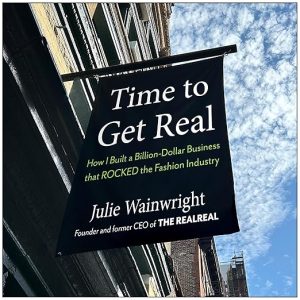
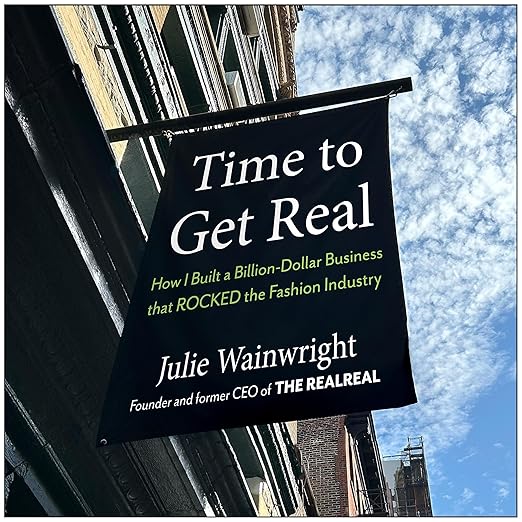
Fifty-two years old and just told by a recruiter that her failed tenure as Pets.com's CEO made her unemployable, Julie Wainwright had every reason to believe Silicon Valley was done with her. This seven-hour, fifty-one-minute audiobook is her own account of what happened instead: building The RealReal from an idea into the largest authenticated luxury resale business in the world.
The Book Julie Wished She Had in the Trenches
Wainwright frames the book explicitly as part tell-all memoir and part entrepreneur crash course, and that dual structure holds up across the runtime. The personal narrative, launching in 2011, scaling into a billion-dollar public company, absorbing every mistake along the way, sits alongside genuinely practical material on building a company from the ground up, hiring for early-stage startups, and pushing through workplace bias.
What makes the memoir half land is Wainwright's willingness to sit with the humiliation of the Pets.com collapse before pivoting to the RealReal success, rather than treating the earlier failure as a quick setup line for the eventual triumph. One reviewer called it 'a rallying cry for women to own their power', and that framing tracks with how directly the book confronts being written off before proving otherwise.
Pets.com remains one of the dot-com era's most enduring cautionary symbols, folding within roughly a year of its sock-puppet mascot's Super Bowl fame, and Wainwright's willingness to revisit that public humiliation in detail rather than gloss past it is what gives the RealReal chapters their earned weight. A recruiter calling her 'unemployable' at fifty-two only lands as a real narrative turn because the book doesn't rush past how thoroughly that failure was covered in the press at the time.
The RealReal's actual business model, authenticating luxury goods for resale at scale, gets real explanatory attention here too, including how Wainwright built consumer trust around a category, secondhand luxury, that had previously struggled with authenticity concerns. The company's eventual path to a public listing in 2019 is treated as the payoff to years of unglamorous operational grinding rather than a sudden overnight win.
The Sock-Puppet Mascot's Super Bowl Fame, Then the Fold
The synopsis's own promise to help listeners 'overcome workplace bias and adversity' carries specific weight given Wainwright's age, fifty-two, at the moment a recruiter wrote her off entirely; the book treats that particular flavor of bias, being counted out for a past failure combined with being older than Silicon Valley's preferred founder profile, as its own distinct obstacle worth naming directly rather than folding into generic startup-hardship language.
The practical promises threaded through the synopsis, hiring for startups while avoiding common oversights, building a business from the ground up, chart real operational ground rather than staying purely inspirational. Wainwright's own path from a very public failure to co-building what the synopsis calls a 'unicorn' required exactly the kind of unglamorous hiring and team-building discipline these sections cover, which gives the practical material an earned specificity a purely theoretical business book couldn't match.
The RealReal's positioning around sustainability, the synopsis notes it made 'luxury items more accessible and sustainable', places Wainwright's second act inside a broader reckoning with fast fashion's environmental costs, giving the business lessons here a relevance that extends past pure entrepreneurship into a genuine cultural shift toward resale and reuse.
The synopsis frames the book's own origin plainly: 'the book Julie wished she had when she was in the trenches', a motivation that shapes the practical sections toward what a founder actually needed to hear mid-crisis rather than tidy advice assembled in hindsight.
LSM's review also credits the book with real clarity on 'how funding and board dynamics can work', governance territory most founder memoirs skip entirely in favor of the more dramatic fundraising pitch stories, and its inclusion here signals Wainwright wanted the book useful past the startup's earliest, scrappiest years.
LSM Calls Wainwright's Read on Hiring Spot-On
Wainwright narrates her own story, and the pacing runs slightly uneven in places, the kind of rough edge you'd expect from a founder reading her own material rather than a trained voice actor. But that unevenness is a fair trade for the authenticity it buys, particularly in the business-history sections covering Pets.com and RealReal, where her firsthand command of the material comes through clearly even when the delivery itself isn't polished.
One listener described being unable to put the book down, calling it 'more than just a business memoir' and praising its 'unfiltered, wildly inspiring account'. That kind of momentum matters for a memoir-plus-business-lesson hybrid, since the personal stakes need to carry a listener through the more instructional stretches.
Wainwright's Uneven, Unfiltered, Wildly Inspiring Account
LSM's review highlights a specific, practical detail: a chart and checklist addressing 'the types of people who make it (and don't) in startups,' calling Wainwright's read on hiring and team dynamics 'spot-on.' That kind of concrete, structural business insight, not just inspirational framing, is what elevates the book above a standard redemption-arc memoir.
Private Name's review credits the book with finding 'a way to mix in education with reality in a way I have never read before', crediting Wainwright for avoiding the trap of choosing between a compelling personal narrative and genuinely transferable business lessons, a tension a lot of founder memoirs never resolve cleanly.
Private Name's review calls the business-lesson integration 'a special treat,' crediting Wainwright with teaching real startup mechanics without the material ever curdling into a lecture, and that momentum reads as a direct byproduct of Wainwright narrating material she lived rather than material adapted for her by someone else.
Exhilarating, Stressful, Glorious, and Messy All at Once
The book includes practical tools, at least one reviewer specifically mentions a chart and checklist among its business content, that were clearly designed with a print or ebook reader in mind. Audio listeners won't have access to those visual references directly, so anyone wanting to actually apply the hiring and fundraising frameworks may want the print edition as a companion.
Because the book blends memoir with instruction, listeners expecting a pure business how-to without the personal narrative wrapped around it should recalibrate; Wainwright's own story is the spine here, not a brief framing device around a checklist.
The synopsis promises 'the whole exhilarating, stressful, glorious, messy truth about success', four adjectives that double as a fair preview of the book's actual tonal range; listeners expecting a cleaner, single-note inspirational arc should know Wainwright deliberately keeps the mess visible rather than smoothing her own story into pure triumph.
Professional Polish Isn't the Promise, Memoir Texture Is
Women in entrepreneurship, fashion and resale industry watchers, and readers of unfiltered founder memoirs will find real value in Wainwright's account, especially anyone who wants startup lessons delivered through lived consequence rather than abstract theory.
Polish and professional narration stripped of memoir texture is not this audiobook's promise, and anyone needing the visual charts referenced in the text should consider pairing this with the print edition rather than relying on audio alone.
Common Questions
Does Julie Wainwright narrate the Time to Get Real audiobook herself?
Yes, and while her pacing runs slightly uneven in places, her firsthand command of the material, especially the Pets.com and RealReal sections, comes through clearly.
Is the Time to Get Real audiobook more memoir or business advice?
Both by design. Wainwright frames it explicitly as part tell-all memoir and part entrepreneur crash course, and the audiobook holds that balance throughout rather than favoring one mode.
Does the Time to Get Real audiobook include the charts and checklists reviewers mention?
Those visual tools exist in the print or ebook edition. Audio listeners get the surrounding explanation but not the visual reference itself, worth knowing before relying on audio alone for the practical frameworks.