Quick Take
- Narration: Patrick Kelly Shannon handles the slow-burn, atmospheric tone well, maintaining the sense of unease the story requires.
- Themes: Institutional corruption, the supernatural as truth-teller, slow-burn investigation
- Mood: Dark, atmospheric, tense, favors dread over shock
- Verdict: A patient, unsettling mystery debut that earns its slow pace if you can give it time to breathe.
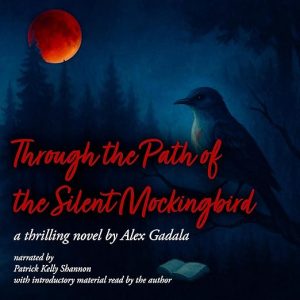
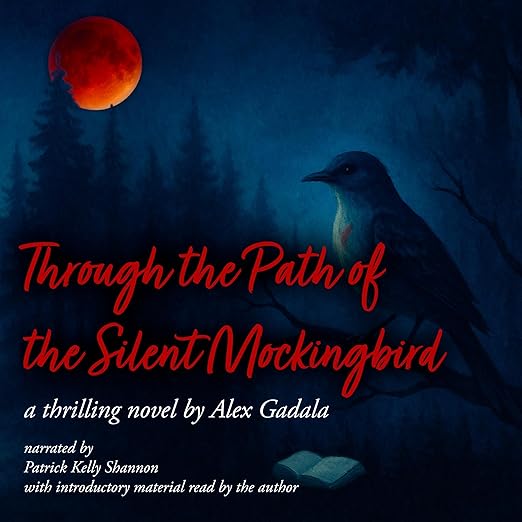
I started this one late on a Thursday evening, which turned out to be exactly the right call. The first chapter of Through the Path of the Silent Mockingbird does not rush anything. It gives you a young detective, a closed case that should have stayed closed, and a bird that appears and disappears just often enough to make you unsure whether it is metaphor or something more. That deliberate pacing either works for you or it does not, and I found myself wanting to stay in it longer than I had planned.
Alex Gadala’s debut novel follows detective-in-training Daniel Falconi as he stumbles into the cold case of Alexandra Muriel, the police captain’s daughter, murdered under circumstances that no one at the department wants to revisit. A lost journal and an elusive mockingbird begin directing Daniel toward truths buried inside the very institution that trained him. The mockingbird of the title is neither fully explained nor fully symbolic, it exists in the space between, which is where the book is most interesting.
Our Take on Through the Path of the Silent Mockingbird
The novel’s central preoccupation is institutional corruption, what happens when the mechanisms designed to deliver justice are the thing you are investigating. Daniel is an insider trying to see from the outside, which creates a particular kind of dramatic tension that differs from the usual detective-against-the-world setup. He is not rogue. He is naive, which is different and, in some ways, more interesting. His inexperience becomes the story’s engine rather than its obstacle.
The supernatural undercurrent is handled with restraint. The mockingbird never tips fully into the explainable or the inexplicable, which is a harder thing to pull off than it sounds. Gadala manages it largely by keeping the focus on Daniel’s psychology rather than on the supernatural element itself. The question is not really what the bird is, it is what Daniel is willing to believe, and what that willingness reveals about him. That interior focus gives the book more psychological texture than a straightforward procedural would have.
Why Listen to Through the Path of the Silent Mockingbird
Patrick Kelly Shannon’s narration maintains the story’s atmospheric register without overdoing it. This is quiet-dread territory, not jump-scare territory, and a narrator who pushed the dramatic notes harder would undermine the whole approach. Shannon’s measured delivery suits a book that the author himself describes as favoring unease over shock, drawing listeners into a gradual descent where every answer raises deeper questions.
The 11-hour runtime gives the story room to build. For listeners who find modern thrillers too fast, too loud, and too plot-dense, this offers a different rhythm. One reader described it as a web of lies with intriguing characters and a well-written plot that pulls you in, the operative phrase being pulls you in rather than drags you through. The pace is intentional, not slack, and it rewards listeners who are willing to sit inside the discomfort rather than wait for the plot to rescue them.
Gadala also makes strong use of the institutional setting. The police department functions as both backdrop and antagonist in a way that feels specific rather than generic, there are hierarchies, loyalties, and self-protective reflexes that shape how every character behaves, and those dynamics are observed with care. This is not a book where the institution is simply corrupt as shorthand. It is a book interested in how corruption actually operates inside organizations that depend on public trust.
What to Watch For in Through the Path of the Silent Mockingbird
This is a debut novel with minimal reviews. The rating of 4.4 is encouraging but based on only three listener responses, so the consensus is too thin to be meaningful. What those three responses share is the word gripping, which is a good sign, but listeners looking for heavy external validation before committing will not find it here yet.
The supernatural dimension will divide some readers. If you want a purely procedural investigation, the mockingbird’s ambiguous presence may feel unresolved in a way that frustrates rather than intrigues. Gadala is not writing toward a clean explanation of the uncanny, and readers who prefer their mysteries fully rationalized should know that going in.
Who Should Listen to Through the Path of the Silent Mockingbird
This is for fans of atmospheric, psychologically grounded mystery fiction, think more Donna Tartt’s layered unease than Lee Child’s kinetic pace. It rewards patience and suits listeners who find supernatural ambiguity interesting rather than annoying. It is also worth seeking out for anyone drawn to crime fiction that takes seriously the internal workings of law enforcement institutions rather than treating them as backdrop. Skip it if you need a fast pace, a reliable detective hero, or a mystery that resolves every thread cleanly by the final chapter.
Frequently Asked Questions
Is the supernatural element in this book explained by the end?
Not fully, and that appears to be deliberate. The mockingbird occupies an ambiguous space between metaphor and genuine supernatural presence. Readers who need clean explanations may find the ending unsatisfying.
Is this a series or a standalone novel?
It appears to be a standalone debut novel. There is no series information attached to the Audible listing as of this writing.
How does Patrick Kelly Shannon’s narration handle the slower pacing?
His measured delivery suits the material well. The book favors atmospheric dread over shock, and Shannon does not push the dramatic register harder than the text requires, which is exactly right for this kind of story.
How graphic is the violence in this mystery?
The book is described as dark and atmospheric but favoring unease over shock. It is not a gratuitously violent thriller. The horror is psychological rather than visceral, though a brutal murder is the story’s inciting event.