Quick Take
- Narration: Tom Wayland delivers a clean and respectful read that fits the book’s reflective, testimony-style writing, his earnest delivery matches Tebow’s own public voice well across the long runtime.
- Themes: Faith as competitive foundation, football as vocation and platform, public devotion in a skeptical culture
- Mood: Sincere and personal, structured as testimony more than traditional sports memoir
- Verdict: A book written for readers who already admire Tim Tebow, those approaching it as outsiders will find genuine sincerity but limited engagement with the controversies his career generated.
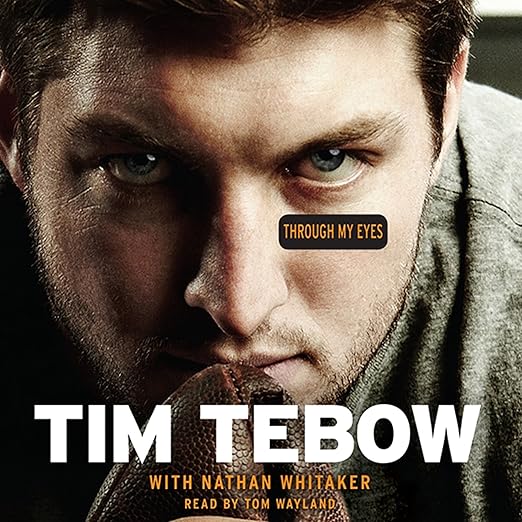
Tim Tebow is not an easy subject to approach neutrally. He was, at his Florida peak, one of the most decorated college quarterbacks in history, two national championships, a Heisman Trophy, a 2010 NFL first-round draft pick. He was also, through that entire career and the professional one that followed, one of the most publicly polarizing athletes in American sport, primarily because of the visibility and sincerity of his Christian faith. Through My Eyes, written with Nathan Whitaker, is very much Tebow’s own account of how those two things relate.
I listened to this on a long drive, and the experience is of riding alongside someone who is genuinely, completely at peace with who they are. That’s either deeply compelling or slightly hermetic depending on where you bring yourself to it. Tebow doesn’t engage with criticism or doubt except to dismiss it with equanimity. He doesn’t narrate a period of crisis or questioning. His faith is the bedrock, the career is the expression of it, and the memoir is the testimony of both. Tom Wayland’s narration is well-matched to this material, earnest, steady, unhurried, and the writing, with Nathan Whitaker’s craft evident in its structure, gives the 10-plus-hour runtime its discipline.
The Heisman Trail and What It Meant at Florida
The University of Florida years are the book’s athletic core, and they’re narrated with earned pride. Tebow’s recruitment to Gainesville, his development under Urban Meyer, the 2006 national championship, the Heisman in 2007, the second national championship in 2008, these are factual landmarks in college football history, and Tebow places himself within them with appropriate humility. He is careful to credit teammates and coaches, which is either genuine modesty or political skill; the memoir presents it as the former.
What distinguishes the Florida chapters from a standard sports biography is the integration of faith into every narrative turn. The John 3:16 eye black. The post-championship press conference. The public kneeling that gave American culture a new verb. Tebow doesn’t explain these as choices made for effect, he explains them as natural expressions of something prior, something he would do whether or not anyone was watching. Wayland’s narration in these sections has the right quality: not celebratory, not apologetic, just present.
The Denver Draft and What the NFL Chapters Reveal
The Denver Broncos sections are the book’s most interesting from a sports analysis perspective. Tebow’s unconventional throwing mechanics, the debates about his future as a professional quarterback, the improbable 2011-2012 playoff run, these chapters are where the memoir’s dual agenda (faith testimony and career narrative) becomes most visibly complicated. Tebow acknowledges the professional criticisms without fully engaging with them, which is his prerogative but limits the usefulness of this account as sports analysis. What it offers instead is a portrait of how someone navigates sustained public doubt while maintaining complete internal certainty. That’s psychologically interesting regardless of the athletic content.
The book was written during and immediately after Tebow’s second year with Denver, and the narrative ends before the subsequent career turns, the New York Jets period, the New England tryout, the late baseball career with the Mets organization. That temporal limitation is worth noting for readers looking for the complete story of Tebow’s post-college career.
The Faith Architecture and Who This Book Is For
Reviewers describe this memoir as “inspirational” with genuine consistency, this is clearly a book that does what it intends to do for its intended audience. Tebow’s faith is presented as a complete system: it explains his work ethic, his relationships, his equanimity under pressure, his indifference to fame. For readers who share that framework or are sympathetic to it, the memoir is a study in applied Christian conviction at the highest levels of athletic competition.
For readers outside that framework, the book is less satisfying as memoir because it forecloses the kinds of questions that create dramatic tension in secular sports writing. There is no crisis of faith, no moment of doubt, no period where Tebow considers that his commitments might be costing him something he values. The conventional memoir structure, conflict, growth, transformation, is replaced by a structure of continued conviction. That’s honest to who Tebow is, but it means the book is best understood as testimony rather than as traditional biography.
Tom Wayland and the Challenge of 10 Hours
Ten hours and seventeen minutes is a substantial commitment for any audiobook in this category. Wayland paces it well, and the writing has enough structural variety, the college years, the missionary work in the Philippines, the draft, the Denver season, to prevent the runtime from feeling uniform. But listeners should know this is a long sit for a memoir that doesn’t generate the kind of suspense that carries genre fiction through similar lengths. Wayland’s earnest delivery is consistent without becoming monotonous, which is the right call for this particular voice. He reads Tebow as Tebow would want to be heard: sincere, grounded, and certain in a way that asks you to meet the conviction on its own terms.
Frequently Asked Questions
Does the book cover Tim Tebow’s career after the Denver Broncos, including the Jets and his baseball career?
No. The memoir was published in 2011 and covers Tebow through his second NFL season with Denver. The Jets period, the New England trial, and the baseball career with the Mets organization are not included. This is primarily a college-football and early-NFL account.
Is this book appropriate for non-Christian readers, or is it essentially a faith memoir that uses football as its setting?
It’s genuinely both, but the faith dimension is primary and inseparable from the sports narrative. Tebow doesn’t segregate the two, his faith is presented as the foundation of every athletic decision. Readers outside a Christian framework will find honest sincerity but limited engagement with the controversies his public faith generated, as the book doesn’t address criticism from that direction.
How much does the book cover Tebow’s missionary work and humanitarian activities beyond football?
The Philippines work and his Tim Tebow Foundation activities are given meaningful space. Tebow presents his faith as expressed through multiple platforms, not just football, and the humanitarian sections are presented as equally central to his identity as the athletic ones.
Is Tom Wayland’s narration a good fit for a memoir with this much faith content?
It is. Wayland has a voice that communicates sincerity and steadiness without religiosity, he reads the faith content as naturally as the football content, which is the right approach for a memoir where the two are deliberately intertwined. The 10-hour runtime is manageable under his even, earnest pacing.