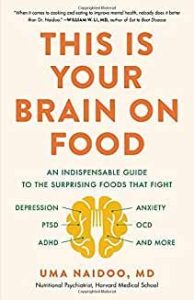
I picked up This Is Your Brain on Food during a period when I was paying more attention than usual to how I felt after eating. Not in a disordered way, just with the growing suspicion that the afternoon fog I was blaming on insufficient sleep might have something to do with what I had eaten for lunch. Uma Naidoo, a Harvard-trained nutritional psychiatrist, has written the book that addresses exactly that suspicion, and she does it with the rigor of a clinician rather than the enthusiasm of a wellness influencer.
Naidoo is the director of nutritional and lifestyle psychiatry at Massachusetts General Hospital, and that institutional grounding matters to the book's credibility. This Is Your Brain on Food is not a diet book. It is an account of the emerging evidence that specific dietary patterns influence specific mental health conditions: anxiety, depression, ADHD, brain fog, OCD, PTSD, dementia, and insomnia, among others. Each condition gets its own chapter, and each chapter moves from a brief overview of the condition to the relevant research and specific dietary recommendations. The structure is clear and practical, which is the right choice for material that could easily become either too technical or too vague.
The field of nutritional psychiatry is relatively young, and Naidoo is honest about the limitations of the evidence base. She distinguishes between associations that have been observed in population studies and mechanisms that have been more directly demonstrated, and she is careful not to overstate what the research can currently claim. This epistemic care is one of the things that separates the book from the more credulous end of the gut-health genre. The gut-brain axis is real and increasingly well-documented, and Naidoo addresses it with proportionate confidence rather than presenting it as a complete explanation for all mental health conditions.
The practical implications of the research are organized around specific foods and dietary patterns rather than abstract nutritional principles. Fermented foods, omega-3 fatty acids, specific antioxidants, and the avoidance of ultra-processed foods all recur across multiple chapters, with condition-specific nuances in how and why they matter. Listeners who are eating fairly well already will find a great deal of confirmation here. Listeners with dietary habits that diverge significantly from Naidoo's recommendations will find the evidence for changing those habits more persuasively assembled than in most popular health books. The book does not moralize about food choices, which is a notable quality in this genre.
What Works
Naidoo narrates her own book, which works well for this genre. The clinical warmth in her voice is genuine rather than performed, and her delivery has the particular quality of a good physician explaining something to a patient: clear, paced for retention, and free of condescension. She reads the more technical passages with appropriate deliberateness, and the dietary recommendation sections with a practical directness that makes them feel actionable rather than aspirational.
At just over eight and a half hours, the book is substantive without being padded. The chapter-per-condition structure allows listeners to navigate directly to sections most relevant to their own concerns, though the book rewards sequential listening because the foundational chapters on the gut-brain connection and inflammation inform everything that follows. The companion PDF that accompanies the Audible version includes practical dietary summaries for each condition, which is a genuinely useful supplement to the audio content and one worth downloading before you start listening.
Things to Know Before Starting This Is Your Brain on Food
The book addresses a broad range of mental health conditions, and the depth per condition varies accordingly. Some chapters are more research-dense than others, reflecting the maturity of the evidence base for each specific condition. The anxiety and depression chapters benefit from the most established nutritional research, while some of the other conditions involve extrapolation from more limited studies. Naidoo is appropriately transparent about these differences, but listeners seeking deep evidence for every condition covered may find some chapters more satisfying than others.
For listeners outside the United States, some of the specific food product references may require translation to locally available equivalents. The underlying dietary principles are universally applicable, but the book was written for an American context, and the food environment it assumes is a North American one. This is a minor limitation for most listeners but worth noting for international readers.
Who It's For
Naidoo is clear that nutritional psychiatry is a complement to conventional psychiatric treatment, not a replacement for it. The book does not argue that dietary change alone will resolve clinical depression or treat ADHD without medication. It argues that dietary patterns are an under-attended variable in mental health management, and that attending to them can improve outcomes alongside other treatments. That framing is responsible and accurate, and it positions the book correctly in relation to its limitations. For listeners managing mental health conditions who want to understand the emerging evidence for dietary intervention, this is the most credible popular-science account currently available in audio form.
The book's rating of four stars with over a thousand reviews reflects a readership that found it useful and credible without finding it perfect. Some reviewers noted that certain chapters feel more like introductions to a topic than fully developed guides, and that is a fair observation for a book that covers as much ground as this one does. But as an introduction to nutritional psychiatry from a credible clinical voice, it is the right starting point, and the audio format makes it accessible in the way that a densely cited academic text would not be.
In Brief
- Read by: Uma Naidoo narrates her own work with the measured authority of a clinician who has spent years translating research into patient-friendly language.
- At its heart: nutritional psychiatry, diet as mental health intervention, the gut-brain connection
- Vibe: Methodical and practical, with an accessible clinical warmth
- Short version: A science-grounded guide to nutritional psychiatry that is most valuable for listeners dealing with specific mental health conditions looking for dietary strategies alongside conventional treatment.