Quick Take
- Narration: Anupama Prasad brings a measured, warm presence to dense philosophical material, the pacing is contemplative, which suits the sutras’ register.
- Themes: self-realisation, the nature of consciousness, yoga as inner architecture rather than physical practice
- Mood: Expansive and unhurried, this is listening as practice, not listening as consumption
- Verdict: Mehrotra’s interpretation earns its place for practitioners who already have some yoga philosophy context and want a living tradition’s voice rather than an academic gloss.
I finished this one on a long train ride through the Pacific Northwest, the kind of grey winter afternoon where the landscape keeps shifting between forest and fog. I’d started it expecting the kind of yoga philosophy book that waves at the sutras before pivoting to breathing exercises and positive affirmations. What I found instead was something considerably more demanding, and more interesting.
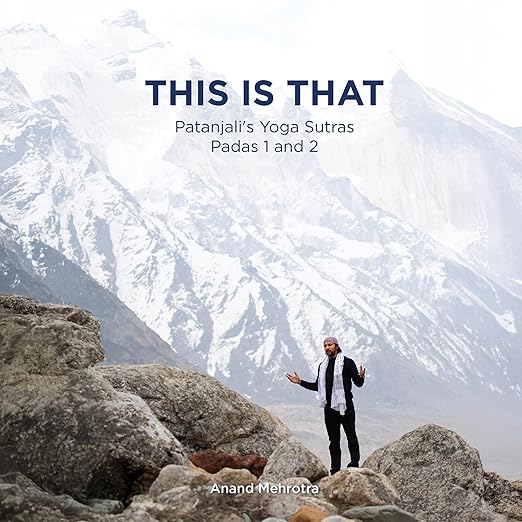
Anand Mehrotra is a Himalayan tradition teacher born in Rishikesh, which the reviews rightly identify as yoga’s geographic heartland. That origin is not incidental. Many commentaries on the Yoga Sutras come from Western academics or practitioners who encountered this tradition from the outside and explain it in terms accessible to that outside perspective. Mehrotra’s commentary moves in the opposite direction: inward, toward the experiential rather than the definitional.
What Makes This Interpretation Radical
The word radical in the subtitle earns its use. Mehrotra isn’t performing line-by-line translation in the standard commentarial mode. What he’s doing is closer to what a living teacher does in a teaching context: finding the sutra’s pulse, then pressing on it to see what living knowledge it still contains. The result is less a reference text than an extended conversation with 2,500-year-old material from someone who considers himself inside that tradition rather than studying it from without.
A reviewer named Aditi notes specifically that most Yoga Sutra interpretations come from scholars who never practiced deeply within the Himalayan tradition, and that Mehrotra’s immersion changes what he’s able to see. That tracks with my own read. The passages on Pada 1, particularly those dealing with the fluctuations of consciousness, have a different texture in Mehrotra’s hands, less psychological inventory, more direct pointing. He’s not describing the states so much as gesturing toward what it would mean to move through them.
The Question of Accessibility
Here I want to be honest about the ceiling this book has. If Patanjali’s Yoga Sutras are entirely new territory for you, starting here may produce more confusion than clarity. Mehrotra assumes a certain baseline familiarity with yoga philosophy vocabulary, terms like prakriti, purusha, samadhi, and samskara appear without extended definition. The approach isn’t pedagogical in the traditional sense; it’s initiatory. That makes it profound for practitioners who have some grounding and frustrating for absolute newcomers.
This is book one of a series covering only Padas 1 and 2 of the four-part Yoga Sutras, which means the listener is getting roughly half of the source text. The series architecture makes sense given the depth of commentary per sutra, but it’s worth knowing you’re entering a longer project if you come to it seeking completeness.
Anupama Prasad and the Sound of These Ideas
Prasad’s narration is a real asset here. The Yoga Sutras are not meant to be rushed, and Prasad doesn’t rush them. Her delivery is clear without being cold, and she carries the Sanskrit terminology with natural ease. The ten-hour runtime might seem long for a text whose source document runs to fewer than two hundred sutras, but the space is earned: Mehrotra’s commentary per sutra is substantial, and the pacing of the narration lets that commentary breathe.
Listeners who have encountered other audio commentaries on the Yoga Sutras, Chip Hartranft’s translation remains a useful academic counterpoint, will find Prasad’s register here more intimate and less detached. That matches Mehrotra’s project. One reviewer calls knowing this book transformative, which may be hyperbole or may be accurate depending on where you are in your practice. The book seems designed to meet practitioners at a certain level of readiness.
Who This Audiobook Is For
Listen if you have a sustained yoga or meditation practice and want your philosophical reading to come from someone inside a living teaching lineage. Listen if you’re comfortable with Sanskrit philosophical vocabulary, or willing to look up terms as you encounter them. Listen if you’re interested in what a classical text looks and sounds like when transmitted by a working teacher rather than translated by a scholar.
Skip this first volume if you’re new to yoga philosophy, start instead with something like Georg Feuerstein’s overview, or even a basic introduction to the sutras, before returning here. And if you’re looking for a practical guide to yoga postures or a wellness-focused yoga experience, this book is structured around none of that.
Frequently Asked Questions
Do I need to have read the Yoga Sutras before listening to This Is That?
Some prior familiarity helps significantly. Mehrotra’s commentary assumes you know the basic vocabulary and structure of yoga philosophy. Complete newcomers to the Yoga Sutras may find the depth of engagement difficult to follow without first spending time with an introductory translation.
Does this audiobook cover all four Padas of the Yoga Sutras?
No. This Is That covers only Padas 1 and 2, as indicated in the title. The series continues in subsequent volumes. If you’re looking for full coverage of all four parts of Patanjali’s text, you’ll need to continue with the rest of the series.
How does Mehrotra’s approach differ from more academic Yoga Sutra commentaries?
Mehrotra speaks from within the Himalayan yoga tradition as a practicing teacher, not as a scholar translating an ancient text. His commentary prioritizes experiential understanding and living transmission over philological precision, which reviewers from within yoga practice tend to find more useful than academic approaches.
Is Anupama Prasad a native speaker, and does that affect how the Sanskrit is handled?
Prasad handles the Sanskrit terminology with evident ease and natural fluency, which several listeners note as an asset compared to narrators who approximate Sanskrit pronunciation from the outside. The narration feels culturally grounded rather than awkward around the source language.