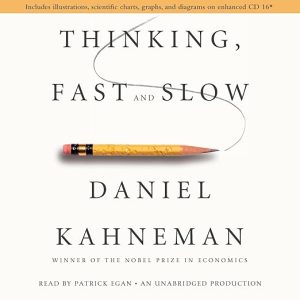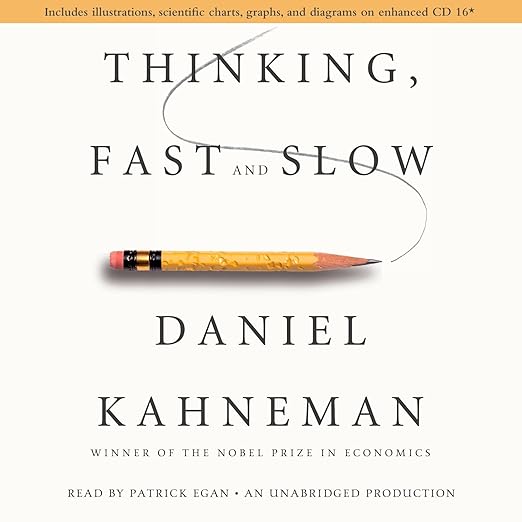
System One acts fast, intuitive and confident, while System Two lags a half-step behind, checking the work: which one do you actually trust when a decision matters? Daniel Kahneman spent a career studying that exact question, and this audiobook is his own account of what decades of research with the late Amos Tversky turned up. The premise sounds academic, but the book itself, at just over twenty hours, reads more like a guided tour through your own mental machinery, one blind spot at a time. Kahneman explains where fast, intuitive judgment serves you well, where it quietly sabotages you, and how the slower, more deliberate system can be recruited to catch the difference. It is a genuinely rare thing: a Nobel laureate's own synthesis of his life's work, written for a listener with no economics background at all.
Egan's Delivery Could Tip Into Detached Lecture
The book's two-system framework, System One as fast and emotional, System Two as slow and effortful, gives Kahneman a structure sturdy enough to hold decades of disparate research: anchoring effects, loss aversion, the planning fallacy, the illusion of validity that convinces experts they are better predictors than they actually are. 'An incredible treatise on primarily the life's work of Dan Kahneman and Amos Tversky' is how reviewer Bill Dahl sums it up, and that description is accurate in scope; this is less a single argument than a comprehensive record of an entire research program, chapter by chapter, study by study, told with more warmth than the subject matter might suggest.
What keeps the book from reading as a dry literature review is Kahneman's willingness to use himself as a test case, walking through his own errors in judgment, including ones made after decades of studying the exact biases that produced them. That self-implication matters for the audiobook specifically, since narrator Patrick Egan's measured, professorial delivery could tip into detached lecture mode in less careful hands. Instead the confessional passages land with real humility, Kahneman not as an authority looking down at everyone else's cognitive failures but as a fellow subject of his own research, still capable of falling for the very effects he first described decades earlier.
The book's most famous single contribution, prospect theory, the finding that people weigh potential losses roughly twice as heavily as equivalent gains, gets developed gradually rather than dropped in all at once, and that pacing is a deliberate teaching choice. Kahneman builds toward it through smaller, more digestible examples first, so by the time the full theoretical apparatus arrives, a listener already has the intuitive scaffolding to understand why it matters, not just what it claims. Few popular-science audiobooks manage that kind of patient, cumulative argument-building without losing momentum somewhere in the middle third.
A Slot Machine, a Courtroom, a Price Tag
Twenty hours is a genuine commitment, and the case for audio specifically comes down to how conversational Kahneman's original prose already is. He favors short illustrative examples over long technical asides, the kind of concrete scenario, a slot machine, a courtroom, a grocery store price tag, that translates cleanly into spoken narration without losing precision. Patrick Egan's pacing gives each example room to land before moving to the next idea, which matters in a book that builds its argument through accumulation of small, specific demonstrations rather than one sweeping thesis stated once and then defended.
Gimlet Eye's review argues that mastering this material should be considered essential to a basic education, calling it close to 'a scandal that mastering the material in this book isn't considered an essential component of a high school education.' That may overstate the case, but it points at something real: once you understand the difference between System One and System Two, you start noticing the distinction everywhere, in your own snap judgments, in advertising, in how confidently other people state opinions they have not actually examined. Few audiobooks change how a listener processes the rest of their week quite this directly.
A Real Loss That Isn't a Fatal One
The prose is dense enough that passive listening will lose you fast. This is not background-noise nonfiction; Matthew Kernodle's review, from a reader with limited formal schooling who still found the book worth the effort, makes the point implicitly: the ideas reward real attention, not half-listening while doing something else. Anyone planning to absorb this on a single commute or during a workout should expect to replay sections, since the connective logic between chapters depends on remembering specific terms and experiments introduced many hours earlier.
A real format loss is also worth naming directly: the synopsis notes a bonus PDF of illustrations, scientific charts, graphs, and diagrams packaged with the book, and none of that material translates into an audio-only format. Kahneman's arguments are built primarily on verbal reasoning rather than data visualization, so the loss is not fatal, but a listener who wants to see the actual experimental figures referenced throughout will need to track down that PDF separately or pair the audiobook with a print copy for reference. Treat the audio edition as the primary reading experience, with the visual supplement as an optional add-on rather than essential scaffolding.
Egan Treats Each Callback as a Refresher
Business readers, students of psychology, and anyone who enjoyed Malcolm Gladwell or Michael Lewis will find familiar territory here, minus the magazine-feature polish; this is the source material those popularizers have been drawing from for over a decade, in Kahneman's own more careful and hedged voice. The synopsis name-checks both Gladwell and Steven Pinker as writers influenced by this research, and listening to the original after knowing their work retroactively clarifies how much of the last fifteen years of pop-psychology writing traces back to these specific studies. Readers of behavioral economics, or anyone who makes real decisions under uncertainty for a living, should treat this as close to required listening.
The audiobook format also suits Kahneman's own writing habits well: he circles back to earlier concepts frequently, reminding listeners of a term introduced hours before rather than assuming perfect retention, which works better read aloud than it might on the page, where a reader could simply flip back. Patrick Egan's narration leans into that repetition naturally rather than rushing past it, treating each callback as a genuine refresher rather than padding.
Twenty hours of behavioral science asks a lot of a distracted or casual listener, and anyone wanting a quick self-help summary of cognitive bias would be better served by a shorter, more prescriptive book. The academic thoroughness that makes this valuable also makes it slow going in places, particularly the middle stretch on prospect theory and risk assessment, where the argument gets technical before circling back to plain language. Approached with patience across multiple sessions rather than one long sitting, though, it holds up as one of the more genuinely mind-altering audiobooks in the business and psychology category.
Good to Know
Do I need a psychology background to follow this audiobook?
No. Kahneman wrote it for a general audience, and the concepts build gradually from concrete, everyday examples rather than technical jargon.
Does the audiobook include the bonus PDF of charts and diagrams mentioned in the description?
The PDF is typically packaged as a separate digital download alongside the audio files, but the visual material itself does not translate into the narration, so treat it as a print companion rather than something you experience while listening.
How long is the Thinking, Fast and Slow audiobook?
Just over twenty hours, narrated by Patrick Egan.