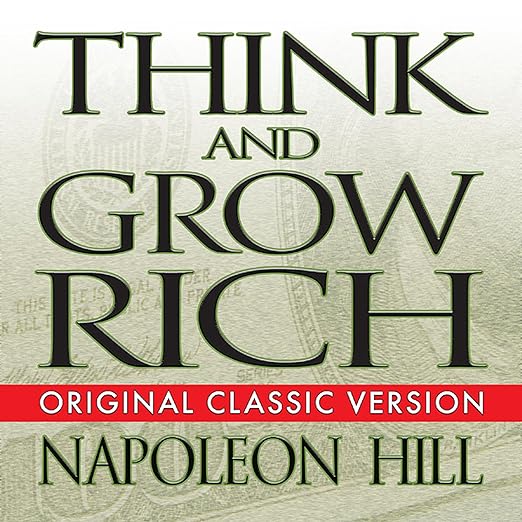
Napoleon Hill's Think and Grow Rich has the unusual distinction of being the book that most of the modern motivational genre is silently in conversation with, whether its authors know it or not. This audiobook presents the original 1937 edition, which the production notes emphasize specifically, and that editorial choice is meaningful. Hill's text has been updated, abridged, expanded, and repackaged countless times in the decades since its first publication, but the original retains a quality that later versions tend to smooth away: the specific texture of its moment, the names of the men Hill interviewed, the era's particular faith in individual will as the engine of civilization, and the raw ambition of a project that took twenty years and more than five hundred interviews to produce.
Thirteen Steps Built From Real Interviews
Hill's thirteen steps to riches are the book's structural spine, covering desire, faith, autosuggestion, specialized knowledge, imagination, organized planning, decision, persistence, the master mind, the mystery of sex transmutation, the subconscious mind, the brain, and the sixth sense. What makes the original text valuable rather than just historically interesting is the specificity of its evidence. Hill interviewed Ford, Edison, Rockefeller, Carnegie, Firestone, Wanamaker, and three US presidents. He quotes from those conversations, builds cases from those examples, and makes claims about the psychology of achievement that are grounded in actual observed behavior rather than in the abstract. Reviewer VoyageAmazon noted that despite the book's age, the lessons remain relevant today, which is a measured and fair assessment. Hill is not making falsifiable empirical claims so much as arguments about the relationship between mental attitude and material outcome, and those arguments have proven durable enough that every major strand of the personal development industry traces itself back to them in some form. Understanding the original, rather than its derivatives, gives a reader a much clearer picture of where those ideas actually came from and what they originally meant. The serial structure of the thirteen steps also means each chapter can be returned to independently once you have completed the full text, which makes the audiobook format particularly suited to revisiting specific principles in different life contexts.
Synnestvedt Avoids Pulpit Performance for Nine Hours
Erik Synnestvedt's narration is well suited to the material. Hill's prose has a rhetorical quality, a cadence of persuasion rather than argument, that can either soar or feel overwrought depending on how a narrator handles it. Synnestvedt finds the register between those poles, delivering the exhortatory passages with conviction without turning them into pulpit performance. This matters because the text asks considerable belief of its reader. The narration honors that requirement without demanding it. Reviewer Northwest Dad made the case that every high school student in America could benefit from the life lessons this book contains, which is the kind of response the book consistently generates from readers who come to it seriously. The nine-hour and thirty-five-minute runtime gives the full original text room to breathe, and Synnestvedt sustains the appropriate register across that span without flagging.
Sex Transmutation and an Era's Blind Spots
The 1937 text is period-specific in ways that require some translation for contemporary listeners. The examples are almost exclusively male and predominantly White American industrialists. The language around gender, race, and social mobility reflects the era of composition rather than our own. The concept of sex transmutation, Hill's argument that sexual energy can be redirected into creative and professional output, strikes many contemporary readers as either prescient or peculiar depending on their framework. None of this invalidates the psychological principles Hill is articulating, but listeners should approach the text with awareness of its historical context rather than as a timeless universal manual. Hill's framework also leans heavily on what he calls definiteness of purpose and the power of belief, which are concepts that work best when paired with honest assessment of structural constraints rather than taken as sufficient conditions for success on their own terms. Treating the book as a foundational document of a specific tradition, rather than as the final word on that tradition, is the approach most likely to yield something genuinely useful.
Trace the Motivational Genre to Its Source
This audiobook serves two distinct audiences well. First, readers who want to understand where the motivational and personal development genre actually comes from, who want to trace ideas like the mastermind group, the definiteness of purpose, or the power of belief back to their most influential source text rather than encounter them through derivatives. Second, listeners who are early in a serious professional or entrepreneurial undertaking and find that the genre speaks to something real in their experience. Those who approach self-help with skepticism about aspirational frameworks, or who are looking for evidence-based behavioral science rather than philosophy of achievement, will find the book's epistemological assumptions frustrating. For everyone else, the original 1937 edition remains the cleanest version of what Hill actually argued, and Synnestvedt's narration makes the experience considered rather than merely long. Listeners who find the book's framework compelling will benefit from reading secondary commentary alongside the original text, since the gap between what Hill actually argued and what the motivational industry has made of his ideas is substantial and worth understanding clearly. Listeners who find the book's framework compelling will benefit from reading secondary commentary alongside the original text, since the gap between what Hill actually argued and what the motivational industry has made of his ideas is substantial and worth understanding clearly. The original 1937 edition, as presented in this audiobook, gives you the best possible foundation for making that assessment yourself.
In Brief
- Performance: Erik Synnestvedt brings a warm, measured gravitas to Napoleon Hill's prose that suits the book's aspirational register without tipping into the performative.
- What it covers: Desire and definite purpose, the psychology of success, belief and persistence
- Feel: Earnest and exhortatory, with the particular confidence of a text that has survived nearly ninety years of scrutiny
- Our call: The original source text for much of the motivational genre that followed it, worth encountering in its 1937 form with all its period qualities intact.