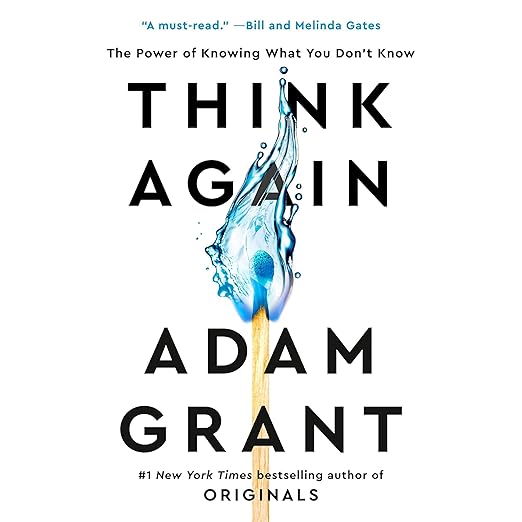
Adam Grant thinks most of us default to one of three modes when we argue, acting like "preachers defending our sacred beliefs, prosecutors proving the other side wrong, and politicians campaigning for approval," instead of scientists testing their own ideas. This audiobook, Think Again, spends its six and a half hours making the case for that fourth mode: rethinking, the deliberate practice of questioning your own opinions instead of just defending them, and it treats that skill as more urgently needed than raw intelligence in a fast-changing world, since a world that keeps generating new information rewards people who can update their views quickly over people who simply defend old ones well. Grant's own research background as an organizational psychologist gives the argument real institutional grounding, drawing on workplace and classroom settings rather than staying purely abstract or philosophical.
Grant's central argument is uncomfortable in a useful way: he suggests that being good at thinking can actually make people worse at rethinking, since intelligence gives you more tools to defend a belief you should probably be questioning instead. The book backs that claim with the same mix of research and storytelling that made his earlier work land with general readers, including how an international debate champion wins arguments, how a Black musician has persuaded members of a white supremacist group to abandon their beliefs, and how a vaccine skeptic gets talked back from that position without being condescended to.
The synopsis carries a striking endorsement from Brené Brown, who called it "the right book for right now" and wrote that Grant "weaves together research and storytelling to help us build the intellectual and emotional muscle we need to stay curious enough about the world to actually change it." That framing, curiosity as a muscle you build rather than a trait you either have or don't, runs through the whole book, and it is echoed in Grant's own description of his guiding principle: arguing like he's right while listening like he's wrong.
What Adam Grant Gets Right
Grant narrates his own material here, and self-narration by an author this comfortable in front of an audience, he is Wharton's top-rated professor according to the book's own framing, tends to add a layer of conviction that a professional narrator reading someone else's research secondhand cannot fully replicate. Listeners get the same voice that has been testing these ideas on students and executives directly, rather than a professional narrator interpreting someone else's research secondhand.
The reader reaction backs up the book's practical value. One reviewer flatly predicted "it will make the short list of books every manager should read," and another, describing themselves as "my own little lab petri dish of thoughts," said they were immediately drawn in by Grant's framing of how individuals and groups actually make decisions. That kind of specific, personal engagement is a genuinely good sign for a book whose core promise is practical, everyday application, not just interesting ideas to admire from a distance, and it lines up with a broader reviewer consensus that this belongs on a short list of books most working managers would benefit from actually finishing, not just buying.
What separates Think Again from a purely inspirational pitch about open-mindedness is how much of the book is built around specific, transferable techniques rather than a general exhortation to keep an open mind. Grant is explicit that intelligence alone does not protect anyone from bad thinking, and can even make someone more skilled at defending a flawed position, which reframes rethinking as a discipline to practice rather than a virtue some people simply have and others lack. Two of Grant's sharper lines capture that worry well: that "our beliefs get brittle long before our bones," and that "the brighter we are, the blinder to our own limitations we can become." Both push back against the comfortable assumption that intelligence and experience alone protect people from bad thinking, precisely the assumption Think Again spends its runtime dismantling piece by piece rather than simply asserting it once and moving on.
The preacher-prosecutor-politician framework also gives the book a genuinely useful diagnostic tool listeners can apply immediately, rather than waiting until the final chapter for a payoff. Noticing which of the three modes you have slipped into during an actual disagreement, defending a sacred belief, trying to win rather than understand, or angling for approval, is the kind of concrete, repeatable exercise that separates a book like this from purely inspirational writing about keeping an open mind. The book's own framing of Grant's expertise, someone skilled at "opening other people's minds, and our own," doubles as a fair description of what listening to Think Again actually asks of you, not just learning new facts, but practicing the harder work of reconsidering your own settled opinions in real time, out loud, chapter after chapter, alongside Grant's own examples, which is a taller order for an audiobook to pull off convincingly than a simple recitation of research findings would ever be, and it is exactly the order Grant's own narration is best positioned to deliver.
Where Adam Grant Loses Some Ground
At least one reader felt that despite Grant's own stated efforts at neutrality, the book still "felt a bit liberal at times," a useful data point for listeners sensitive to any perceived political framing in business and psychology nonfiction. Grant states directly in the book that he does not favor a political party, but perception of tone is subjective, and it is fair to flag that not every reader experienced the book as fully neutral.
This is squarely a research-and-argument book rather than a memoir or narrative nonfiction title, and listeners wanting more personal storytelling and less structured case-study-by-case-study argument should know the emphasis here sits closer to Grant's academic training than to a looser, anecdote-driven style.
Who Should Pick Up Think Again
Managers and team leads hunting for a practical vocabulary around changing their minds without losing credibility in front of a room will get the most direct career application here, and Grant's own examples, from debate champions to public health communicators, are chosen specifically for that transferability. Anyone who has ever dug into a position out of pure stubbornness will likely recognize themselves somewhere in these six and a half hours.
Readers who have already worked through Originals or Give and Take will recognize Grant's formula, research paired with accessible storytelling, applied here to a new subject rather than reinvented from scratch, so go in expecting a familiar structure rather than a stylistic departure from his earlier bestsellers.
Key Details
- Performance: Adam Grant narrates his own material with the same measured, research-forward delivery his prior audiobooks are known for, letting the evidence carry the argument instead of overselling it.
- What it covers: Intellectual humility, changing your mind, productive disagreement
- Feel: Confident, research-driven, practically minded
- Our call: One of the more useful business-psychology audiobooks for anyone whose job depends on persuading people, minor political grumbling from at least one reader aside.