Quick Take
- Narration: Desmond Reed’s delivery is clear and measured, which suits the therapeutic context well, the pace allows listeners to absorb movement cues without feeling rushed, though the lack of visual demonstration is an inherent audio limitation.
- Themes: Injury recovery and rehabilitation, therapeutic movement for chronic pain, safe exercise for limited mobility
- Mood: Steady and encouraging, like a knowledgeable physical therapist talking you through a session
- Verdict: A practically structured, evidence-informed guide to therapeutic exercise that delivers real value for listeners recovering from injury or managing chronic pain, with the honest caveat that movement instruction always benefits from a visual complement.
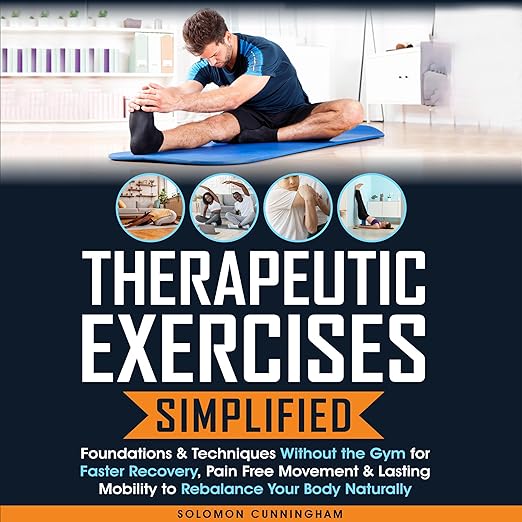
I put Therapeutic Exercises Simplified on during a slow Saturday afternoon, having spent the previous two weeks nursing a shoulder that did not appreciate the way I had been sleeping. I was not in acute recovery, but I was in that particular phase where you know you should be doing something deliberate and structured and keep putting it off because the options feel either too intense or too vague. This audiobook is specifically for that phase.
Solomon Cunningham’s approach is evident from the first chapter: this is not a program for athletes optimizing performance. It is a guide for people managing the real-world complications of existing in a body that has been through something, whether injury, surgery, arthritis, chronic back pain, or the accumulated stiffness of a sedentary period. The audience is explicitly broad, from post-surgical recovery to active aging to athletes wanting to reduce injury risk, and the content is structured to serve all three rather than narrowing to one.
Evidence Base and the Home Practice Philosophy
The emphasis throughout is on exercises that can be performed at home without specialized equipment. This is not a constraint of budget: it is a deliberate philosophy. Cunningham’s argument is that therapeutic exercise compliance is fundamentally a convenience problem. Programs that require gym access, specific machines, or professional supervision have higher dropout rates because the barriers to entry are higher. The home-based approach removes the friction, which is ultimately more important than the marginal benefit of specialized equipment for most therapeutic goals.
Reviewer feedback reinforces this from multiple angles. A Pilates instructor describes the book as well-organized, easy to follow, and filled with evidence-based exercises safe for people recovering from conditions ranging from back pain to orthopedic surgery. Another notes that instructions are easy to follow and the results feel real. A third reviewer, identifying as a movement professional, describes it specifically for the clarity of exercise cues: how it should feel, what to avoid, and variations for different mobility levels.
Those cues matter more than the exercise names. Therapeutic exercise audio fails when it describes movement positions without giving the listener a way to verify whether they are doing it correctly. Cunningham’s inclusion of sensory feedback language, what the engaged muscle should feel like, what sensation indicates the form is off, is the design choice that makes the audio format viable here.
Pain Management and the Recovery Mindset
The pain management section addresses the relationship between therapeutic movement and pain response in a way that distinguishes this from generic exercise content. The distinction between pain that indicates appropriate therapeutic challenge and pain that signals harm is covered clearly, which is the critical piece of information for someone exercising in recovery who is not under direct clinical supervision.
Cunningham also addresses the motivation and consistency dimension with practical specificity rather than vague encouragement. The section on integrating therapeutic exercise into daily routines, rather than treating it as a separate scheduled activity, reflects a realistic understanding of how people actually maintain health behaviors outside clinical settings.
The Persistent Audio Limitation
Desmond Reed narrates with the clear, unhurried delivery the material needs. The problem is not Reed’s performance but the format itself: therapeutic exercise is fundamentally a kinesthetic and visual domain. Even excellent verbal descriptions of movement patterns produce varying results across different listeners, because people interpret positional language differently. Listeners who have been through physiotherapy and have a body vocabulary, meaning an experiential understanding of what certain muscle groups feel like when engaged correctly, will extract more value than those without that background.
This is an argument for treating the audiobook as a complement to at least a few in-person sessions with a physiotherapist or movement professional rather than as a fully self-contained program, particularly for listeners in active post-surgical or injury recovery. As maintenance, motivation, and consolidation for someone who has already learned the movement patterns, it works extremely well.
Who Should Listen and Who Should Skip
This audiobook is well-matched for listeners recovering from soft tissue injuries, managing chronic back pain or arthritis, older adults looking to maintain mobility, and athletes in a recovery phase who want structured but gentle movement guidance. The Pilates instructor review is a useful credibility signal for the professional-quality evidence basis.
Those in acute post-surgical recovery or with complex orthopedic conditions should be supervised by a qualified physiotherapist before using any home exercise guide, including this one. And listeners without any background in movement or body awareness will benefit most from combining this audio resource with visual instruction for at least the foundational exercises.
Frequently Asked Questions
Is this appropriate for someone immediately post-surgery, or does it assume a certain baseline of mobility?
The guide includes modifications for limited mobility and is designed to be accessible across a range of recovery stages. However, immediately post-surgical patients should have clearance from their surgeon or physical therapist before beginning any unsupervised exercise program. The book is most suitable for the rebuilding phase rather than the acute immediate post-operative period.
Does the guide cover specific conditions like lower back pain, knee injury, or shoulder rehabilitation separately?
The guide is organized around foundational movement principles and exercise categories rather than condition-specific protocols. Listeners managing a specific diagnosis will find relevant content but will need to apply the general principles to their particular situation rather than following a condition-specific program.
How does Desmond Reed’s narration handle the movement description passages?
Reed’s pacing is measured and clear, which is the right approach for movement instruction. He allows the descriptions time to register rather than moving rapidly from cue to cue. The core limitation is the audio format itself rather than the narration performance: movement feels and positions benefit from visual demonstration that audio cannot provide.
Is this suitable for athletes as well as people recovering from injury?
Yes. The synopsis explicitly addresses athletes seeking better performance while reducing injury risk as one of three core audiences. The therapeutic movement principles, particularly around controlled loading, mobility, and pain-free range of motion, are applicable to performance contexts as well as rehabilitation ones.