Quick Take
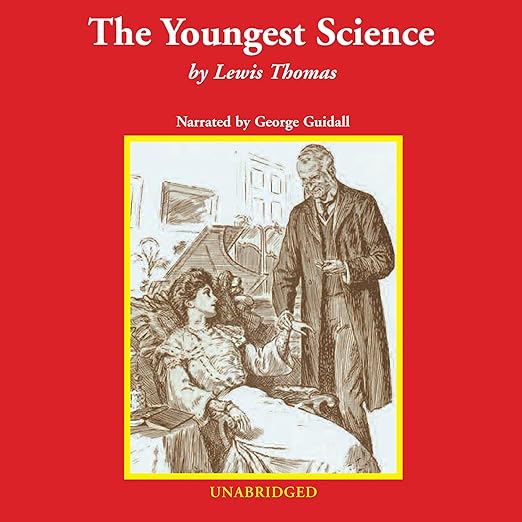
- Narration: George Guidall brings characteristic warmth and gravitas to Thomas’s reflective prose, letting the wit land without overselling it, an ideal match for a memoir this literary.
- Themes: Medicine as vocation, the evolution of scientific knowledge, the doctor-patient relationship
- Mood: Reflective and gently humorous, with the unhurried quality of a long conversation over dinner
- Verdict: If you want to understand how a life in medicine actually feels from the inside, this is the audiobook to reach for.
I came to Lewis Thomas backwards. I had read his essays in The Lives of a Cell years before I found The Youngest Science, and I remember the particular pleasure of discovering there was more of him. I finished this one on a rainy Thursday evening, stretched out with tea going cold on the side table, entirely unwilling to move. That is the kind of book this is. It does not demand your attention so much as earn it, quietly, over the course of eight hours.
Thomas was, depending on what year you caught him, a physician, a researcher, a hospital administrator, a patient, and a writer. He was also the son of a country doctor, which gives the opening chapters of this memoir their particular texture. He is not simply describing a career. He is tracing what it meant to practice medicine across a century of radical transformation, from an era when doctors could do almost nothing to the moment when they suddenly could do nearly everything.
A Childhood That Shaped a Vocation
Thomas opens with his father, a general practitioner who made house calls in a pre-antibiotic world. What the father could offer was presence, reassurance, and the occasional dose of something that probably did nothing. Thomas writes about this with great tenderness and without sentimentality. He understood early that medicine was as much performance as science, and this observation, rather than cynicism, fuels the book’s deeper argument: that medicine became a real science only within living memory. He calls it the youngest science because most of the actual therapeutic power arrived so recently. That framing gives everything that follows a kind of historical weight the author earns rather than imposes.
The Texture of Medical Training, Honestly Told
The middle sections, covering Thomas’s own medical education and early career, carry the best anecdotes. He was trained during the Second World War, worked in laboratory research, served in administration, and somehow also found time to become one of the more incisive essayists of his generation. What is remarkable is that he describes professional prestige without ever seeming to claim it for himself. Reviewers have noted that this reads as the quintessential account of what it means to be a physician, and that is not hyperbole. Thomas writes about hierarchy, about colleagues, about the particular loneliness of being the person in the room who is supposed to know what to do, with an honesty that feels almost confessional without ever being self-pitying.
The Wider View: Computers, Cancer, and the Planet
The book’s later chapters expand outward in the way Thomas’s essays always do. He turns to human versus computer intelligence, the future of cancer research, gender differences, the longevity of Earth as a biological system. These sections are denser, more speculative, and occasionally dated in ways that are historically interesting rather than distracting. He was writing in the early 1980s, and his tentative curiosity about computing has an endearing freshness to it now. His views on cancer research, on the limits of what medicine can honestly promise, remain sharper than almost anything written since.
What Guidall Does With the Prose
George Guidall is one of those narrators whose voice has become so associated with serious American nonfiction that you almost stop noticing how much work he is doing. Here, he does something specific and right. Thomas’s prose has a wry, self-deprecating quality that could easily tip into smugness in the wrong hands. Guidall keeps it grounded. He reads the funnier passages with restraint, which is exactly what they require. He gives the more scientific sections their weight without turning them into a lecture. The pacing is measured throughout, which suits a memoir written in the register of quiet reflection. At eight hours and twenty-five minutes, this is a comfortable sitting, though I found myself pausing often to think about what had just been said.
Who Should Listen, Who Should Skip
Listen if you work in medicine or healthcare and want something that makes the larger shape of your profession visible. Listen if you love literary memoir that happens to be about science, rather than science writing that happens to have a narrator. Listen if you appreciated The Lives of a Cell and want more Thomas.
Skip if you are looking for a medical history with the drive and architecture of narrative nonfiction. The book meanders in the way that personal essays do. There is no single protagonist’s journey here, no dramatic resolution. That is not a flaw, but it is a real feature of the form, and it will not suit everyone. The fact that this book is out of print, as one reviewer notes, is genuinely baffling. Fortunately, the audiobook preserves it well.
Frequently Asked Questions
Do I need a medical background to follow The Youngest Science?
No. Thomas writes for a curious general reader throughout. The science is explained in plain language and the memoir sections require no background knowledge beyond a general interest in medicine as a human institution.
How does this compare to Thomas’s essay collections like The Lives of a Cell?
The Youngest Science is more personal and chronological than his essay collections. If you loved the philosophical breadth of The Lives of a Cell, you will find that here too, but woven into memoir rather than pure essay form. Many readers find this the more emotionally resonant entry point.
Is the audio version complete, or is this an abridgement?
The audiobook runs 8 hours and 25 minutes, which corresponds to the full text. This is not an abridgement.
Does the book feel dated, given that it was published in the early 1980s?
Some sections, particularly those touching on computing and certain areas of cancer research, reflect the thinking of their era. But the memoir sections and Thomas’s central argument about medicine’s transformation are timeless, and the dated passages are interesting as intellectual history rather than misleading.