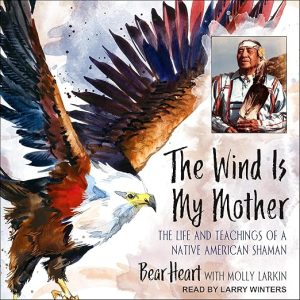
I came to The Wind Is My Mother the way several reviewers seem to have found it: at a moment when I needed it. I'd been in a run of several weeks where everything felt fast and crowded, too many obligations, too many screens, too many urgent things demanding the kind of attention that leaves you depleted at the end of the day with nothing having felt genuinely nourishing. A colleague mentioned Bear Heart's name in passing, and I looked up the audiobook on the same afternoon. I listened to the first chapter walking around the block after dinner and didn't come back inside for two hours.
Bear Heart (Nokus Fixico, 1918-2008) was a Muskogee Creek medicine man and healer who spent decades traveling to share traditional Native American wisdom with those who sought it. The Wind Is My Mother, written with Molly Larkin, gathers his teachings on spiritual and physical health, on the relationship between human beings and the natural world, on how to face difficulty, loss, and uncertainty in ways that don't deplete the soul. The book is structured loosely around his life and teachings, moving between memoir and instruction in a way that reflects the oral tradition from which it emerges.
Where This One Lands
There's a specific quality to writing that originated as spoken teaching, and The Wind Is My Mother has it. Bear Heart's prose has the unhurried clarity of someone who has told these stories many times, to many different people, and has distilled them down to what is actually essential. Nothing is over-explained. The meaning of a story about a bear encountered during a vision quest, the story in which Bear Heart speaks to the bear as if to kin, and the bear departs, is not spelled out in analytical terms. The story is the teaching. That approach requires trust from both the teller and the listener, and it rewards that trust.
The audiobook format suits this text especially well because Bear Heart's voice, as mediated through Larkin's transcription, was always meant to be heard. One reviewer compared the experience to listening to Pema Chodron, another teacher whose insights are transmitted through a quality of presence rather than argument, and the comparison is apt. Both writers communicate something through the texture of their prose that summarizing or paraphrasing would lose.
The central themes of the book are the interconnectedness of all living things, the importance of learning from the natural world, the cultivation of resilience through relationship rather than through hardening, and the spiritual dimensions of everyday experience. These are not esoteric teachings available only to initiates; Bear Heart presents them as practical wisdom about how to live. The grass blade that recovers from an arrow's blow, the bear that can be addressed as kin, the wind that is not an absence but a presence, these are not metaphors in Bear Heart's telling. They are descriptions of a world organized differently from the one most Western readers inhabit.
The book doesn't demand conversion or ask readers to adopt a belief system wholesale. Bear Heart's approach is genuinely ecumenical, he worked with people of many traditions and understood that the underlying questions (how do we heal, how do we face loss, how do we maintain dignity under difficulty) are not exclusive to any one answer. That openness is one of the book's most attractive qualities.
Weak Spots in The Wind Is My Mother
Larry Winters's narration honors the unhurried quality of Bear Heart's teachings without making them feel slow or precious. He reads with appropriate reverence, this is a text that has been found transformative by many listeners, and performing it as though it were light entertainment would be a serious misread. But he avoids the trap of over-solemnity that can make spiritual audiobooks feel inaccessible. The pacing gives listeners room to sit with what they've just heard, which is essential for this kind of material.
At eight hours and forty-nine minutes, the runtime allows for genuine accumulation of Bear Heart's wisdom without feeling repetitive. The teaching stories vary enough in context and texture that the book's argument, about the availability of healing and dignity through reconnection with the natural world and ancestral wisdom, builds convincingly over time rather than making its point once and repeating it.
Bear Heart's descriptions of specific ceremonies and practices are offered with discretion, he shares what is appropriate for a general audience without diminishing the depth of what he's transmitting. There's a sense throughout the book that he has spent a lifetime calibrating this balance: how much to share with people outside his tradition, how to invite genuine understanding without performing his culture for curious outsiders. That calibration is itself a form of wisdom, and one that Larry Winters's narration conveys through its own kind of measured restraint. Neither the author nor the narrator overshares or undershares. Both trust the listener to receive what is offered.
Recommended For
Listeners who are drawn to Pema Chodron, Thich Nhat Hanh, or other teachers who communicate through presence and story rather than argument will find Bear Heart's approach deeply compatible. Anyone interested in Native American spiritual traditions who wants to encounter them through a primary voice rather than academic mediation will find this essential. The audiobook format is particularly appropriate, this is wisdom literature that was always meant to be heard.
Listeners who approach spiritual texts analytically and want their claims tested rigorously against argument and evidence will find the teaching-story format insufficient. This is not a book of proofs; it is a book of transmission. Readers who need the former should look elsewhere, but those who can receive the latter will find The Wind Is My Mother among the most genuinely sustaining audiobooks they encounter.
Key Details
- Voice: Larry Winters reads Bear Heart's words with unhurried reverence, matching the text's oral-tradition origins without making it feel staged.
- Big ideas: Native American spiritual wisdom, the relationship between humans and the natural world, healing through ancestral knowledge
- Atmosphere: Quiet and grounding, like sitting by a fire with someone who has learned how to be patient
- Worth it?: Bear Heart's teachings have a genuine stillness that the audiobook format preserves well, this is one of those titles where listening feels more appropriate than reading.
How does the audiobook compare to reading the physical book, is one format preferable?
The audiobook is arguably the preferable format. Bear Heart's teachings originated as oral transmission, and hearing them read aloud by Larry Winters preserves a quality of presence that the page alone may not convey as fully.
Is this a memoir, a spiritual guide, or something else, and does the blend of both forms work on audio?
It's both simultaneously, memoir and teaching are woven together throughout, which reflects how Bear Heart actually transmitted his knowledge. The blend works well on audio because each story carries its own weight and the transitions between personal narrative and general teaching feel natural rather than disruptive.