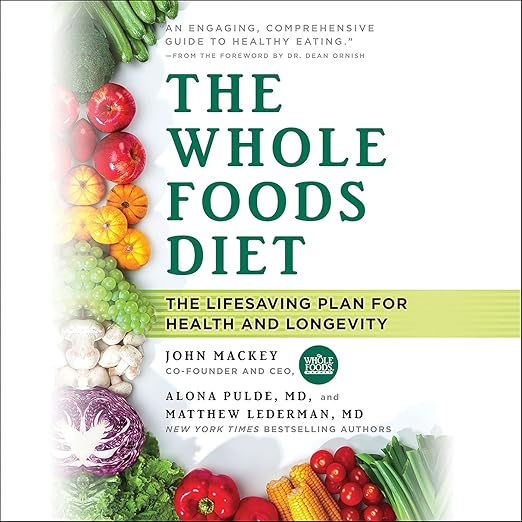
Quick Take
- Narration: Dan Woren delivers a clean, authoritative read that suits the book’s evidence-led tone, he handles the dietary science sections with clarity and the personal success stories with appropriate warmth.
- Themes: Whole food plant-based eating, nutritional science consensus, sustainable lifestyle change
- Mood: Confident and advocacy-driven, with an undertone of genuine enthusiasm
- Verdict: A well-constructed case for plant-based eating backed by Whole Foods Market’s credibility and Forks Over Knives medical expertise, most persuasive for listeners already curious about the approach.
I was making lunch when I started this one, habit, really, since I tend to queue up health-adjacent listening when I am actually handling food. Within the first twenty minutes, John Mackey had explained why the founder of a grocery chain co-writing a nutrition book is not the conflict of interest it initially sounds like, and the argument held. The Whole Foods Diet is the product of a genuine personal conviction, not a marketing exercise, and that comes through clearly in the audio version.
The co-authorship with the Forks Over Knives doctors gives it a medical credibility that Mackey’s business background alone could not provide. The positioning is deliberate: this is not a diet trend, it is what the research has been pointing toward for decades. Whether you accept that framing depends partly on your prior relationship with nutrition science debates, and Dan Woren’s narration serves the argument faithfully without editorially softening its stronger claims.
The Consensus Argument, Laid Out Plainly
The book’s central rhetorical move is to present the whole foods, plant-based approach not as one of many competing dietary philosophies but as where the scientific consensus actually lands. Mackey and his co-authors acknowledge that nutrition science has been confusing and contradictory in popular media, and then argue that if you read the peer-reviewed research rather than the headlines, the picture is considerably less murky. This is a contestable claim, legitimate researchers do disagree about optimal macronutrient ratios, but the book presents its evidence coherently rather than dishonestly.
The 28-day program is practical and structured without being punishing. The guidelines are simple: eat whole foods from plant sources, minimize processed ingredients and animal products. Woren reads the recipe sections with the same measured tone as the science sections, which helps the book feel cohesive rather than like a recipe compendium stapled to a scientific argument. That said, recipes in audio are always a partial experience, the book clearly benefits from having the print or digital version open for the actual cooking.
Success Stories That Do Not Oversell
The inspirational case studies woven through the audiobook are better than the genre average. Reviewers noted them specifically, and listening, it is clear why: these are not miraculous transformation stories stripped of context. They are accounts of people managing specific conditions, heart disease reversal, diabetes, obesity, with enough clinical detail to feel credible. The restraint is important. The book does not promise these outcomes universally; it presents them as what is possible when the approach is applied seriously and consistently.
One reviewer with a long investment in Whole Foods Market stock described the book as vindicating his admiration for Mackey’s approach. But the book also reads as genuinely useful to someone coming in cold, particularly the sections addressing why whole plant foods have a different metabolic effect than processed versions of ostensibly healthy ingredients.
Where the Advocacy Gets Ahead of the Evidence
This is not a neutral survey of dietary research. It is a persuasive argument for one approach, and it is worth knowing that before you start. The chapters on animal products are particularly advocacy-forward, citing the strongest anti-animal-food research without substantially engaging with the counter-literature. That is a choice the authors are entitled to make, but listeners who want a balanced view of, say, the omega-3 debate or the role of fermented dairy will need to seek that elsewhere.
The runtime of nine and a half hours feels well-proportioned for the scope. The science, the program, and the recipes all get adequate space, and the audiobook does not drag. Woren keeps the pacing brisk enough that even the denser nutritional biochemistry sections stay listenable without becoming superficial.
For the Curious and the Committed
If you are already plant-curious and want a single, well-argued audiobook to firm up your reasoning, this is an excellent choice. The Forks Over Knives medical research layer gives it more scientific weight than most celebrity-adjacent wellness titles. If you are a committed omnivore looking for a balanced dietary overview, you will find this unconvincing in parts, not because it is wrong, but because it is not trying to be balanced.
Frequently Asked Questions
Does the audiobook include the 28-day program and recipes in a usable format, or is the print companion essential?
Woren reads the recipes and program guidelines in full, but practically speaking, recipes are difficult to follow in audio alone. The print or digital version is strongly recommended if you intend to cook from the book rather than just absorb the dietary philosophy.
How does this compare to the Forks Over Knives documentary for someone already familiar with that material?
This book covers overlapping ground but adds Mackey’s business and personal perspective alongside updated research. For someone who has already engaged with Forks Over Knives, the new material is primarily in the practical program design and Mackey’s framing of plant-based eating as accessible rather than restrictive.
Is John Mackey’s role as Whole Foods Market founder a conflict of interest that undermines the dietary advice?
The book addresses this directly. Mackey’s advocacy for whole foods predates and operates independently of his retail business, and the co-authors bring independent medical credentials. The advice to eat more whole plants does not obviously benefit Whole Foods Market over any other food retailer.
Does the audiobook address common concerns like protein, calcium, and B12 on a plant-based diet?
Yes. The book dedicates specific sections to common nutritional concerns about plant-based eating, including protein adequacy, calcium sources, and the need for B12 supplementation. The answers are pro-plant but not dismissive of the practical challenges.