Quick Take
- Narration: Kate Winslet and Helena Bonham Carter narrate this sequel, and the casting is genuinely inspired, Bonham Carter’s affinity for gothic eccentricity and Winslet’s warmth between them cover the book’s tonal range from darkly comic to genuinely affecting.
- Themes: Found family versus biological family, hidden fortunes, children navigating adult chaos
- Mood: Darkly comic and warmly chaotic
- Verdict: The celebrity casting here isn’t decoration, Winslet and Bonham Carter bring distinct registers to a book that needs both gothic menace and genuine tenderness, and the combination delivers.
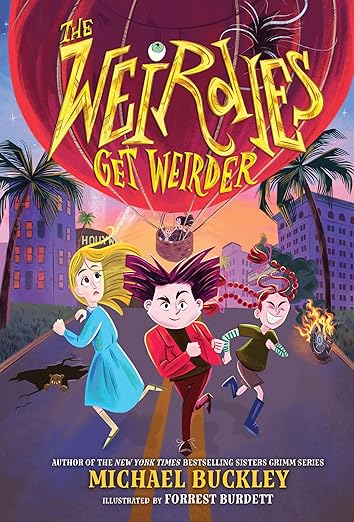
I picked up The Weirdies Get Weirder on the strength of one thing: Helena Bonham Carter narrating a book about bank-robbing parents coming back from the dead. That is not a premise that requires much additional convincing, and the book does not disappoint the expectation that premise creates. Michael Buckley writes comedic darkness for children in the tradition of Roald Dahl and Lemony Snicket, and this sequel to The Weirdies has the sustained commitment to its own chaotic logic that distinguishes that lineage.
The Weirdie triplets, Barnacle, Melancholy, and Garlic, are back and still burdened. Their horrible parents have returned from the dead and are forcing the children to search Deadeye Manor, a house built around an actual bank, for their grandfather’s stolen fortune. Meanwhile their beloved adoptive mother Miss Emily, from whom they were ripped away at the end of the first book, is sneaking into the manor to get her children back. The plot operates at the cheerfully implausible level that good children’s gothic comedy requires, and Buckley doesn’t slow down to explain itself when it can move instead.
The Casting That Earns Its Billing
Kate Winslet and Helena Bonham Carter are not names that appear in audiobook credits by accident, and whoever made this casting decision understood the book’s tonal requirements precisely. Bonham Carter’s natural register is somewhere between theatrical and unhinged, which is exactly right for Deadeye Manor and its population of hooligans, criminals, and resurrected bank-robbing parents. Her delivery of the villainous material has the quality of someone who is entirely at home in this territory, which she demonstrably is.
Winslet brings something different: warmth and a kind of earnest goodness that makes Miss Emily’s determination to reclaim her adopted children feel genuinely moving rather than plot-functional. The emotional stakes of the book depend on the listener believing that the triplets and Miss Emily belong together, and Winslet’s narration of that relationship earns the belief. The two narrators together cover the book’s tonal range cleanly. Bonham Carter handles the dark comedy while Winslet carries the emotional core.
The Architecture of Deadeye Manor
A house built around an entire bank is the kind of world-building detail that children’s fiction can deploy without apology, and Buckley uses it with full conviction. The manor’s geography matters to the plot in ways that gradually reveal themselves, and the grandfather’s hidden fortune is distributed through the architecture in a manner that makes the children’s search feel like genuine problem-solving rather than a treasure hunt on rails. For listeners who enjoyed the first book, the return to this setting will feel like coming home to somewhere specifically strange.
The book is positioned as perfect for fans of The Swifts and A Series of Unfortunate Events, and both comparisons are accurate. It shares Snicket’s commitment to children as the only competent agents in a world run by unreliable adults, and its humor has the same dark edge. It’s slightly gentler than Snicket at his bleakest, which makes it appropriate for readers who found the Baudelaires too relentlessly grim. The Weirdies maintain a stubborn affection for each other and for Miss Emily that keeps the comedy from curdling into despair.
Who Will Love This and Who Might Not
Children who loved the first Weirdies book will want this immediately, and the sequel rewards that loyalty by raising the stakes and deepening the characters without losing the anarchic energy that made the original work. Children who respond to Roald Dahl’s particular flavor of gleefully horrible adults and resourceful children will find this series a natural companion. The rating of 4.7 from a substantial number of reviewers suggests the quality is consistent with audience expectation.
The gothic comedy register won’t appeal to every child. Listeners who prefer straightforward adventure or find the names Barnacle, Melancholy, and Garlic more alarming than funny will probably not connect with the tone. But for children who have always suspected that the adult world is slightly more chaotic and unreliable than it presents itself, and who find that suspicion entertaining rather than distressing, The Weirdies Get Weirder is exactly right.
Frequently Asked Questions
Do I need to have listened to the first Weirdies book before starting this sequel?
The sequel assumes familiarity with the first book’s setup, who the triplets are, who Miss Emily is, and what happened at the end of the first volume. While Buckley provides enough context for a new listener to follow the broad strokes, the emotional investment in the Miss Emily reunion depends significantly on knowing the first book’s events. Starting with the original Weirdies is recommended for the full experience.
How are Kate Winslet and Helena Bonham Carter divided in the narration, do they each take sections or alternate throughout?
Both are credited as narrators, suggesting they handle different sections or characters rather than alternating line-by-line. Bonham Carter’s casting strongly suggests she handles the darker or more eccentric material while Winslet voices the warmer human elements, but the exact division is part of the listening experience worth discovering on first listen.
Is this appropriate for the age range that loved A Series of Unfortunate Events, or does the Weirdies skew younger?
The Weirdies series occupies a similar tonal space to the early Lemony Snicket books and is suitable for a slightly younger audience than the later, darker Snicket volumes. Children who found the Baudelaire orphans compelling at ages eight to ten will likely connect with the Weirdie triplets at that same range. The darkness is gothic comedy rather than genuine menace, and the emotional resolution is warmer than Snicket typically provides.
Does the book resolve whether the triplets get back to Miss Emily, or does it end on another cliffhanger?
As a sequel in an ongoing series, The Weirdies Get Weirder is positioned as a continuing chapter rather than a final resolution. What the book does offer within its runtime is a series of escalating confrontations and a clear movement toward the question of whether found family can win against biological claim. Whether that question is answered here is something best discovered by listening rather than spoiled in a review.