Quick Take
- Narration: Dana Lubotsky handles the dual-perspective structure with clarity, giving Sophie and Cody distinctly different registers without exaggerating the contrast, the journals feel genuinely authored by two different kids.
- Themes: Grief held beneath the surface, proving yourself to the people who doubt you, the ocean as both freedom and reckoning
- Mood: Quietly luminous, with the gentle roll of open water beneath everything
- Verdict: One of Sharon Creech’s most structurally inventive novels reads beautifully on audio, the alternating journals gain something in the spoken form that a single printed read cannot quite replicate.
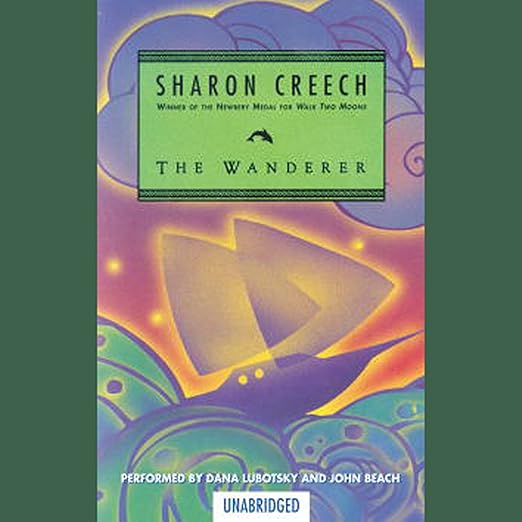
I finished The Wanderer on a Sunday afternoon with the windows open, and for about ten minutes afterward I could not quite remember that I was in my apartment in the city and not on a boat somewhere in the Atlantic. Sharon Creech has that quality in her best work, she makes you inhabit a world so completely that coming back feels slightly disorienting. Walk Two Moons does it. Love That Dog does it. And this book, quieter and somehow more interior than either of those, does it too.
I came to this audiobook specifically because I wanted to test how the dual-journal structure translated in audio format. The novel alternates between Sophie’s lyrical, slightly dreaming voice and Cody’s more earthbound, self-deprecating humor. On the page, you navigate between them visually. In Dana Lubotsky’s narration, the distinction is carried entirely through vocal quality and tempo, and it works considerably better than I expected.
Two Journals, One Ocean, One Buried Story
The structure is worth understanding before you begin listening. Sophie and Cody are thirteen-year-old cousins on a transatlantic sailing voyage with Sophie’s three uncles and Cody’s father. Each chapter is a journal entry, alternately voiced by Sophie and Cody, and the two accounts do not simply duplicate events, they observe each other, notice different things, and gradually reveal a larger picture that neither narrator can see alone.
This is a technique Creech has used elsewhere, but here it is deployed with particular emotional intelligence. Sophie’s entries are full of her love for the sea, her idealized stories about Bompie (her grandfather in England), and a peculiar resistance to discussing certain parts of her past. Cody’s entries are funnier and more grounded, but they carry their own ache: his father’s low expectations of him, the casual cruelty of being called a knucklehead in front of others, the quiet desire to prove something on the open water.
Dana Lubotsky navigates these registers with real skill. Sophie’s voice has a slightly incantatory quality, the sea, the sea, the sea, that captures the girl’s almost mystical relationship with water. Cody’s sections come down to earth with a soft thump. Neither performance feels caricatured.
What the Sea Knows That Sophie Will Not Say
Without giving away the emotional center of the book, I want to note that Creech builds toward a revelation about Sophie’s past that reframes everything she has told us. The stories Sophie tells about Bompie, vivid, funny, specific childhood tales of near-catastrophes survived, turn out to carry a weight that the listener gradually suspects before Sophie is willing to confront it.
This is the book’s real subject: how children carry grief, and what stories we tell ourselves to keep moving. The ocean in Creech’s hands is not just setting, it is the right landscape for this theme. Water does not lie still. It insists on motion even when you want to stay where you are. Sophie cannot outrun her past on the Wanderer, and the sea provides no hiding places.
Reviewers who read this with children aged eight to thirteen consistently note how accessible the emotional depth is to younger readers. One grandmother who purchased it for a ten-year-old noted she read it first herself and found it a keeper. That dual-adult-and-child readability is the hallmark of Newbery-quality fiction, and The Wanderer won a Newbery Honor for exactly this quality.
When Humor and Sorrow Share the Same Boat
Cody’s storyline might initially seem lighter than Sophie’s, but Creech takes it seriously. His father’s dismissiveness is rendered without melodrama, it is the quiet, accumulated kind of parental disappointment that is harder to argue against than outright cruelty. Cody’s voyage is about discovering his own capability, and the moments when he does something well on the boat, when he handles a sail correctly, when he navigates in difficult weather, land with genuine earned weight.
Lubotsky’s pacing in these sections is careful. She does not rush Cody’s small victories. This is where the audio format adds real value: in print, a reader’s natural pace might skim these quieter moments. In narration, they settle into the listener at the speed the book deserves.
Who Will Love This Audiobook
The Wanderer is appropriate and genuinely rewarding for listeners from about age eight through adult. Children in the eight-to-twelve range who have experienced family complexity, grief, divorce, the particular loneliness of not quite fitting, will find something true in both protagonists. Sharon Creech fans who have not yet encountered this novel are in for a particular pleasure. And adults who are looking for something to share with a young person as a starting point for conversation about loss and resilience will find it unusually well-constructed for that purpose.
Those who prefer faster-paced adventure fiction may find the meditative quality of Sophie’s journal entries too slow at the opening. Stick with it. The payoff is real.
Frequently Asked Questions
Do I need to know anything about sailing to follow The Wanderer?
No sailing knowledge is required. Creech includes enough nautical context to orient listeners without making the book feel instructional. The sailing is texture rather than technical subject matter.
Is the dual-journal format confusing to follow on audio when you cannot flip back to check who is speaking?
Dana Lubotsky’s vocal differentiation between Sophie and Cody is clear enough that listeners quickly learn to identify whose journal entry they are in. There is also a brief contextual identifier at the start of each section that orients the listener.
Is The Wanderer connected to any of Sharon Creech’s other books, or does it stand completely alone?
It stands entirely alone. No prior knowledge of Creech’s other work is needed, though fans of Walk Two Moons will recognize her gift for narrators who reveal their full emotional reality gradually and from an angle.
At 4 hours and 18 minutes, is this suitable for multiple shorter listening sessions, or is it better listened to in longer stretches?
It works well in shorter sessions because the journal-entry structure provides natural stopping points. Each entry is self-contained while accumulating toward the larger emotional revelation, so listeners can pause and return without losing the thread.