Quick Take
- Narration: Virtual Voice narration delivers the tactical content without warmth or personality, which strips the motivational framing of its intended urgency.
- Themes: Emergency preparedness, grid-down survival, home defense and food security
- Mood: Instructional and dense, like a field manual read aloud
- Verdict: A comprehensive prepper reference that covers the key bases, but the Virtual Voice narration and heavily promotional framing make the print version the better format for this material.
I want to be transparent about something before I get into the content: this audiobook uses Virtual Voice narration, which is Amazon’s AI text-to-speech technology. For most reference-style survival content, this is a tolerable tradeoff. For a 35-chapter tactical manual that structures its appeal around urgency and emotional resonance, “the clock is ticking,” “disasters strike without warning”, the absence of a human voice creates a persistent gap between what the text is trying to do and what the listening experience actually delivers. I flagged this not to dismiss the content, which has genuine depth, but to help you make an informed format decision.
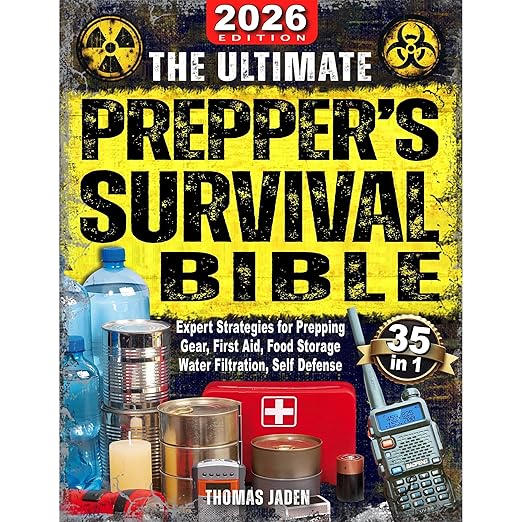
Thomas Jaden’s Ultimate Prepper’s Survival Bible is the kind of comprehensive aggregation title that the preparedness genre produces regularly. The 35 in 1 framing signals breadth over depth, and the promise of covering everything from water purification to psychological resilience in nine hours is a function of scope compression rather than superficiality. What you get is a structured overview of the major survival domains, organized well enough to function as a reference framework rather than a sequential read.
What the Thirty-Five Chapters Actually Cover
The strongest sections are the ones with the clearest procedural content. Water sourcing and purification, food preservation and storage, and first-aid fundamentals all benefit from Jaden’s stated preference for clear, direct, step-by-step instructions over theoretical discussion. These chapters follow through on that promise. If you are new to preparedness thinking and want to understand the logical sequence of building a resilient household, what to prioritize, in what order, and why, this section of the book does useful work.
The home defense and perimeter security content is more uneven. It covers the conceptual framework adequately, layered security, awareness protocols, community coordination, but stops short of the operational specificity that experienced preppers or security professionals would find valuable. This is a reasonable scope decision for a general audience title, but worth noting if you come in with a specific security question.
The psychological resilience chapter is one I was glad to see included. Too many survival manuals treat mindset as a preface rather than a domain with its own protocols. Jaden devotes meaningful space to stress management, decision-making under pressure, and leadership in group survival scenarios, which is more than most comparable titles offer.
The 2026 Update and What It Claims to Add
The synopsis emphasizes this as an updated 2026 edition with expanded sections and new guidance on emerging threats. The content on cyber threats and grid vulnerability feels current, and the framing around modern communication preparedness is specific enough to suggest genuine revision rather than a relabeled earlier text. Three reviewers note approvingly that it feels practical rather than fantasy-adjacent, and one specifically praises the absence of doomsday framing in favor of real-world utility.
Format Limitations Worth Naming Directly
Virtual Voice narration works best when the content is purely informational and linearly organized. This title meets that first condition but not always the second. The chapter transitions, which exist in the text as printed headers, land awkwardly in audio without the visual organization that makes a reference manual navigable. You cannot flip to the water purification section on a camping trip the way you could with a physical book. The audio format adds friction to what is essentially a reference text.
If you already have the audiobook and are committed to the format, treat it as a survey course: one listen through to build the mental map, then supplement with more format-appropriate resources for any domain you want to pursue deeply.
Who Should Listen and Who Should Skip
New-to-preparedness listeners who want a broad orientation to the major domains will get real value from the content here. Experienced preppers will find the depth insufficient in most chapters. Anyone bothered by AI narration should seek the print edition. The 341 ratings averaging 4.6 suggest the core audience finds it satisfactory, and the reviews emphasize its no-nonsense practical orientation as its primary strength.
Frequently Asked Questions
Does the 35 in 1 framing mean 35 separate books, or 35 chapters in one volume?
It is 35 chapters within a single volume, not 35 separate books bundled together. The scope is broad but the treatment of each domain is necessarily compressed.
Is Virtual Voice narration a serious problem for this type of survival content?
For purely procedural content like water purification or food storage techniques, it is tolerable. For the motivational and emotional framing the author clearly intends, it creates a noticeable gap. The print version is the better format for a reference manual of this kind.
Is this appropriate for complete beginners, or does it assume existing knowledge?
It is pitched explicitly at a general audience and works well as a first-entry preparedness overview. The reviewers who respond most positively are newer to the subject and appreciate having a broad framework before going deeper on specific domains.
How does this compare to other comprehensive survival guides like those from military or special forces authors?
It covers similar terrain to titles like Surviving the Wild or Les Stroud’s Survive at a higher-level survey depth. The military-origin titles tend to go deeper on wilderness-specific protocols, while this one gives more space to home and urban preparedness scenarios.