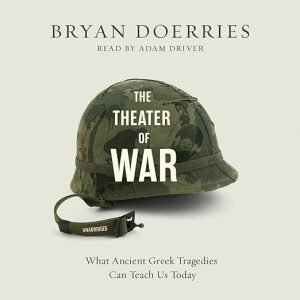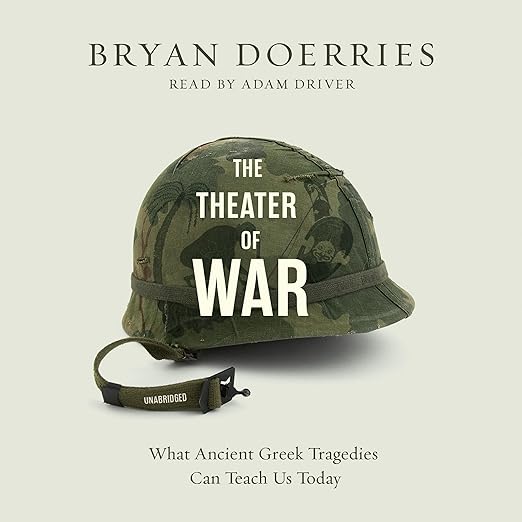
Bryan Doerries came to my attention through a description of his Theater of War project: staging performances of Ajax and Philoctetes in front of active-duty soldiers and veterans grappling with PTSD, then opening the floor to discussion. This audiobook is both the record of that work and the intellectual argument behind it, and it arrives narrated by Adam Driver, himself a Marine veteran before his acting career. That casting is not incidental. Driver narrates with the contained intensity of someone who understands, from the inside, what Doerries is describing.
The Verdict, Briefly
What Doerries accomplishes in these roughly five and a half hours is rare in the literature around both theater and trauma: he resists sentimentality without losing empathy. The book is, as one reviewer observed, wholly unsentimental but intensely felt, and that tonal precision is evident from the first chapter. Doerries is not arguing that Greek tragedy is culturally important in an abstract sense. He is arguing that Ajax's shame spiral after being passed over for Achilles's armor is the same psychological mechanism as the shame many veterans carry home, and that hearing that story told in community, in public, with space to respond, does something that individual therapy often cannot.
The scope broadens as the book progresses. Doerries extends his framework beyond veterans to include addicts, incarcerated people, hurricane and tornado survivors, and others navigating what he calls unspeakable suffering. The unifying argument is that ancient tragedy works precisely because it refuses easy resolution. Sophocles does not fix Ajax. The plays hold pain in view long enough for an audience to recognize it as shared rather than singular, and that recognition is itself therapeutic. One reviewer, a drama teacher at a classical school, described the book as revealing the power of inherited tragedies to connect people to universal questions about existence, which captures Doerries's central claim accurately.
The audiobook format suits this particular book very well. Doerries writes in a voice that has been shaped by years of spoken performance, and Driver's narration honors that quality. The prose is accessible without being simplified, and the firsthand accounts from participants in Doerries's productions carry genuine emotional weight when heard rather than read. The passages where Doerries reconstructs what happened in the room during particular performances, the questions raised, the silences, the moments of sudden recognition from an audience member who had never spoken about their experience publicly, are among the most affecting in contemporary nonfiction.
At 5 hours and 49 minutes, the audiobook is substantive without becoming exhausting. Doerries does not overstay his welcome in any section, which reflects a writer who has learned his pacing from the stage. The book draws on his encounters with current and returned servicemen and women, with addicts, with trauma survivors of various kinds, and the accumulation of these accounts builds into something larger than any individual story.
One of the book's quietest achievements is its account of what happens in the audience during these performances. Doerries describes moments when a veteran in the crowd begins to speak during the post-performance discussion and others in the room recognize, sometimes for the first time, that their experience is shared rather than singular. Those accounts resist sentimentality because Doerries refuses to dramatize them beyond what actually happened. The restraint is a form of respect for the people in those rooms, and it makes the moments land with more weight than theatrical embellishment would allow.
What to Watch For in The Theater of War
One caveat worth noting: Doerries comes to this material as a believer. This is not a neutral or academic survey of applied theater as a therapeutic modality. He is an advocate, and while his advocacy is grounded in extensive firsthand experience, readers looking for a rigorous empirical evaluation of theater's measurable therapeutic effects will find the book more anecdotal than scientific. That is not a flaw, exactly, but it is worth calibrating expectations. The book's strength is experiential and argumentative, not clinical.
The reviews available skew strongly toward five stars, and several come from people with direct professional stakes in the territory Doerries covers: a former teacher, a drama instructor, someone who identifies as having needed the book before knowing it existed. That pattern suggests the book resonates most with people who already have some relationship, however distant, to either theater or the experience of trauma in community. General readers interested in the history and philosophy of Greek tragedy will find Doerries's readings stimulating, even if the therapeutic applications feel secondary to their interests.
The book's reach across populations is part of what makes it more than a veteran-specific resource. Doerries applies the Theater of War framework to incarcerated people, to addiction recovery communities, to disaster survivors. In each case, his argument is the same: that the suffering depicted in ancient tragedy is not historical artifact but present reality, and that an audience recognizing itself in Ajax or Prometheus experiences something therapeutically meaningful that individual treatment cannot always replicate. That universalizing argument is the book's most ambitious claim, and it is one Doerries earns through the specificity of his firsthand accounts.
Who Will Get the Most From It
This audiobook belongs on the listening list of anyone who works with trauma survivors, teaches literature or drama, or is curious about the practical uses of ancient art forms in contemporary life. Veterans and their families may find particular resonance in Doerries's accounts of what happens in the room when Ajax is performed for people who have been in combat. Theater makers and humanities educators will find his methodology both inspiring and practically applicable. Casual listeners looking for a lighter or more narrative-driven listen will find the book demanding in its seriousness. It is a book that asks you to sit with difficult material, which is precisely the point Doerries is making about the tragedies themselves.
- Read by: Adam Driver brings an unexpected gravity to Bryan Doerries's arguments, his distinctive voice lending the ancient tragedies a contemporary weight that a standard narrator would likely miss.
- At its heart: Ancient tragedy as therapy, collective suffering, the redemptive function of art
- Vibe: Serious and humane, with moments of genuine emotional force
- Short version: Bryan Doerries makes a compelling case that Sophocles and Aeschylus understood trauma better than most modern therapists, and Adam Driver's narration makes that case land with real authority.