One reviewer here settled the format question in 2013 and nobody has improved on the answer since. Writing under the handle hawthorne wood, that notice states: "I say go with the audio (CD) version because his energy, his voice and his message must be" heard, a word the reviewer puts inside quotation marks, "to make an impact". Grant Cardone reads his own book. For once, choosing the audiobook over the printed page is not a convenience decision, and a reviewer made the case thirteen years ago.
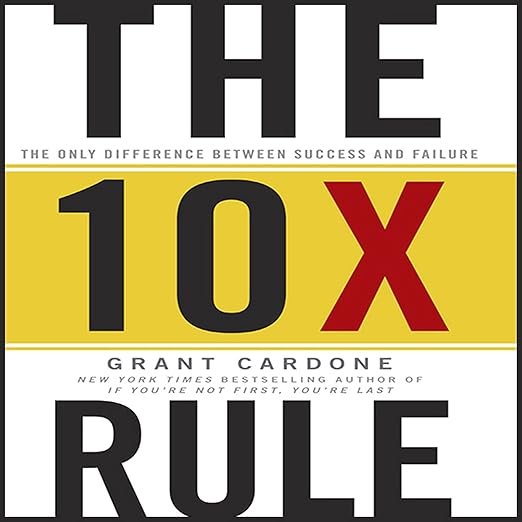
A note on the name before anything else, because it affects searching. This listing appears as The TenX Rule while the publisher's own description and one reviewer both write it as The 10X Rule, and that same reviewer gives the full title as The 10X Rule: The Only Difference Between Success and Failure. Same book, two spellings of the number, and the numeral version is the one nearly everyone types. The recording runs seven hours and twenty-four minutes and dates from July 2011.
The Review
Cardone has one argument and repeats it. The claim is that "Four degrees of action exist" and that reaching anything worth having requires the fourth, which the book names Massive Action, applied at roughly ten times the level you first estimated. Everything else follows from that: goal setting, fear, procrastination, competition. The contents list promises to teach you to "Correctly set goals and guarantee their achievement" and to "Reach goals that you previously thought were impossible", which tells you both how confident the book is and how little interest it has in hedging. It makes no attempt at subtlety.
Everything here is written as address rather than as exposition, which is exactly what makes it work aloud. Fernando Ramos describes a text that "doesn't just present ideas; it invites you to actively reflect on your own behavior, decisions, and patterns", with the reader "constantly prompted to pause, think, and reassess". A book built out of second-person instruction is already halfway to being a talk, and having its author deliver it closes the remaining distance. That interactivity is also the reason a passive listen will waste your time. The chapters ask you to stop and audit your own behavior, and a recording playing while you drive gives you nowhere to put the answer.
Having the author read it therefore does more than save a casting fee. A 2023 notice filed in the United Kingdom describes a writing style that is "energetic and direct", and the 2013 review makes the same observation about the person rather than the prose: "He's articulate and refreshingly straight-on. No b.s. here." When the argument of a book is that intensity is the missing variable, hearing intensity from the source is not decoration, it is the demonstration.
Fifteen years of shelf life is the first thing this listing proves. A title released in July 2011 is still collecting five-star notices in February and March of 2026, and the readable pool spans thirteen years: 2013, 2017, 2023 and two from 2026. Motivational publishing has a brutal shelf life, and a book that people are still buying and reviewing a decade and a half later has demonstrated something the jacket copy cannot.
Ambition reframed as arithmetic is the second reason. Zack Rao describes the book as "a great place to start in shifting your mindset from being your typical average joe to a person of great aspiration", and calls it "very easy and clearly laid out". That combination, an aggressive premise delivered in plain structure, is what makes it usable rather than merely rousing. The same notice describes Cardone as "a very well respected entrepreneur and author", which is worth registering because it identifies who this book is aimed at: people who already accept the premise and want the method, not skeptics who need converting. I would not hand it to a skeptic.
Just over seven hours is a well-judged length for this kind of material. Long enough to build the case and hammer it, short enough to run through twice, which is arguably how a book like this is meant to be used. That same October 2023 notice records that the central premise is simply "setting goals and working at levels that are ten times higher than what you initially think is necessary", and a premise that compact benefits from repetition rather than length.
Weak Spots in The TenX Rule
Something odd sits under the score, and it runs the opposite way to the usual pattern. All five readable notices give five stars, yet the listing shows 4.6 across twelve ratings. Do the subtraction and the seven silent raters must land somewhere between 4.2 and 4.4 as a group. The people who wrote are not merely more enthusiastic than average here; they are meaningfully more enthusiastic than the majority of a very small sample.
Discount that sample further. One of the five reviews is about a physical object rather than about the ideas, ending on the observation that it is a "Durable book" bought as a gift, and it does describe the recipient as someone who "loves to listen and watch Grant Cardone". Useful for what it says about the audience, less useful as an assessment. That leaves four notices of substance behind a twelve-rating average.
Loudness is the last filter, and a genuine one rather than a flaw. The description promises you will "Dominate your competition", calls success "your duty, obligation and responsibility", and instructs you to "Use fear as fuel". Some listeners find that clarifying. Others find it exhausting within an hour, and at this volume the author reading it himself makes the effect stronger in whichever direction you already lean. Sample ten minutes before committing.
Is This One for You?
Sales professionals and founders are the obvious fit, and the pool bears that out. So is anyone who has read a shelf of goal-setting books and found them too polite to change anything, since the whole proposition here is that politeness is the problem. And so is anyone who genuinely absorbs instruction better by ear than by eye, given that a reviewer argued this specific book works better heard.
Steer clear if you want research, case studies or nuance, because the book substitutes conviction for all three. Steer clear if aggressive self-help language raises your hackles rather than your pulse. Volume is the method here, not a side effect, and if that idea does not appeal on paper it will appeal even less coming through headphones at full length.
Before You Press Play
- Voice: Grant Cardone reads his own book, and a 2013 reviewer argues that hearing him is precisely the point of choosing this format.
- Big ideas: Massive action as the missing variable, goal setting at ten times your estimate, fear repurposed as fuel.
- Atmosphere: Loud, insistent and unembarrassed.
- Worth it?: The right format for this particular book, provided its volume energizes you rather than wearing you down.
A Few Questions About The TenX Rule
Is the audiobook read by Grant Cardone himself?
Yes, the author holds the narration credit for all seven hours and twenty-four minutes. One reviewer argues specifically that the audio version is the one to choose because the energy, voice and message need to be heard rather than read. For a book whose thesis is about intensity, that is a substantive point.
Does an audiobook recorded in 2011 still hold up?
The reviews suggest yes. This recording released in July 2011 and readable notices arrive in 2013, 2017, 2023 and twice in 2026, which is unusual staying power for motivational publishing. The advice is about effort levels and goal setting rather than about tools or platforms, so little of it has dated.