Key Details
- Read by: Brian Jacques reading his own Redwall book is the only way this should exist, his accents, pacing, and evident love for his characters transform a good children's fantasy into something closer to theater.
- At its heart: Nature versus nurture, identity and belonging, the pull of goodness against violent conditioning
- Vibe: Adventurous and deeply warm, with genuine moral weight for younger listeners
- Short version: The fourteenth Redwall book is one of the series' strongest precisely because its protagonist is its most psychologically interesting, and Jacques' narration makes it an audio event in itself.
I listened to The Taggerung over a weekend when I was craving something with moral clarity, not simple morality, but the kind where goodness is a genuine force and the question isn't whether it exists but whether it can survive what the world throws at it. I came to the Redwall series late, as an adult, and I initially expected charming animal fables for children. What I found instead was a body of work that takes its young audience seriously enough to give them real questions inside the adventure.
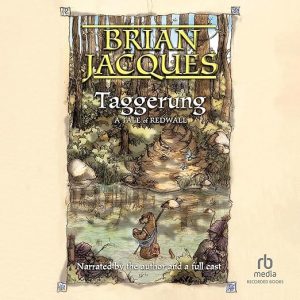
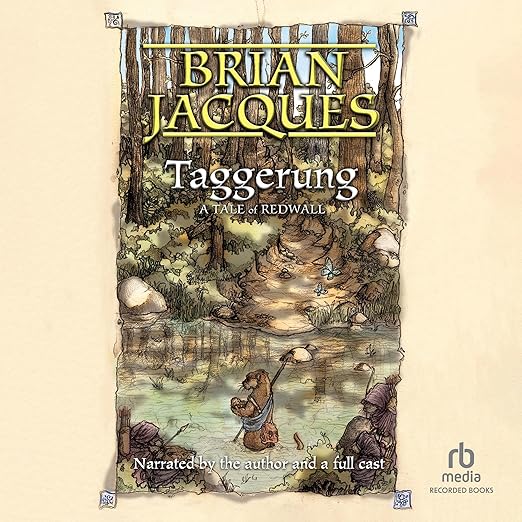
The Taggerung is the fourteenth book in Brian Jacques' long-running Redwall series, and it works as a standalone for new listeners, though the world of Redwall Abbey and its surrounding territories will feel richer if you've spent time there before. The premise is striking: a baby otter is kidnapped from Redwall by Sawney Rath, the leader of the Juska clan, who believes the child is a Taggerung, a legendary warrior of supernatural skill and power. Sawney raises the otter, named Tagg, as his own son, training him to be a killer. What Sawney cannot train away is the Redwall spirit the otter carries with him, the quiet incapacity for cruelty that reasserts itself no matter what violence surrounds him.
Where This One Lands
This is fundamentally a story about whether you can make someone into something they aren't. Sawney spends years trying to corrupt Tagg, and the book's most interesting passages are the ones where we watch Tagg comply outwardly while something in him refuses to close down. He is skilled at violence because he has been trained to be, but he cannot make himself enjoy it the way the Juska do. One reviewer called Tagg "heroic with a capital H, while still being a decent guy", which captures something real about Jacques' achievement here. The protagonist's goodness is not passive or naive. It is active and costly.
The Juska clan is drawn with more complexity than Redwall antagonists sometimes receive. Sawney Rath is genuinely menacing, and his relationship with Tagg has an uncomfortable intimacy that Jacques handles with care. The sense that Tagg is both captive and, in some sense, beloved makes the eventual confrontation land with real weight rather than feeling like a simple villain defeat.
The Best Parts of The Taggerung
Brian Jacques narrating his own Redwall books is one of those listening experiences that is genuinely irreplaceable. He wrote these stories partly as oral performance, the series began as tales Jacques told to children at a school for the blind in Liverpool, and they have always been meant to be heard. His voice is warm, characterful, and absolutely committed. He differentiates the accents of his creature characters with evident pleasure, and the feasts, Redwall's famous, elaborate descriptions of food, become almost sensory experiences when he reads them. At nearly thirteen hours, this is a full-length listening commitment, but the pacing never drags.
There is a quality to the audio that printed text cannot replicate: the sound of someone who loves these characters telling their story. Jacques died in 2011, and these recordings feel now like something to be cherished rather than simply consumed.
What Gives Us Pause
This is the fourteenth book in a series, and while it works as a standalone, some of the emotional resonance of returning to Redwall Abbey and its inhabitants will be muted for first-time listeners. Jacques does good work orienting new readers, but the specific joy of recognizing familiar faces and places is something you earn over the course of the series.
The violence, while not graphic, is present and consequential. Characters die in this book, including some you'll care about. Jacques never uses death as shock value, it carries weight, and it is handled with appropriate seriousness, but parents of younger listeners may want to be aware that this is not a sanitized adventure. The darkness is what makes the warmth meaningful.
Who Should Listen to The Taggerung
This is the right audiobook for children who are ready to encounter real moral questions inside an adventure story and for adults who remember the Redwall books with affection and want to return. It is also a genuinely good entry point for new listeners who want to test whether Redwall is for them, the identity-and-belonging theme gives it an emotional hook that doesn't require prior knowledge of the series.
Listeners looking for fast-paced action without the weight of character development should know that Jacques slows down for the emotional and descriptive work. The feasts, the landscapes, the inner lives of his animals, these are the parts he loves most, and it shows. If you've always found fantasy world-building tedious, you'll struggle here. But if you've ever wanted to listen to a story that feels told rather than read, start with Brian Jacques narrating his own world.
Is The Taggerung appropriate for young children, or is it aimed at older kids?
The Redwall series generally reads to older children, think ages nine and up, or whenever a child can handle consequential violence and character death in service of a larger story. The violence in this book is not graphic but it is real. Jacques takes the moral stakes seriously, which is part of what makes the series durable but also means it isn't entirely soft territory.
Why does Brian Jacques narrating his own book matter so much for this series specifically?
Jacques originally told these stories aloud to children at a school for the blind in Liverpool. They were designed as oral performance from the start. His narration captures accents, warmth, and a love for his characters that no professional narrator reproduces. The feast descriptions, the creature voices, the sense of a world that is genuinely inhabited, these all arrive differently through his voice.