Quick Take
- Narration: Michael David Axtell delivers a clean, measured performance that suits the science-heavy material without adding much interpretive warmth.
- Themes: Autophagy and cellular repair, intermittent fasting and ketogenic eating, aging and longevity science
- Mood: Methodical and quietly urgent
- Verdict: A well-sourced entry point into autophagy science that works best for listeners who already practice some form of fasting and want the biology explained.
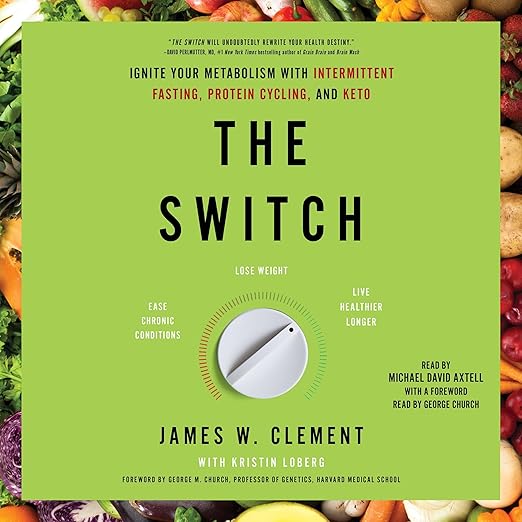
I picked up The Switch on a long drive back from visiting family, somewhere between mile markers 140 and 220 on a stretch of interstate I know by heart. I had been doing intermittent fasting on and off for about two years at that point, mostly guided by instinct and a few scattered articles. What I wanted was someone to explain the actual mechanism, not just give me another protocol to follow. James W. Clement delivered that explanation with enough scientific grounding to satisfy my curiosity without losing me in the weeds.
The book opens with a question that sounds almost philosophical: what if your body already knows how to heal itself, and the main obstacle is that you keep interrupting the process? That question frames everything that follows, and it is a smart entry point because it reframes fasting not as deprivation but as activation.
Autophagy: The Biology Clement Builds Everything Around
The core of The Switch is autophagy, the cellular cleanup process that the body initiates during periods of nutrient scarcity. Clement traces this mechanism with impressive patience, starting from the research foundations and building toward practical application. He is not a physician but a researcher and entrepreneur who spent years studying centenarian genetics, and that background gives him an unusual vantage point: he is invested in the science but not locked into a clinical framework that discourages dietary experimentation.
The book distinguishes between the three main levers that activate autophagy: fasting duration, protein restriction, and carbohydrate reduction. Clement is careful to note that these levers interact with each other, so a reader following only one approach may get partial results. This nuance is one of the book’s genuine contributions. Most fasting literature treats intermittent fasting as a single practice, but Clement makes the case that the combination of timing, protein cycling, and ketogenic eating creates a synergistic effect that any one intervention alone cannot match.
Reviewer D. Pearson noted that the book prompted them to buy multiple copies, including one for a physician friend, which reflects what several listeners describe: a sense that the information contained here is genuinely actionable and not already obvious from mainstream health coverage.
Where the Prescription Gets Demanding
Reviewer Jon G. raised a fair question about realism. The protocol Clement recommends is not casual. Protein cycling in particular requires tracking macronutrients carefully, timing eating windows, and adjusting based on whether you are in a fasting or feeding phase. For someone already embedded in a structured dietary practice, this is manageable. For a newcomer, it can feel like a second job.
Clement is honest about this. He does not pretend the protocol is easy or that it fits into a standard American eating schedule. What he does argue is that the biology justifies the effort, and the book presents enough data to make that case credibly. The endorsements from David Perlmutter and Mark Hyman on the back matter signal the audience well: this is a book for people who already take functional medicine seriously and want to go deeper.
Axtell’s narration serves the text competently. He keeps a consistent pace through the denser scientific sections and does not overreach in the explanatory passages. Some listeners may want a narrator with more presence in a book this heavy on data, but the choice is defensible: the content is the point here, and Axtell does not distract from it.
What Separates This from Generic Fasting Guides
The specific contribution of The Switch is the protein cycling argument. While other books in this space focus almost exclusively on fasting windows, Clement’s framework is tripartite: when you eat, what you eat in terms of protein, and the macronutrient composition of your meals all matter. The sweet spot he describes, a state of mild controlled autophagy maintained over time rather than triggered in short spikes, is a more sophisticated target than most fasting literature aims at.
The guidelines section in the latter portion of the book is where this becomes practical. Clement provides food guidance, timing charts, and phase-based instructions that give the listener something concrete to work with after the science sections have done their job.
Who Should Listen, Who Should Skip
This audiobook rewards listeners who are already familiar with intermittent fasting basics and want the biological context for what they are doing. It is less suited to complete beginners who may find the simultaneous introduction of autophagy, protein cycling, and ketogenic principles overwhelming without prior grounding. If you are deep into the longevity and cellular health space, The Switch is a serious and well-researched addition to your listening library. If you are looking for a gentle starting point, there are more accessible entry points in this genre.
Frequently Asked Questions
Does The Switch require following a ketogenic diet?
Not strictly, but Clement argues that combining fasting windows with reduced carbohydrates and strategic protein cycling produces the strongest autophagy response. He presents keto as one lever among three, not an absolute requirement.
How does Clement’s protein cycling approach differ from standard intermittent fasting advice?
Most fasting guides focus only on the eating window. Clement adds protein restriction during fasting phases and controlled protein refeeding afterward, arguing that this prevents the body from suppressing autophagy through amino acid signaling even within a fasting window.
Is Michael David Axtell’s narration appropriate for the dense scientific content?
Axtell is clean and consistent, which suits the information-dense sections well. He does not add interpretive color, so listeners who prefer a more conversational delivery may find him neutral to a fault, but he does not interfere with comprehension.
Does the audiobook include the guidelines and food lists from the print edition?
The core content including the phase-based protocols and food guidance is covered in the narration. Some editions include a supplemental PDF; check your Audible library for attachments, as availability varies by platform.