Quick Take
- Narration: Tom Sullivan delivers Jean-Henri Fabre’s conversational prose with a patient, unhurried warmth that suits the Victorian storytelling register perfectly.
- Themes: Natural history, the lives of insects, scientific wonder through narrative
- Mood: Leisurely and rich, like being read to by a wise uncle on a summer afternoon
- Verdict: One of the most genuinely pleasurable long-form science audiobooks for children and families, provided you can embrace its nineteenth-century conversational pace.
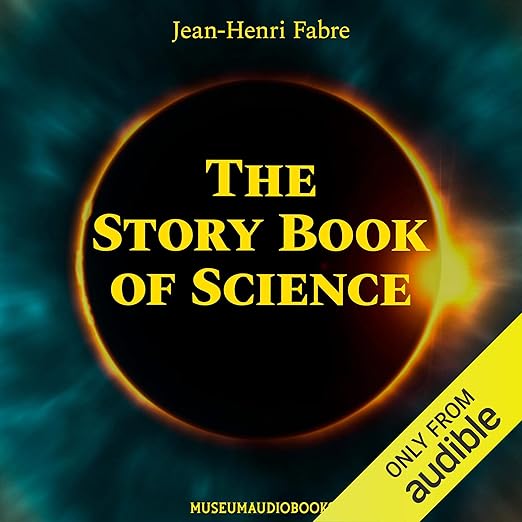
I discovered Jean-Henri Fabre late, through an adult biography of E.O. Wilson that mentioned him as a foundational influence. By the time I went looking for his work in audio format I had already read enough about his insect studies to know what I was in for: slow, careful, biological observation rendered in prose that treated every caterpillar as worthy of a full chapter. The Story Book of Science confirmed all of that and then surprised me with how well it translates to the format Fabre intended from the beginning. He wrote these chapters as spoken dialogues, conversations between an adult called Uncle Paul and three children. Tom Sullivan’s narration restores that dimension completely.
Fabre was born in 1823 and spent most of his life in the south of France observing insects in gardens, fields, and forests. He is considered by many to be the father of modern entomology, though the discipline he practiced had more in common with natural philosophy than the laboratory science that would eventually follow. What he brought to the table was an almost unprecedented ability to observe without disturbing, to describe without oversimplifying, and to communicate genuine wonder to readers who would never set foot near an anthill with a magnifying glass. The Story Book of Science collects those conversations, ranging from ants’ underground cities to spider webs to caterpillar processions to thunder, lightning, volcanoes, and the mechanics of the seasons.
Uncle Paul and the Art of Scientific Conversation
The framing device of an adult explaining the natural world to curious children is not unusual in Victorian educational literature, but Fabre uses it more skillfully than most. Uncle Paul is not a lecturer. He asks questions before answering them. He lets the children’s wrong assumptions stand long enough to illuminate why they are wrong. He moves from the familiar to the unfamiliar in gradients rather than jumps, which is exactly what good science pedagogy looks like. One homeschooling reviewer noted that the chapters connect to each other in organic ways, with each subject growing naturally out of something the children observed or asked in the previous session. That structural attention holds across nearly ten hours of listening, which is a real achievement for any educational audiobook.
What Nine Hours Gives You That a Shorter Book Cannot
The Story Book of Science is long by children’s audiobook standards. At nine hours and fifteen minutes, it commits to the conversational depth that Fabre’s method requires. You cannot rush an explanation of why spiders spin different kinds of silk for different purposes, or why caterpillars travel in single-file processions for reasons that have nothing to do with following a leader. The length is the argument. Fabre is demonstrating that close attention to ordinary things reveals a world far stranger and more organized than casual observation suggests. Sullivan’s narration supports that pace. He reads at a speed that would feel slow in a thriller and feels exactly right here, because the material rewards a listener who is not in a hurry.
Homeschool Curriculum or Independent Listening?
The reviews on this title skew heavily toward homeschooling families, and the fit is obvious. Fabre’s structure of question and answer, observation and explanation, maps naturally onto a discussion-based science curriculum. The material covers a wide range of natural history topics without requiring any particular scientific background, and the writing is rich enough to support vocabulary development alongside the science content. That said, children who listen independently without a parent or educator in the room will still absorb a great deal. The narrative frame keeps the material from feeling like a textbook, and the character of Uncle Paul is warm enough that his explanations feel like stories rather than lessons.
Who Should Listen, Who Should Skip
Children who already love nature, insects, and the kind of unhurried outdoor observation Fabre practiced will find this audiobook revelatory. Families who use living books as a homeschool curriculum component will recognize immediately what they have found. Skip this if your listener needs kinetic pacing, sound design, or a dramatized cast to stay engaged. This is the opposite of that. It is a book about sitting still and paying attention, narrated by someone who understood that paying attention to the right things is a form of adventure.
Frequently Asked Questions
What age range is The Story Book of Science best suited for?
The conversational content and vocabulary are appropriate for roughly ages eight through fourteen, though the material is genuinely interesting for adults. Younger children may find the pace and discussion-based structure less engaging than more dramatically produced audiobooks.
Tom Sullivan is not a well-known narrator. How does his performance hold up across nearly ten hours?
Quite well. He maintains a consistent warmth and patience that suits Fabre’s Uncle Paul character without making it feel performed. The narration is not flashy, but it is steady and genuinely suited to the material, which asks for a reading companion rather than a theatrical performance.
Can this audiobook be used in a secular homeschool science curriculum?
Yes. Unlike some science audiobooks that embed a specific faith framework, Fabre’s work is rooted in close empirical observation. The book reflects a nineteenth-century sense of wonder at the natural world’s complexity but does not argue from that wonder toward any specific theological conclusion.
Is the audio edition based on a complete or abridged text?
The available edition runs nine hours and fifteen minutes, which corresponds to a reasonably full version of the book. Fabre’s original is quite long, and some print editions make different selection choices, but the audio version covers the major subject areas he addresses in the complete text.