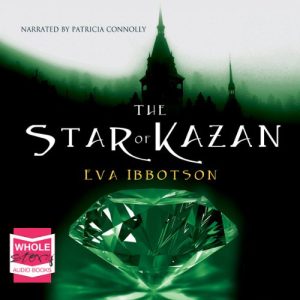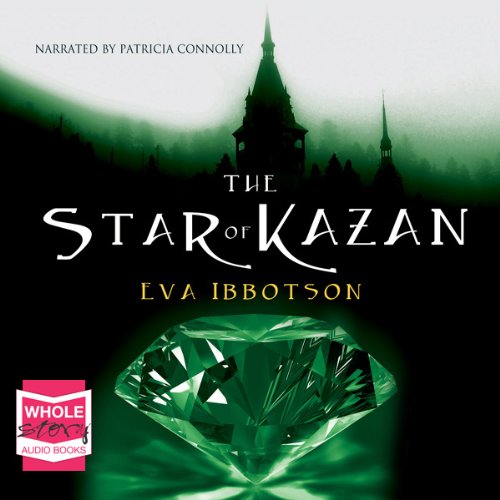
My niece was visiting for the weekend when I put on The Star of Kazan, mostly because I needed something both of us could share during a long Saturday afternoon. She is ten and deeply suspicious of anything I describe as literature. Within twenty minutes she had moved from the beanbag in the corner to the arm of my chair. By the end of the first disc, her father was listening from the kitchen doorway, pretending to wash dishes. Eva Ibbotson does that to people.
The story is set in early twentieth-century Vienna, one of the most richly detailed settings in children's fiction from that period. Annika is a foundling, discovered as a baby and raised by Ellie and Sigrid, a cook and housemaid in the household of three bachelor professors. She grows up in a world that is warm, eccentric, and genuinely loving, even if it is not the aristocratic life she has sometimes imagined for herself. When a glamorous woman arrives claiming to be her mother, Annika is swept away to a crumbling German castle, and the story's central tension begins: the question of whether this woman is who she says she is, and what true family actually means.
First, the Big Picture
Eva Ibbotson, who also wrote Journey to the River Sea and Which Witch, has a particular talent for writing moral universes that feel complete without being simple. The villains in The Star of Kazan are not cartoonish. They are recognizable human types: vain, acquisitive, self-deceiving, capable of affection that curdles quickly when it stops being convenient. The story does not pretend that greed and cruelty are alien to ordinary life. It locates them in domestic spaces, in the performance of aristocracy, in the gap between what a person claims to feel and what they actually do.
What Ibbotson is most interested in, as one reviewer noted, is belonging, kindness, and what it means to be loved for who you truly are. Annika's journey is not simply from poverty to wealth or from obscurity to recognition. It is a more complicated movement toward understanding which relationships are real and which are performance. The book is darker than some of Ibbotson's other work, but the darkness is purposeful. It earns the warmth of its resolution rather than simply delivering a comfortable ending.
A former school librarian reviewing the book mentioned it was presented at a conference by someone who had served on the Newberry committee, and that it received rave attention. The book was shortlisted for the Whitbread Award. These are signals of what kind of novel this is: one that operates in the tradition of classic children's literature where the story is genuinely about something beyond its plot.
What Makes The Star of Kazan Worth Hearing
Part of what makes The Star of Kazan so pleasurable to listen to is the density of its world-building. Ibbotson is a meticulous creator of setting. The professors' household is rendered in detail, from the specific smells of Ellie's kitchen to the particular rhythms of academic life in early twentieth-century Vienna. The Lipizzaner horses that appear in the story are not decorative. They carry genuine historical weight and become central to both the plot and the emotional logic of the ending.
The German castle Annika is taken to is a masterpiece of Gothic atmosphere. It is crumbling in the literal sense, and the crumbling is a perfect metaphor for everything that is false about the life offered to her there. Ibbotson never makes the symbolism heavy-handed. The castle simply is what it is, and what it is speaks for itself.
A Few Reservations
Patricia Connolly's narration is one of the reasons this audiobook works as well as it does. The cast of characters is large, the settings shift between Vienna, rural Germany, and several transit points in between, and the emotional register varies enormously across the story's ten hours. Connolly holds all of it together with voice differentiation that is specific enough to be useful without ever becoming parody. One reviewer noted that her character voices allowed listeners to easily differentiate each person and understand what they were feeling, which is precisely what a long audiobook with a large cast needs.
At ten hours and seven minutes, this is the kind of listening experience you want to stretch over several sessions rather than trying to finish in one sitting. The story rewards the slower pace. There are cliffhangers at the end of sections that Ibbotson has placed deliberately, and the structure holds up across multiple listening sessions without losing momentum.
Should You Listen to The Star of Kazan?
This audiobook is an excellent choice for family listening with children aged approximately nine and up, and equally rewarding for adults who love classic children's fiction. It works particularly well as a shared experience, and reviewers have noted that fathers, mothers, and children alike get pulled in by the story. It also functions well for solo adult listeners with an appetite for atmospheric historical fiction that takes its emotional stakes seriously.
Listeners who prefer lighter, funnier children's fare may find the middle section, where Annika begins to understand what she has been brought into, somewhat heavy. The book handles the darker material with care, but it does not shy away from it. That is part of its quality, but it is worth flagging for listeners expecting something entirely without shadow.
Frequently Asked Questions
What age is The Star of Kazan most appropriate for?
The book is generally recommended for readers and listeners aged nine to twelve, and it is widely used in school libraries for that age group. Adult listeners who enjoy classic children's literature will find it equally rewarding. The themes of identity and belonging resonate across ages, and one reviewer noted her husband refused to miss a single page when it was read aloud.
Is Patricia Connolly's narration suitable for younger listeners who struggle with distinguishing characters by voice alone?
Yes. Multiple reviewers have specifically praised Connolly's ability to give each character a distinct voice. Even listeners who are not experienced with audiobooks will be able to follow who is speaking. The narration is one of the book's genuine strengths.