The Trust Dividend and the Trust Tax
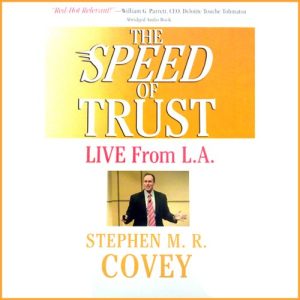
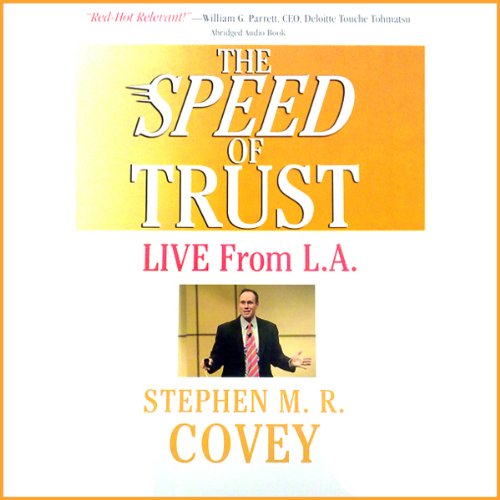
Stephen M.R. Covey narrating The Speed of Trust adds a layer of authority that self-narration in business books sometimes achieves: when the author reads his own work, the listener is arguably closer to the original thinking than when an actor interprets it. The audiobook runs three hours and twenty-six minutes, which is notably short for a business title that claims to offer actionable frameworks for thirteen leadership behaviors applicable across every dimension of organizational life. That tension between ambition and brevity is the first thing a serious listener notices, and it shapes how you receive everything that follows.
The core argument is one that business literature has been circling for decades but rarely formalizes as cleanly as Covey does here: trust is not soft. It is measurable, it has economic consequences, and it operates as a variable that directly affects organizational speed and cost. When trust is high, decisions happen faster, communication is cleaner, and overhead decreases. When trust is low, verification processes multiply, bureaucracy expands, and the cost of doing business with yourself and others rises. Covey calls this the "trust dividend" and its opposite the "trust tax," and the formulation is genuinely useful as a way of making visible a factor that most organizations treat as ambient rather than strategic.
Calibrated Trust Is Itself a Skill
The thirteen behaviors of high-trust leaders form the practical core of the audiobook. Covey organizes them around what he identifies as the foundational components of trust: character and competence, each further subdivided into specific behavioral manifestations. This architecture is clear and teachable, which is presumably why the reviewer identified as Dirkk found the content applicable both at work and at home. The framework translates across contexts because Covey argues that trust operates at five concentric levels: the self, relationships, organizations, markets, and society. The ripple-in-the-pond metaphor from the synopsis captures this neatly.
The self-narration question is worth sitting with for a moment. Covey delivers the content with the conviction of someone who has spent decades thinking and speaking about these ideas, and that conviction is audible. But conviction can tip into assertion, and parts of the audiobook have the quality of a well-rehearsed keynote rather than the exploratory quality of a writer working through complexity in real time. The reviewer who rated it one star and called the content "overstated; poor content" is being harsh but is pointing at something real: Covey makes strong claims, and the short runtime does not provide enough case study depth or counterargument engagement to fully substantiate them.
The two five-star reviews are brief but representative of how most business-book listeners engage with this kind of content: Dirkk listened for work and found a message applicable across professional and personal contexts. Kevin McDonald simply called it excellent. These responses reflect the book's utility as a framework-delivery system for people who are ready to apply its ideas, rather than as a work of rigorous analysis for people who need to be convinced. The question of which kind of listener you are will determine how much you get from the three and a half hours. Leaders who have already witnessed the organizational costs of low trust, who have lived through the delays and the verification overhead that mistrust generates, will find the framework immediately legible and useful.
Covey's distinction between what he calls "smart trust" and naive trust is worth noting as one of the audiobook's more nuanced contributions. He does not argue that leaders should trust unconditionally, which would be an implausible and counterproductive position. Instead he argues that the ability to extend trust appropriately, calibrated to track record and context, is itself a skill that can be developed and that differentiates high-performing leaders from their peers. That distinction gives the framework more operational texture than a simple pro-trust argument would provide.
A Second Covey Applies His Father's Framework
The runtime of three hours and twenty-six minutes positions this as an audiobook introduction to a framework rather than a comprehensive treatment. Covey has written a full-length book of the same title that goes into significantly more depth on each of the thirteen behaviors and the five levels of trust. This audiobook appears to be a condensed version, and that compression shows in places where the argument would benefit from the kind of extended case study analysis that the print version provides.
The rating of 4.0 across only thirteen reviews is a small sample with real variance: five-star reviews alongside a one-star review, no middle ground represented. That pattern is more common in nonfiction audiobooks where the content either resonates immediately or fails to connect, and it suggests that the book's utility is highly context-dependent. Managers and leaders who are already thinking about organizational trust as a strategic variable will find the framework immediately applicable. Readers who need more foundational persuasion about whether trust is genuinely measurable may find the book assumes too much agreement from the start.
Covey's family legacy, as the son of Stephen R. Covey of The 7 Habits of Highly Effective People, is present in the structure of his thinking. The habits-and-principles approach to leadership, the argument that character precedes technique, the emphasis on concentric spheres of influence: all of these echo the father's framework while applying it to a different variable. Listeners familiar with the elder Covey's work will find the intellectual lineage clearly visible and will either find it reassuring or find it limiting, depending on their prior relationship with that tradition.
An Asset for Some, a Limitation for Others
This audiobook is well-suited to managers and team leaders who want a conceptual framework for thinking about trust as a measurable organizational factor and who want to hear the framework from the author's own voice in a concentrated format. The three and a half hours make it an accessible supplement to a broader leadership reading program rather than a standalone education.
Listeners who want comprehensive depth, detailed case studies, or critical engagement with the trust framework's limitations will need the full print book or a more analytically rigorous treatment. The self-narration is an asset for listeners who want directness and authority; it is a limitation for those who find self-promotion embedded in the text harder to absorb from the author's own mouth. The framework itself is solid and worth the runtime if the application is already clear.
A Few Questions About The Speed of Trust
Is the audiobook of The Speed of Trust a full version of the book or an abridgment?
At three hours and twenty-six minutes it is significantly shorter than a full treatment of the thirteen leadership behaviors and five trust levels Covey describes, suggesting this is a condensed or abridged format. Listeners who want comprehensive coverage should also consider the full print edition.
Does Stephen M.R. Covey's self-narration add to or detract from the audiobook experience?
It adds authority and conviction, since Covey has clearly spent decades refining these ideas and his confidence in the material is palpable. It can also create a keynote-address rather than a conversational quality in some passages, which works for listeners who respond to that register and may feel too declarative for others.
How does this audiobook define the practical meaning of trust for organizational leaders?
Covey frames trust as an economic variable with measurable consequences: high trust reduces verification overhead, speeds decisions, and lowers the effective cost of working together. The thirteen behaviors he identifies are specific and behavioral rather than attitudinal, which gives the framework practical traction beyond simple exhortation.
Is The Speed of Trust audiobook better suited to individual self-improvement or team leadership development?
Both, since Covey explicitly argues that trust operates at five levels from personal credibility outward through relationships, organizations, markets, and society. The framework applies across all five, but the audiobook's most immediately practical material is aimed at leaders managing teams and organizations.