Quick Take
- Narration: Amanda Jo brings a crisp, professional clarity to legal and procedural content that can otherwise feel like a bureaucratic maze, her pacing is well-suited to material listeners may need to replay.
- Themes: IEP advocacy, special education law for non-lawyers, the parent as informed partner in educational planning
- Mood: Empowering and organized, the tone of a confident guide who has walked this particular maze before
- Verdict: One of the most practically useful audiobooks available for parents entering the special education system, the 3.5-hour format makes it accessible and replayable.
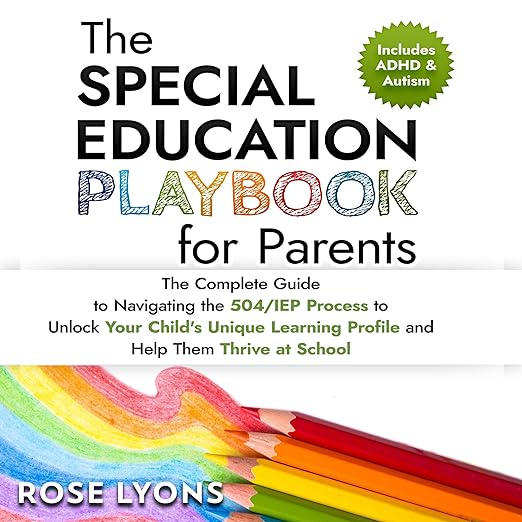
I’ve spoken with enough parents of children with disabilities to know that the moment a school district schedules an IEP meeting is the moment many of them feel simultaneously most responsible and least equipped. The paperwork is impenetrable, the acronyms multiply, and the power differential between a parent and a room full of school officials is significant even when everyone in the room means well. Rose Lyons wrote this book for that parent, and she has organized it as though she understood that a parent in that situation needs clarity above everything else.
The Special Education Playbook for Parents is part of the Thriving Beyond Labels Toolbox series, and the series framing tells you something about the design philosophy: this is a reference tool, not a narrative. Amanda Jo narrates with the professional crispness that reference material requires, clear, well-paced, never rushed through the sections that listeners will need to replay.
Demystifying the IEP Process in Sequence
The book’s most valuable section is its treatment of the IEP process itself. Lyons walks through each stage in sequence, from evaluation to eligibility determination to the meeting itself to implementation monitoring, and at each stage she names the specific mistakes parents most commonly make and how to avoid them. The reviewer who spent twenty years as a social worker before finding this book described it as putting in one place information she had learned in bits and pieces over those two decades. That compression of institutional knowledge is exactly what the book delivers.
The section on evaluation results is particularly useful. Lyons explains how to read and interpret assessment reports, which is the part of the process where parents most often feel lost. Understanding whether a psychoeducational evaluation supports or contradicts an eligibility determination is a skill most parents are never taught, and Lyons walks through it without condescension.
The IEP vs. 504 Distinction Most Guides Skip
One of the book’s practical contributions is its clear treatment of the difference between an IEP and a 504 plan. The reviewer whose daughter doesn’t qualify for an IEP but does for a 504 described the book as resolving months of confusion about why the district kept saying no. This distinction, and particularly Lyons’ treatment of what to do when your child doesn’t qualify for an IEP, fills a genuine gap. Many comparable guides handle it poorly or skip it entirely. Lyons takes it seriously.
The book also addresses the accommodations versus modifications distinction, flagging one commonly used accommodation that Lyons argues should be used with caution. She doesn’t name it in the synopsis, the full treatment in the audio makes the caution legible in context, which is a reasonable editorial choice.
Records, Implementation, and What Happens After the Meeting
The guidance on creating a records binder is one of those deceptively simple pieces of advice that changes how parents show up in meetings. Lyons walks through exactly what should be in it, how to organize it, and how to use it to hold schools accountable for implementation. This is the kind of institutional knowledge that experienced special education advocates take for granted and that first-time IEP parents rarely have.
The implementation monitoring section, what to do when your child’s IEP is not being followed, is similarly concrete. Most guides stop at the meeting. This one continues through what happens after. The reviewer who described preparing comprehensively for every step of the IEP process after reading is describing the book at its most practical level, and that is where the audiobook earns its high rating.
Who Should Listen / Who Should Skip
Essential listening for any parent who is at or approaching the IEP process for the first time. Equally valuable for parents who have been through multiple IEP cycles but feel they’ve been flying blind, the organized overview will fill gaps even for experienced advocates. Professionals who work with families, including social workers and therapists, will find it a useful reference for the parent perspective. Parents dealing with private school settings or college transition planning will need supplementary resources, as the book focuses on K-12 public school rights.
Frequently Asked Questions
Does the book cover 504 plans as well as IEPs, or only special education eligibility?
Yes, Lyons specifically addresses the 504 plan as an alternative when IEP eligibility is denied, and explains the differences in protections and services between the two. This is one of the book’s more useful sections for parents who have been told their child doesn’t qualify for special education.
Is the legal information in this book current, and does it apply in all US states?
The book addresses federal special education law under IDEA, which applies nationally. State-specific variations exist, and listeners should verify state-specific procedures with a local advocate or attorney if their situation requires it. The federal framework Lyons explains is the foundation in all states.
What does Lyons mean by an accommodation that should be used with caution, does she explain it in the audio?
Yes, she names and explains it in the audiobook itself. The synopsis withholds the specific name but the audio section is clear. Listeners should hear it in context rather than seeking a shortcut answer.
At 3.5 hours, is there enough depth for parents dealing with complex or contested IEP situations?
For foundational understanding, yes. For parents dealing with due process hearings, private school placements, or extended school year disputes, the book is a starting point rather than a complete guide. Consulting a special education attorney or advocate for contested situations is advisable regardless of how well-prepared you are.