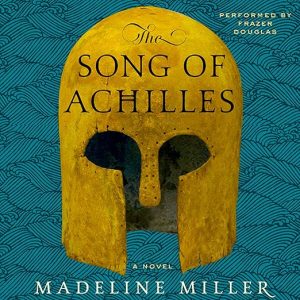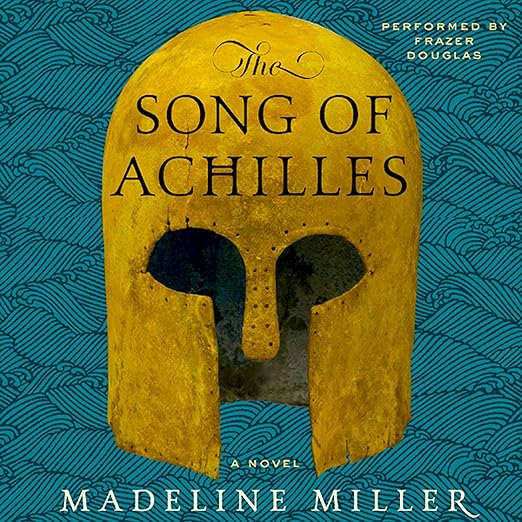
Patroclus tells this story, which is the decision the whole audiobook rests on. Madeline Miller's retelling of the Iliad is spoken by Achilles' companion rather than by Achilles, and Frazer Douglas delivers it as one continuous first-person account across eleven hours and fifteen minutes. Every battle, every prophecy and every god reaches you filtered through a boy who was sent away to Phthia as a child and never expected to matter to anyone.
Sustaining Patroclus's Flatness Without Sliding Into Monotony
Miller's premise is a scholar's, and the copy says so: a homage to the Iliad from a novelist reimagining Homer's work as an action-packed adventure and an epic love story simultaneously. In practice that means a novel keeping the mythic architecture, gods, kings, immortal fame, prophecy, while rebuilding everything interior. The Trojan War is where the book ends up. The childhood in Phthia is where it spends its patience, and that proportion is the single most important thing to know going in.
S. Smith, five stars in July 2024, quoted the line that establishes the entire voice: No one spoke to me. I was easy to ignore. It was not so very different from home, really. Patroclus is a prince in his father's kingdom who has always felt unworthy and unloved, and exile changes nothing about that. Flatness of self-regard is the register a performer has to sustain for the length of the book without letting it slide into monotony, and it is the hardest thing this recording asks.
Achilles enters as the exact opposite: handsome, athletic, a prince who is everything Patroclus is not, and hated at first for precisely that. Miller lets the resentment run long enough to feel real before turning it, and that is why the love story carries a weight the mythology alone could never supply. The book was Miller's debut, and the description names Mary Renault, Bernard Cornwell, Steven Pressfield and Colleen McCullough's Masters of Rome as the shelf it expects to sit on.
Frazer Douglas Carries One Voice Across Gods and Kings
Mary Renault lives again is the comparison the copy reaches for first, in a line attributed to Emma Donoghue, and Ann Patchett supplies the other, calling the book at once a scholar's homage to the Iliad and a startlingly original work of art that could not be put down. Blurbs of that weight usually indicate a high floor rather than a high ceiling. This one earns them by being genuinely readable, which is not something most retellings of Homer manage without either flattening the myth or drowning in it.
The strongest practical case comes from a five-star account filed in October 2025. Homer's poems, it says, have always felt just out of reach, and most of what it knows about Greek mythology comes from summaries and retellings; The Song of Achilles asked for none of that and demanded only the heart. On audio that matters twice over, because a listener cannot stop to check who Agamemnon is or why Phthia is a punishment. A retelling that carries its own context is the only kind that works in this format.
Frazer Douglas takes the file alone, which suits a book designed as a single voice. Gods, kings and the war itself all arrive inside Patroclus's telling rather than in separate registers, so the production question is less about range than about whether one sustained tone can hold across the whole length without going gray. What the written record does instead of assessing that is quote Miller's sentences in blocks, which is a decent proxy for what the performance has to carry.
Blurbs Fill the Page Over Effle's Mild Reservation
Blurbs make up the entire publisher description on this page. Ann Patchett, Emma Donoghue and a list of comparable authors occupy the space where a plot summary belongs, and the only content information offered is that this reimagines the legend of Achilles and the Trojan War. A buyer learns considerably more from the written responses than from the copy, which is an inversion worth flagging on a listing this heavily rated.
Effle filed four stars in January 2026, the one written grade here that stops short of the top, and named the reason: genuine frustration with Achilles' feud with Agamemnon, tempered immediately by an admission that feuds are simply like that. The complaint lands on Homer rather than on Miller, and it identifies the stretch where the novel's momentum stalls, which is roughly where the Iliad's stalls too. The same note calls the writing lyrical, so it is a reservation rather than a warning.
Knowing the myth is the other variable. Anyone who remembers how the Trojan War goes knows what is coming for Patroclus, which turns the back half into a countdown rather than a mystery, and Miller writes it that way on purpose. Listeners who do not know are better off staying that way for as long as possible. The description gives nothing away, though the responses discuss the ending's emotional cost freely, so read the page at your own risk.
Skip This if You Want a Battlefield Epic
Readers who have avoided Homer their entire lives are the audience this was built to convert, and it manages the job without a trace of condescension. One September 2025 account, filed at five stars, described finding Patroclus and Achilles as a teenage boy grappling with identity, in a world whose only message was that being different should be hidden, and finding in that bond a picture of love that was fierce and unapologetic. That is the book's real constituency, and the listing files it under LGBTQ+ accordingly.
It is also the wrong purchase if what you want is the Iliad. Miller keeps the architecture and swaps the values: honor and immortal fame remain the currency of the world, but the book measures its characters by tenderness instead. Anyone expecting a battlefield epic will spend a long time in Phthia waiting for a war that arrives late and stays further offstage than they are braced for.
Classics teachers have an obvious use for this, and so do book clubs willing to sit with a queer love story told without apology, which is how the listing files it, under three genres at once. The prose is the actual draw: Miller writes at sentence level in a way that survives being pulled out of context, and the written record demonstrates that repeatedly rather than asserting it. A debut that makes the Trojan War feel like something happening to people you know is worth the modest commitment it asks.
- Read by: A single voice for a book that is one continuous first-person account, so tonal consistency matters far more here than range or accent work.
- At its heart: Achilles and Patroclus, queer love inside myth, the Trojan War, fame measured against tenderness, Homer retold.
- Vibe: Tender and elegiac, with the ending in plain sight from the start.
- Short version: The rare Iliad retelling that requires no Homer; buy it for the prose and the pairing, not for the battles.
Frequently Asked Questions
Do you need to have read the Iliad before this audiobook?
No, and that is one of its genuine strengths. The novel supplies its own context for Phthia, Agamemnon, the prophecy and the war, so nothing whatsoever depends on prior reading. Listeners who do know the epic will catch more of what Miller is doing with it, but they are not the audience this book was written to reach.
Is the audiobook narrated in first person the whole way through?
Yes, from the opening line to the end, with Patroclus speaking throughout. Arah-Lynda Hay's five-star account, filed from Canada in November 2016, quoted a long passage to demonstrate it, all in that same close, breathless first person. One reader carries every character, so the distinctions between voices are made by tone rather than by casting.