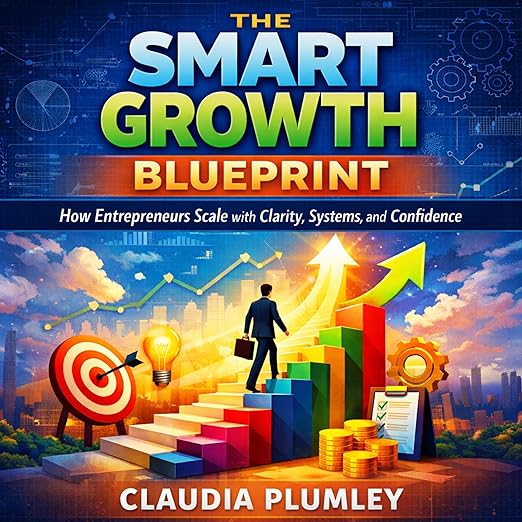
In Brief
- Performance: Scott LeCote delivers a clean, professional reading suited to business content - clear pacing with enough energy to carry the how-to sections without tipping into motivational-speaker territory.
- What it covers: Sustainable business scaling, systems thinking, delegation and clarity
- Feel: Calm and practical, like a well-organized consultation
- Our call: At just 81 minutes, The Smart Growth Blueprint is a tight primer on intentional business scaling, though listeners seeking case studies and industry-specific depth will need to supplement it with further reading.
The central premise of The Smart Growth Blueprint audiobook is stated with unusual directness: growth doesn't have to feel chaotic. For any solo entrepreneur or small business owner who has spent months in what Claudia Plumley calls constant firefighting mode - reacting to problems faster than they can build the systems that would prevent them - that sentence functions less as a marketing claim and more as a specific diagnosis. At one hour and twenty-one minutes, this is a brief audiobook by business genre standards, but Plumley uses the runtime efficiently, moving through a structured framework without overstaying her welcome on any single concept.
The question that opens the synopsis - whether you're working harder than ever but still feeling overwhelmed and scattered - is a question that Plumley clearly understands her audience is already asking. The audiobook doesn't spend much time convincing you that the problem exists; it assumes you've arrived already knowing the answer to that question, and gets on with addressing it. That choice of entry point shapes the whole listening experience.
Ten Clients Break the Founder, Fifty Breaks Harder
Plumley organizes her framework around seven core capabilities: creating clarity before chasing growth, building simple systems to eliminate daily chaos, scaling revenue without extending hours, delegating effectively, making confident decisions in uncertainty, tracking meaningful metrics, and managing energy alongside output. The audiobook works through these in a linear progression, with each chapter building on the previous. This is a methodology book rather than a narrative one, and Scott LeCote's narration reflects that - he reads the material with professional crispness, and the clarity of delivery helps the structural logic land cleanly in audio form.
The "clarity before growth" chapter is the most substantive section. Plumley makes the argument that most small business owners pursue growth as though it were a cure for the disorganization they're already experiencing, when in practice growth amplifies whatever systems - or lack of systems - are already in place. The business that runs on a founder's individual judgment at ten clients will simply break that founder more thoroughly at fifty clients. It's a familiar argument in business literature, but Plumley renders it concisely and without the case-study padding that fills many audiobooks of this genre to feature length. The absence of reviews makes it harder to gauge how the framework performs for specific industries, but the logic of the approach holds up on its own terms.
Short Enough for a Lunch Break and a Commute
The audiobook's strongest pitch is its accessibility. Plumley is explicitly targeting solo entrepreneurs and first-time scalers - people who have built something that works at small scale and are confronting the specific friction of growing it without losing the qualities that made it work. She is not addressing enterprise leaders or sophisticated operations managers, and the audiobook's vocabulary reflects that. The language is direct and untechnical, the framework is presented as a step-by-step progression rather than a system of competing priorities, and the runtime means a listener can move through the whole structure in a lunch break and a commute.
The book is part of the Wealth Creation series (Book 8), which gives it a context that individual listeners may or may not have engaged with. Each entry in the series appears to function as a standalone volume rather than requiring sequential reading, so entering here without the earlier installments should not create gaps in comprehension. Plumley positions this audiobook specifically against hustle culture - the exhaustion model of growth that treats long hours as a proxy for ambition - and the alternative she's proposing is sustainability-focused: build a business that fits your life rather than consuming it. That reframe is the book's genuine value proposition, and she states it consistently rather than burying it under productivity tactics.
The Seven Capabilities Work as a Map
Listeners who have significant experience with business systems literature will find the conceptual ground here familiar. The core arguments - that systems enable delegation, that clarity must precede scale, that metrics should track outcomes rather than activity - appear in a range of business books from the last two decades. What Plumley contributes is synthesis and accessibility rather than novelty. If you're encountering these ideas for the first time, or if you've encountered them elsewhere but struggled to translate them into your specific situation as a small business owner, the book's structured presentation will be useful. If you're already operating with formal systems frameworks, this audiobook probably covers territory you know.
The brevity is both the book's strength and its most significant constraint. At under ninety minutes, Plumley cannot go deep on any individual topic, and the absence of extended examples means some listeners will finish the audiobook understanding what to do in principle but less clear on how to translate the framework into the specifics of their business. The seven capabilities function as a map rather than a detailed route - which is fine as far as it goes, but listeners should calibrate their expectations accordingly. The audiobook works best as an orientation or a framework sketch, not as a comprehensive implementation guide.
A Reinforcement Listen for the Already-Familiar
Solo entrepreneurs and small business owners who are actively hitting the ceiling of founder-led operations and looking for a structured way to think about the transition to systems will find this audiobook a clean and efficient starting point. The runtime makes it a realistic listen for busy people who struggle to complete longer business books, and the structured progression means it works well as a repeated reference. Listeners already embedded in business operations literature - readers of established works in the productivity and management space - may find the material familiar enough to make this primarily a reinforcement listen rather than a discovery one. The audiobook works well on first play, but listeners who want case studies, industry specifics, or deep implementation guidance will need to pair it with more detailed resources.