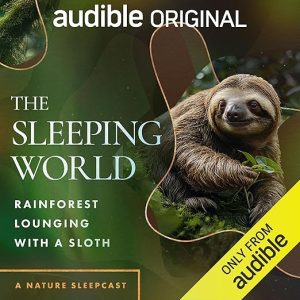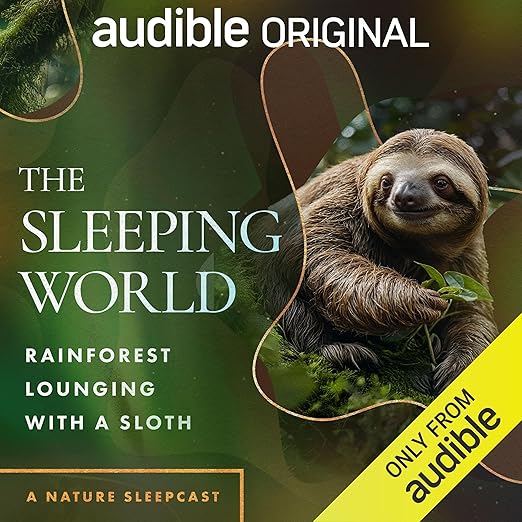
Mumble Media's The Sleeping World: Rainforest Lounging with a Sloth audiobook is an Audible Original produced in Dolby Atmos - 53 minutes of immersive sleep audio built around a sloth moving through the Costa Rican rainforest. Listing it alongside conventional audiobooks requires a caveat: this is not a narrative in the usual sense. It is part soundscape and part bedtime story, designed to dissolve attention rather than hold it. That is not a failing; it is the explicit intention. Knowing this going in shapes what the experience offers.
Jake Young's writing, narrated by Cynthia Kimola, follows a three-toed sloth across a month of extraordinary slowness. The sloth's life is organized around one task per month. He hangs in the canopy of a Costa Rica rainforest, digesting a single leaf across thirty days, while jaguars, pumas, and insects move through the world around him. The narrative keeps returning to the central paradox: that the sloth survives not through speed or aggression but through the opposite - through being so profoundly unhurried that predators overlook him, and so covered in algae that the ecosystem folds him into itself as camouflage. Slowness is not the sloth's limitation. It is his strategy.
Rain That Moves Instead of Simply Looping
The production values are genuinely distinctive. Mumble Media's sound design team - credited specifically in the production notes - created a layered rainforest environment that, in Dolby Atmos, places sound in three-dimensional space around the listener. Rain moves. The canopy shifts. The ambient sounds of the Costa Rican night are not a static loop but a living field that changes as the sloth's month progresses. This is not background audio added to narration; the sound design is the other half of the experience. Listeners without access to Dolby Atmos will still find the soundscape effective, but the spatial audio version is clearly the intended format.
Cynthia Kimola's narration is an ideal match for the material. Her voice is warm without being artificially soothing - she does not perform the narrator's usual act of guiding the listener somewhere but instead seems to be observing alongside them. The sloth's movements are described in prose that deliberately mirrors the pace being narrated: sentences that pause, that circle back, that allow the soundscape to breathe between observations. This is not an accident of writing; it is a formal choice by Young that Kimola extends into performance. The result is audio that does not demand attention so much as it offers permission to release it.
Real Algae Science Behind a Sleepy Sloth
Sloth consultant Julian Monge-Najera and fact-checker Andrea Lopez-Cruzado are credited in the production notes, which signals that the ecological content beneath the sleep-audio surface is accurate. The sloth's biology - the algae-symbiosis that serves as camouflage, the digestive system calibrated for maximum slowness, the body temperature that fluctuates with the environment - is not invented for narrative convenience. The science is real, which gives the bedtime story an unexpected substance. A listener who falls asleep before the sloth finishes his month will have absorbed a genuine account of how a specific animal survives in a specific ecosystem.
The content works on a second level that the synopsis does not fully articulate: by the time the sloth has made his way across his tree and returned to rest, the listener has been held in the rhythms of a world organized around patience, symbiosis, and the long cycles of a rainforest ecosystem. The seasons and routines the synopsis mentions are not metaphorical - the narrative tracks actual ecological cycles, the timing of rainfall, the movement of predators. Sleep audio at this level of specificity is rare. Most sleep content relies on generic nature sounds or abstract visualization. This grounds the listener in a particular place, with a particular animal, in a particular season.
More Narrative Than Pure Ambient Noise Allows
The 53-minute runtime means this is not structured for multiple listening sessions - it is a single experience designed to carry a listener from wakefulness into sleep. Listeners who use it as background audio rather than as a sleep tool will find it more engaging than most ambient content but potentially too narrative-forward for pure environmental listening. The writing emerges clearly enough from the soundscape that it asks for slightly more attention than pure white noise would require, which is occasionally at odds with the deepest sleep applications.
This release carries no reviews to draw on, which makes it difficult to gauge how broadly effective the experience is across different listeners. The production is Audible-exclusive and produced in partnership with Mumble Media, which means the Dolby Atmos version is only available through that platform. Listeners who access it through other means may encounter a version of the soundscape that loses the spatial audio dimension, which is a meaningful reduction from the intended experience. The narration and writing remain effective without it, but the full intended format is clearly the Dolby Atmos production, and that is the version worth seeking out.
Kimola's Unhurried Narration Rewards Staying Awake
This audio experience is suited for listeners who use long-form content as a sleep aid and want something more substantive than ambient sound loops or guided breathing exercises. The ecological specificity and Kimola's unhurried narration make it genuinely interesting to a listener who is still awake enough to follow the sloth's month, while the soundscape's immersive depth does the work for listeners who drift before the narrative resolves. Those looking for educational content about rainforest ecosystems will find accurate material here, though the bedtime-story framing means depth of information is not the priority. Listeners who prefer silence or very minimal ambient audio for sleep may find even this gentle narration too present to ignore. The Dolby Atmos production, heard through good headphones, is the ideal context for this particular audiobook.
Is this audiobook effective as a sleep aid, or is the narration too engaging to fall asleep to?
The production is specifically designed to be used as a sleep tool, the pacing, the soundscape, and Kimola's narration all work toward that effect. The writing is gentle enough that drifting off mid-listen is the intended outcome rather than a listening failure. Listeners who want to absorb all the ecological content attentively may find it works better as a quiet early-evening listen rather than a sleep-onset tool.
Does the audiobook require Dolby Atmos equipment to be worth listening to?
The Dolby Atmos spatial audio is the intended format, and listeners with compatible equipment will have the most complete experience, the three-dimensional soundscape of the Costa Rican rainforest is a significant part of what makes this production distinctive. However, the narration and writing are effective without spatial audio, so the experience holds up on standard equipment, just with less immersive depth in the sound design.