Quick Take
- Narration: Simon Vance is excellent, his pacing matches the locomotive’s rhythm and he handles the shift between dry irony and genuine wonder without losing either register.
- Themes: Environmental responsibility, the wildness beneath the ordinary world, sibling dynamics, childhood as a time of genuine power
- Mood: Whimsical but not lightweight, with real moral stakes underneath the adventure
- Verdict: Lev Grossman’s middle-grade debut is the most interesting children’s audiobook in this batch, smart, funny, emotionally serious, and beautifully narrated by Simon Vance.
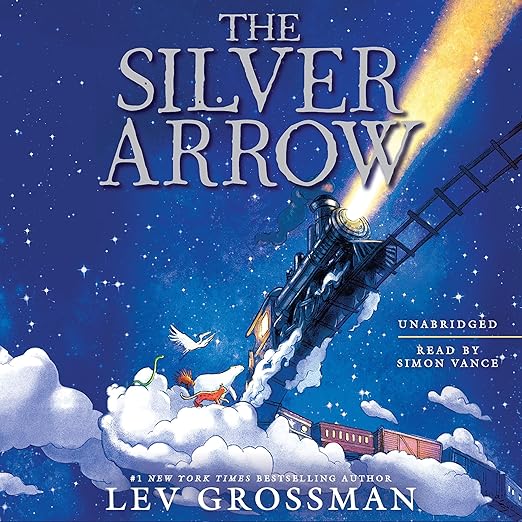
I finished The Silver Arrow on a Sunday evening in one long uninterrupted session, which is not something I often do with middle-grade fiction. I had been intending to listen in pieces, but Simon Vance’s narration and Lev Grossman’s premise kept making me think: just one more chapter. The result was an evening well spent.
Lev Grossman is best known for The Magicians, his adult fantasy series about a Narnia-obsessed young man who discovers magic is real and considerably more dangerous than the books promised. That series is sophisticated, melancholic, and not for children. The Silver Arrow is Grossman’s middle-grade debut, and it carries a family resemblance to his adult work in the best way: it trusts its young readers to handle complexity, it doesn’t sentimentalize the journey, and it has a real argument to make about the world. But it makes that argument through an eleven-year-old girl and a 102-ton steam locomotive, which changes everything.
A Premise That Announces Its Intentions
Kate writes a letter to her mysterious, never-met Uncle Herbert requesting a birthday present. Uncle Herbert shows up in a yellow suit and parks a colossal steam locomotive in the backyard. This is the kind of premise that announces its intentions clearly: we are going to take an ordinary child and give her something so extraordinary that the world she knew cannot contain it. Grossman executes this with wit and efficiency. The locomotive, the Silver Arrow, becomes a character in its own right, and the animals who board it as passengers, and who can talk, bring the book’s environmental themes into the open without turning the narrative into a lecture.
Simon Vance and the Weight of Wonder
What Vance does with this material is impressive. He has a dry wit that suits the book’s ironic distance, Kate’s narration is sardonic in the way that genuinely funny eleven-year-olds are sardonic, aware that the world often doesn’t make sense, but he also knows when to let the wonder land without undercutting it. The talking animals are varied in voice and personality in a way that makes the train feel genuinely populated. The adventure sequences have momentum. The quieter moments where Kate and her brother Tom reckon with what the journey is asking of them are handled with the same seriousness that Grossman brings to those moments in the text. Ann Patchett called it middle grade fiction at its best, and Vance’s narration is a significant part of why that holds up on audio.
The Environmental Argument and How It Functions
The ecological underpinning of The Silver Arrow is not a background theme or a moral tagged onto the adventure. It is the reason the train exists and the reason the children are needed. The animals who board the Silver Arrow are endangered, displaced, struggling, and they are not tragic figures but fully realized characters with opinions and preferences and humor. One reviewer who tried the sequel found it disappointing by comparison, which suggests this book manages a balance between adventure and meaning that the follow-up doesn’t maintain. This first volume earns its reputation.
The Sibling Dynamic That Makes It Work
Kate’s younger brother Tom is not a tag-along or a plot device. He is a credible child who is frightened and excited by the right things in the right proportions, and the sibling dynamic between him and Kate is one of the book’s unacknowledged strengths. They disagree, they protect each other, they are changed differently by what they experience. Grossman understands that children’s fiction is often better when the protagonists include two perspectives rather than one, and he makes that count here.
Who Should Listen and One Honest Caveat
This audiobook is ideal for ages 8 to 12 with appetite for adventure that has ideas underneath it. Children who loved The Chronicles of Narnia or Roald Dahl will find the familiar shape of a magical vehicle taking children beyond the ordinary world, but with something more contemporary in the environmental stakes. One reviewer strongly recommended skipping the sequel, calling it very simplistic compared to this book, a caveat worth noting if a young listener finishes and wants more immediately. Simon Vance’s narration makes this the most complete audiobook listening experience in this collection.
Frequently Asked Questions
Is The Silver Arrow standalone, or do I need to continue with the sequel The Golden Swift?
The Silver Arrow resolves fully and satisfyingly on its own. One prominent reviewer specifically advised against the sequel, finding it far weaker than the first book. This entry works as a standalone and is arguably best experienced that way.
How does The Silver Arrow compare to The Chronicles of Narnia or Roald Dahl, as the marketing suggests?
The comparison is earned but imprecise. It shares Narnia’s structure of children entering a magical world through an unusual doorway, and Dahl’s sharp wit and willingness to put genuine danger around child protagonists. Grossman’s specific contribution is an environmental consciousness and a dry contemporary irony that feel distinctly different from mid-century British fantasy.
Does Simon Vance differentiate the various talking animal characters clearly enough to follow on audio?
Yes. Vance gives each animal character a distinct vocal personality without tipping into caricature. The train feels genuinely populated, and listeners tracking multiple animal characters across the journey should have no difficulty following who is speaking.
Is there anything in The Silver Arrow that might be too dark or frightening for younger middle-grade listeners?
The book has real stakes, some of the animals’ situations are genuinely sad, and the environmental themes are not softened, but nothing is graphic or traumatic. The age range of 8 to 12 is appropriate. Children on the younger end who are sensitive to animal harm or displacement may find some passages affecting.