Quick Take
- Narration: Miles Carter delivers a steady, professional performance suited to the handbook’s clinical-but-accessible register, clear enough for note-taking, warm enough for a hard day.
- Themes: Sensory processing differences, home and school advocacy, child self-regulation
- Mood: Practical and reassuring, structured for reference as much as straight listening
- Verdict: A well-organized resource for parents navigating sensory challenges, though the density of strategies works better in print for ongoing consultation.
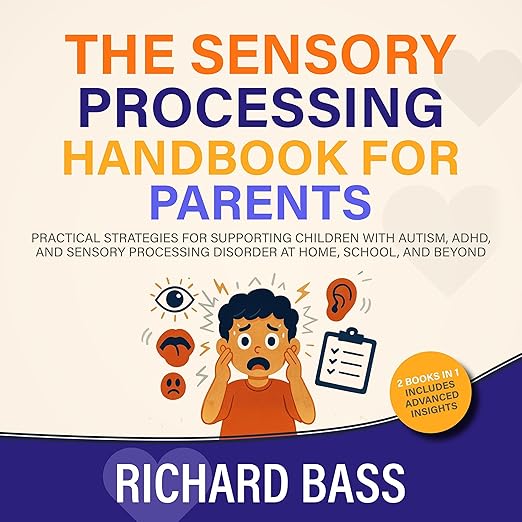
I listened to a significant portion of this one while folding laundry on a Sunday, which is probably exactly the kind of multitasking the author would both understand and gently advise against. Richard Bass knows his audience: parents who are exhausted, who have twelve tabs open in their browser and eleven unanswered emails from the school, who are trying to decode a child’s behavior at the same time they’re trying to keep the rest of the household functioning. The Sensory Processing Handbook for Parents is built for that kind of reader, overwhelmed, practical-minded, and deeply motivated to actually help.
Bass is the author of several books in this parenting-neurodivergent-child space, including guides on teens’ self-regulation, ADHD parenting for boys, and parenting children with autism. This handbook, framed as a “2-in-1 resource” combining foundational strategies with advanced insights, aims to cover sensory processing differences comprehensively across the age range from early childhood through adolescence. That’s an ambitious scope, and Bass largely delivers on it, though the breadth means some sections are necessarily more introductory than specialists might want.
Reading a Child’s Sensory Profile
The most immediately useful section of the book is its framework for understanding a child’s individual sensory profile, specifically, the distinction between sensory-seeking behavior (craving stimulation) and sensory-avoidant behavior (overwhelmed by it), and the recognition that many children present with elements of both. One reviewer, a stepfather to a twelve-year-old with high-functioning autism, described this framework as “life-changing” for helping him understand behaviors that had previously seemed random. That response makes sense: Bass’s explanations are concrete and example-driven rather than theoretical, and the case studies he uses across chapters are recognizable without being reductive.
Miles Carter’s narration is a good fit for material of this kind. He reads with the consistent clarity of someone who has thought carefully about pacing, the chapters on sensory environments and home modification, which involve a lot of specific recommendations, are delivered at a speed that allows you to actually absorb each point rather than having them blur together. When the material becomes more emotionally textured, the passages on navigating public meltdowns, or the sections on what parents carry alongside their children, Carter adjusts his delivery without becoming theatrical.
Navigating Schools and IEPs
The chapters on school environments and IEP accommodation are among the stronger sections of this audiobook. Bass writes here from an understanding of how schools actually function, what they are likely to offer without prompting, where you have to push, how to document sensory needs in ways that translate into institutional action rather than remaining vague parental concern. The language he provides for these conversations is specific enough to be usable and flexible enough to adapt. For parents who have felt dismissed or patronized in school settings, this section in particular has real practical value.
The book also addresses nutrition, sleep, and stress management as they intersect with sensory processing, which broadens its scope further. These sections are necessarily briefer, and the treatment is more introductory, enough to orient a parent toward further investigation, but not sufficient as a standalone resource for any of these areas.
Audio Format Considerations and Who This Serves
I want to be direct about one limitation: the density of specific strategies and recommendations in this handbook means that many listeners will want access to the print edition for ongoing reference. The audiobook is excellent for an initial orientation, understanding the framework, internalizing the philosophy, getting a sense of the full range of tools available. But when you need to recall a specific accommodation technique for a school meeting, or revisit the chapter on travel planning before a family trip, a printed or digital version that you can navigate directly is more practical.
That said, for the target audience, parents who are trying to understand sensory processing differences for the first time and who learn well through narrative explanation, this audiobook delivers. The combination of research grounding, case examples, and age-specific tips makes it one of the more thorough resources in the genre, and Bass’s consistent emphasis on the child’s individual profile (rather than a generic protocol) keeps it from feeling prescriptive in the way that more rigid guides sometimes do.
Frequently Asked Questions
Does this book cover sensory processing in children without an autism or ADHD diagnosis?
Yes. Bass explicitly addresses children who have sensory differences without a formal diagnosis of autism or ADHD, as well as those with diagnoses. The framework around sensory profiles is applicable regardless of whether a child has received a specific label, and many parents find the book useful before or in the absence of formal evaluation.
How does the 2-in-1 structure work in audio format?
The book is organized so that the foundational section comes first and the more advanced strategies build on it. In audio, this works naturally as a linear listen, you move from understanding sensory profiles to applying more nuanced strategies. Listeners who already have a solid foundation in sensory processing theory may find the early chapters introductory, but they move efficiently enough not to become frustrating.
Is Miles Carter’s narration appropriate for a clinical handbook, or does it feel too dry?
Carter avoids the two failure modes of this genre, he’s neither so flat that the material feels like a medical textbook nor so warm that the clinical specificity gets soft. He reads the strategies and frameworks with clarity and the case study sections with appropriate human register. The narration supports rather than dominates the material.
Does this book help with sensory challenges in public spaces specifically?
Yes, and in some detail. Bass devotes dedicated sections to public spaces and social situations, including preparation techniques and on-the-spot regulation tools. There is also a section specifically on travel and vacations. These practical chapters are among the most directly applicable in the book for parents whose biggest daily challenges occur outside the home.