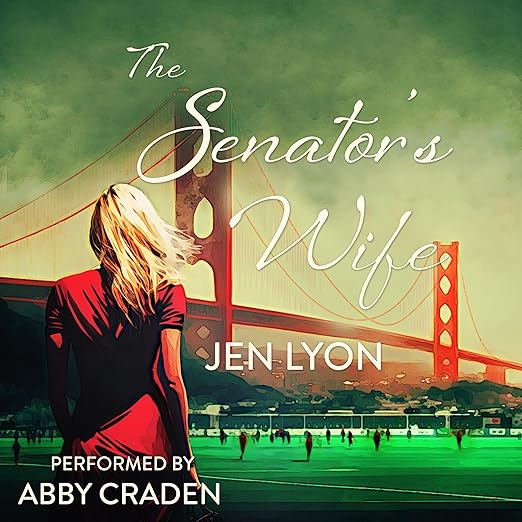
Quick Take
- Narrator: Abby Craden gives each protagonist her own tonal register and lets the attraction build through restraint rather than performance.
- Subjects: Slow-burn F/F romance, public identity versus private feeling, political scrutiny
- Tone: Tense and quietly electric
- Bottom line: A carefully structured LGBTQ+ romance that earns its emotional weight through patience, though you will need the full series to see it through.
A rescue at sea is a strange way to begin a love story, but Jen Lyon's audiobook The Senator's Wife opens exactly there: professional soccer player Alex Grey alone on the South Carolina waterway, watching a sailing accident unfold and making a split-second decision to dive in after a drowning stranger. That stranger turns out to be Catharine Cleveland, wife of a sitting US senator. In Abby Craden's narration, the moment crackles with the particular voltage of things about to shift irrevocably. I started this one on a flight delay, headphones in, and by the time my gate changed I had completely missed the announcement.
What Lyon sets up in that opening scene is a slow-burn romance that never rushes its own emotional logic. Alex and Catharine circle each other across multiple cities and contexts, from the soccer fields of Portland to the Marina District of San Francisco to the political machinery of Washington, D.C. Each location is carefully chosen to signal who these women are separately before showing who they become together. The geography is part of the characterization, and in Craden's hands it serves as a kind of emotional shorthand for the distance these two women must close.
The Review
Lyon writes with real structural patience. This is a slow burn in the truest sense: the attraction builds through accumulation rather than incident, and the emotional stakes arrive gradually rather than through plot mechanics. The novel spends considerable time establishing why each woman cannot comfortably pursue what she clearly wants. For Alex, it is the scrutiny of professional athletics and the visibility that accompanies it. For Catharine, the barriers are heavier: she is locked into an arranged marriage with a man one reviewer describes as 'truly vile,' and her public identity as a senator's wife leaves almost no room for private feeling or private risk.
That domestic reality is not kept offscreen. A significant domestic violence scene surfaces in the second half, and reviewer A.M.G. flags it clearly in her community comments. Lyon handles it with directness rather than gratuitousness; it functions as a clarifying moment about what Catharine's real life actually costs her. The violence is not incidental texture. It is the weight against which every other moment in the novel must be understood.
What Makes The Senator's Wife Worth Hearing
Abby Craden is a particularly good match for this material. She handles dual-register narration, giving each woman her own tonal identity while keeping the story's shared emotional temperature consistent. Alex's voice has an athlete's directness; Catharine's carries a kind of practiced composure that slowly develops cracks the longer the friendship deepens. Craden does not hammer the contrast, which is exactly right. The romance is felt rather than announced, and that interpretive restraint is what makes the eventual emotional payoff land so cleanly.
Craden also navigates the political milieu without condescension. Scenes set at Washington gatherings, where everyone in the room is performing something other than what they feel, are rendered with an awareness of social artificiality that never flattens the characters who must live inside it. For a book that spans multiple professional and geographic worlds, the coherence of the listening experience across all of them is genuinely impressive work on her part. She holds the whole architecture together.
The Caveats
This is book one of a three-book series, and Lyon makes no pretense about resolving everything here. The ending, as one reviewer notes, 'ends in a nice enough place,' but several threads remain deliberately open. Listeners who prefer self-contained romantic arcs will find this frustrating. The book earns its stopping point emotionally, and the narrative does not feel incomplete within its own terms, but it is unmistakably a first installment. The investment it asks readers to make in Catharine's complicated circumstances will require the subsequent volumes to pay off completely.
The pacing in the early middle section slows considerably. Lyon takes her time establishing the friendship between Alex and Catharine before acknowledging its romantic dimension, and while this structural choice ultimately serves the emotional arc, it can feel deliberate to the point of restraint in the audio format. At 13 hours and 30 minutes, the book has room to breathe, but some listeners may find that the middle section tests their patience before the story finds its footing in the third act. The reward at the far end of that slow build is genuine, but the build itself is long.
What Lyon also does well is locate the romance within the specific pressures of two very different professional worlds. Catharine's position as a senator's wife is not simply a social label; it comes with obligations, appearances, and a surveillance that never fully lifts. Alex's world as a professional athlete carries its own visibility: sponsorships, team dynamics, a career that can be derailed by the wrong headline. The novel understands that these women are not choosing between love and abstract social pressure; they are choosing between love and everything they have built their public lives around. That specificity of cost is what makes the slow burn feel earned rather than manufactured.
Who Should Listen to The Senator's Wife
This is the right audiobook for readers who love a slow-burn F/F romance with real political texture and a narrator who understands what understatement can do for emotional pacing. If you are drawn to love stories where the attraction simmers under layers of professional identity and public obligation, and where the obstacles are structural rather than contrived, Lyon's setup delivers exactly that. Abby Craden's performance makes the quiet scenes as compelling as the charged ones.
Skip it if you need a complete romantic resolution within a single audiobook, or if depictions of domestic violence, even handled with narrative care, are material you prefer to avoid. But if you can commit to the series, this first volume builds a foundation with real places to go. The three reviewers who gave it five stars had reason for their enthusiasm: the emotional architecture is sound, and Craden's narration serves it well from start to finish.
Questions Listeners Ask
Does The Senator's Wife audiobook work as a standalone, or do you need to continue the series?
It functions as a strong first volume but does not resolve its central romance fully. The ending reaches a stable emotional point, but several threads carry into books two and three. Be prepared to continue.
Is the domestic violence scene in this audiobook graphic?
It is present and handled with directness rather than exploitation. It serves a narrative purpose in clarifying Catharine's circumstances, but listeners sensitive to that content should go in aware.
What genre does The Senator's Wife audiobook sit closest to?
It is primarily a slow-burn F/F romance with a political setting. The emphasis is on emotional development and character rather than plot mechanics or thriller pacing.