
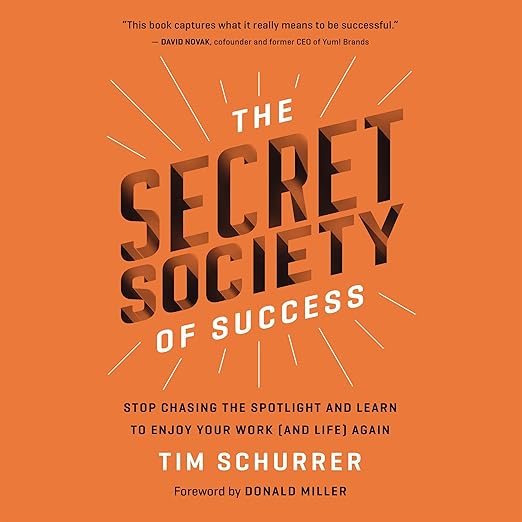
Tim Schurrer builds his entire argument around a single scene: he's backstage, adjusting a mic stand, swapping out equipment, slipping away again before anyone in the audience notices he was there at all. That's the kind of person this audiobook is written for and about, the ones doing essential work just outside the spotlight, and Schurrer uses his own career, largely spent supporting more visible leaders rather than becoming one himself, as the evidence for his central argument: that our current cultural definition of success, climb the ladder, become the boss, chase the spotlight, is not the only version available, and maybe not the healthiest one.
He narrates the audiobook himself, and that choice matters structurally as much as it does for authenticity, since the book includes audiobook-exclusive interviews woven directly into the chapters, conversations with former Yum! Brands CEO David Novak, Olympic gold medalist Scott Hamilton, and Thistle Farms founder Becca Stevens. None of that supplementary material exists in the print edition, which makes this one of the rarer cases where the audio version isn't just a different format of the same content but genuinely expands on it.
How Fred Rogers Outlasted Flashier Contemporaries
Schurrer coins the phrase Spotlight Mindset for the success model he's arguing against, chasing credit, visibility, and hierarchy for their own sake, and builds his alternative, the Secret Society framework, around contribution that doesn't require public recognition to count as meaningful. He illustrates the idea through stories about genuinely famous figures, Tim Cook, LeBron James, Fred Rogers, alongside people whose names never made headlines, and the pairing works: readers get both the reassurance that even famous, successful people wrestle with this tension and the more grounded reminder that most meaningful contribution happens without anyone watching at all.
David Dahlen D'Cruz's review highlights something the book does well structurally: opening with Schurrer's own vulnerable account of struggling with the Spotlight Mindset himself before ever asking the listener to examine their own relationship to it. That sequencing, personal confession before broader argument, builds real trust early, and reviewer Blake Randall's summary of the core idea, that most people default to chasing money, fame, and status without questioning whether that's actually what they want, captures the book's diagnostic starting point accurately, even without needing Schurrer's own words to make the point.
What's absent, in a genre prone to famous-name-dropping, is any sense of glamorizing celebrity, even while the book uses well-known figures as its central illustrations. The examples skew toward well-known, successful people, Cook, James, Rogers, Novak, even while making an argument about the value of unrecognized work, and that's a tension worth naming: listeners hoping for a book built entirely around ordinary, unfamous people's stories will still encounter plenty of boldface names alongside them. Schurrer seems aware of the irony, using famous examples partly to prove that even people who did reach the spotlight validate his argument about what actually matters underneath it.
Fred Rogers gets particular weight among the book's examples, and it's an apt choice: decades of unglamorous, patient work on a low-budget children's program, decidedly not chasing scale or spectacle, produced a kind of cultural impact that outlasted flashier contemporaries by a wide margin. Schurrer uses Rogers less as a saint to admire from a distance than as concrete proof that the Secret Society approach, quiet, consistent, values-driven work, can outperform the Spotlight Mindset on its own terms, reach and lasting influence, not just moral high ground.
An Audiobook With More Than the Print Edition
The audiobook-exclusive interviews are the strongest argument for choosing this format specifically over the print edition. Hearing Novak, Hamilton, and Stevens in their own voices, rather than paraphrased or quoted secondhand in text, adds a documentary layer to Schurrer's argument that a reader flipping pages simply doesn't get access to. It's a genuinely rare case of an audiobook edition offering more content than its print counterpart, not just a different delivery method for identical material.
SB's review is titled 'I almost hugged the Amazon guy!' and it captures the kind of personal enthusiasm this book seems to generate reliably across its reviewers, and the specific anecdote in that review, watching Schurrer work unnoticed backstage before ever meeting him, mirrors exactly the kind of story Schurrer tells about himself throughout the book. That alignment between how readers describe encountering him and how he describes his own working life suggests the persona on the page and the actual person are consistent, which matters for a book this dependent on its author's credibility.
Ernie Johnson Jr.'s blurb, printed in the synopsis itself, calls the book a genuine outlook changer, and having spent decades as the steady, unshowy anchor of TNT's Inside the NBA broadcasts himself, Johnson's endorsement carries a specific kind of credibility for this particular argument, since he's spent a career adjacent to enormous individual celebrity, professional athletes and coaches, without becoming that kind of spotlight figure himself.
The book's workplace and organizational-behavior framing also gives it practical relevance beyond pure inspiration; Schurrer explicitly connects the Spotlight Mindset to real dysfunction inside teams and companies, credit-hoarding, visibility politics, burnout from chasing recognition rather than doing valuable work, which grounds the more philosophical material in workplace dynamics a listener will likely recognize from their own job.
More Interested in Ambition Than Career Moves
This is fundamentally a mindset and philosophy book rather than a tactical career guide, and readers wanting a numbered system for getting promoted or negotiating a raise will find Schurrer more interested in your relationship to ambition itself than in specific career moves. The stories about Cook, James, and Rogers illustrate a way of thinking about contribution and credit, not a repeatable career strategy with measurable steps, and that's a meaningfully different kind of business book than the genre's more tactical entries.
At six hours and twenty-two minutes, the pacing stays brisk and story-driven throughout, which works in the book's favor for engagement but means less space for deep theoretical grounding than a denser academic treatment of the same ideas might offer. Listeners wanting rigorous research citations behind the Spotlight Mindset framework specifically, rather than illustrative stories and interviews, may find the evidentiary approach here more anecdotal than data-driven.
A Pick for Yum! Brands Leadership Fans
Anyone feeling burned out chasing visibility, credit, or promotion for its own sake, or anyone who has quietly done excellent work without recognition and wondered if that makes them a failure by conventional standards, is the exact reader Schurrer is writing for. It's also a strong pick for fans of Yum! Brands leadership content generally, given Novak's direct involvement, and for anyone who enjoys business books built more around story and interview than pure framework and bullet points.
If a numbered, step-by-step productivity system is what you came for, Schurrer's approach will disappoint, since posture and mindset interest him more than concrete tactical moves. Readers who prefer dense research citations over personal stories and guest interviews as their primary evidence should also know this leans heavily on narrative persuasion rather than data.
In Brief
- Performance: Tim Schurrer's self-narration adds real intimacy, and audiobook-exclusive interviews expand well past the print edition.
- What it covers: Redefining success beyond the spotlight, contribution without recognition, purpose over hierarchy
- Feel: Warm, reflective, sincere
- Our call: A genuinely moving alternative career-success framework, best for readers who value story and interview over rigid frameworks.







