Quick Take
- Narration: Liz de Nesnera’s voice has exactly the right quality for this material: French-inflected cultural history told with precision and a light touch of glamour.
- Themes: Perfume history as cultural biography, the construction of luxury mythology, Coco Chanel’s complicated legacy
- Mood: Elegant and investigative, with the pacing of a well-researched profile piece
- Verdict: One of the stronger examples of object biography in audio form, blending cultural history and personal legend into something genuinely absorbing over eight hours.
There is a specific pleasure in listening to a book about a sensory experience you cannot have while listening. I was on a long drive through the French countryside years ago, a trip I can barely afford to remember without longing, when I first encountered a genuine bottle of Chanel No. 5 on a perfume counter in a small department store in Rouen. I didn’t buy it. I’m still thinking about that, and about the way the perfume smelled, which is neither exactly what I expected nor what anyone can fully describe in words. Tilar J. Mazzeo has written an entire book about why that description gap exists, and why it matters, and it turns out to be one of the better books I’ve spent eight hours with in recent memory.
Liz de Nesnera narrates, and the casting is excellent. De Nesnera has a measured, slightly formal warmth that suits the book’s movement between cultural history and personal biography. She doesn’t oversell the glamour, which is the right call for material that is genuinely complicated beneath its luxury surface.
An Object That Contains a Century
Mazzeo, who previously wrote The Widow Clicquot, is expert at what you might call object biography: taking a single artifact and using it to trace the cultural forces that produced it and the historical circumstances that made it significant. Chanel No. 5 is, in her account, not simply a perfume. It is a document of early twentieth century aesthetics, of the relationship between French fashion and American commerce, of the wartime cultural politics that allowed the scent to become a symbol of liberation for American soldiers who brought bottles home from Paris, and of the complicated personal history of Gabrielle Chanel herself.
The scent was created with the perfumer Ernest Beaux in 1921, reportedly the fifth sample presented to Chanel in a numbered series. It introduced an aldehyde-heavy, abstract quality to fine perfumery that was genuinely radical at the time, departing from the single-flower or bouquet constructions that dominated the industry. Mazzeo explains all of this with authority, drawing on extensive research into the perfume industry and into Chanel’s biography without reducing either to a simplified narrative.
The Coco Chanel Problem
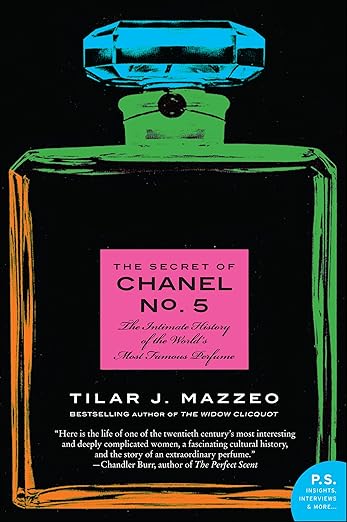
Any book about Chanel No. 5 is necessarily a book partly about Coco Chanel, and writing about Chanel requires navigating a biographical record that contains genuine darkness alongside the legendary creativity. Mazzeo does not ignore the complicating details: Chanel’s wartime collaboration with German intelligence, her anti-Semitism, her manipulation of business relationships, and the legal battles over the perfume’s ownership and licensing that extended across decades. The Chandler Burr quote on the cover, about Chanel being one of the twentieth century’s most interesting and deeply complicated women, anticipates this, and Mazzeo honors it by not letting the legend crowd out the person.
This is where the book distinguishes itself from more hagiographic treatments. Mazzeo is interested in the truth of how the perfume came to be and what sustained its cultural dominance, and that interest leads her into the less comfortable parts of the story as readily as the romantic ones. The tension between Chanel and the Wertheimer family, who held the perfume’s commercial rights, is one of the more riveting threads: it involves wartime opportunism, postwar restitution, and a commercial relationship that shaped the twentieth century perfume industry in ways that are still visible today.
Scent, Memory, and the Audio Paradox
There is something pleasurably paradoxical about listening to an eight-hour history of a perfume. You cannot smell No. 5 while listening, and yet Mazzeo’s descriptions of the aldehyde opening, the floral heart, and the musky base are so precise that many listeners report reaching for whatever fragrance they have nearby. One reviewer notes that reading about Coco Chanel’s life led her to retry a perfume she had dismissed at fourteen, and found it transformed by context. The audiobook version of this experience works similarly: the history changes your relationship to the scent in ways that are only possible when you understand what it contains and why.
De Nesnera’s narration is particularly effective in the descriptive passages about the perfume itself. She reads them with the care of someone who understands that the words are doing the work of an unavailable sense, and the pacing gives each phrase space to register.
Eight Hours Well Spent
This is not a short or breezy listen. Mazzeo is a serious cultural historian and the book has the density of serious research. Listeners who come expecting a light celebrity biography of Coco Chanel may find the commercial history sections, which trace the Wertheimer family negotiations and the postwar transformation of luxury goods marketing, slower than anticipated. But those sections are load-bearing: they explain why No. 5 is still the world’s bestselling perfume a century after its creation, which is the central puzzle the book sets out to solve.
For anyone with genuine interest in fragrance, fashion history, cultural biography, or the mechanics of luxury myth-making, this is close to essential listening. For casual fans of Chanel who want the romantic version of the story, Mazzeo will give it to them, but she will also give them the complicated version alongside it.
Frequently Asked Questions
Do you need to be a perfume enthusiast to enjoy this book, or does it work as straight cultural history?
It works as cultural history. Mazzeo uses the perfume as a lens for examining early twentieth century aesthetics, wartime cultural politics, and the business of luxury goods. The scent knowledge helps but is not required. The book consistently moves from the specific fragrance to broader cultural forces.
Does the book address Coco Chanel’s wartime collaboration and controversial history?
Yes, and with appropriate seriousness. Mazzeo does not reduce Chanel to a legend. Her wartime collaboration with German intelligence, her anti-Semitism, and the complex legal battles over No. 5’s ownership are all present in the narrative.
How does Liz de Nesnera’s narration suit this material?
Very well. She has a measured, slightly formal warmth that suits the movement between cultural history and personal biography. Her pacing in the descriptive passages about the perfume itself is particularly effective, giving the words room to do the work of a sensory experience the audio format cannot otherwise provide.
Is this book connected to Mazzeo’s other work, like The Widow Clicquot?
Thematically yes. Both books practice object biography, using a single luxury artifact to trace the cultural and historical forces that produced it. Readers who enjoyed The Widow Clicquot will find a familiar methodology here applied to different but equally rich material.