Quick Take
- Narration: Suzanne Toren is a precise and steady presence, delivering Callahan’s evidence-dense prose with the measured authority it requires, clinical enough to earn trust, warm enough to stay human.
- Themes: Evidence-based parenting, infant health literacy, separating science from media hype
- Mood: Reassuring and rigorously honest, the opposite of panic-inducing
- Verdict: The most methodologically literate parenting audiobook in the infant-health space, essential for new parents who want to understand how to evaluate claims, not just receive conclusions.
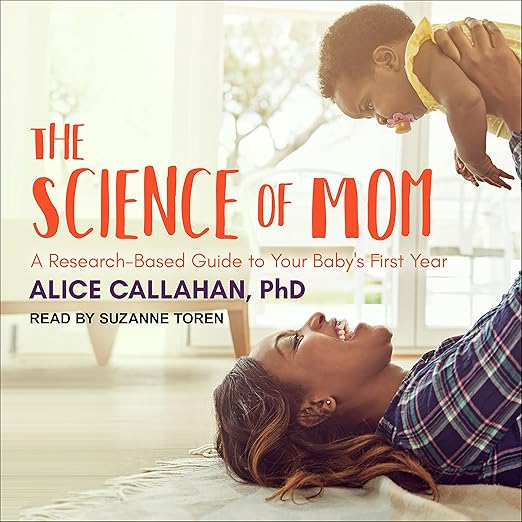
I remember the specific kind of information exhaustion that sets in around the fourth month of caring for a newborn, not yours, necessarily, but someone else’s. A close friend had just had her first child and had been texting me links at all hours: studies about swaddling risks, opinion pieces on sleep training, contradictory guidance on solid-food timing. She was a scientist by training and was more stressed by the research than comforted by it. I pointed her toward Alice Callahan’s book and then listened to it myself. About three hours in, I understood exactly why Callahan built it the way she did.
Callahan is a PhD scientist who came to this material as a new mother, overwhelmed by the same flood of headlines and social media certainty that swamps most parents today. The Science of Mom grew from her blog, where she had been applying actual scientific literacy to parenting claims. Suzanne Toren narrates the audiobook with a composure that perfectly matches the text’s register, measured, intelligent, never breathless. At nearly ten hours, this is a substantive listen, and Toren earns every minute of it.
Teaching the Method, Not Just the Conclusions
What distinguishes this book from most parenting guides is that Callahan is not primarily interested in telling you what to do. She is interested in showing you how to think about the evidence that supposedly tells you what to do. She walks through specific controversies, breastfeeding duration claims, vaccine safety research, infant sleep approaches, not to settle them with a verdict but to model how to read a study, understand sample sizes, recognize conflicts of interest, and distinguish preliminary findings from established consensus.
One reviewer put it well: Callahan does a good job of “drawing attention to disparities in findings between different studies” and takes “a pretty good stab at trying to assimilate a ton of data into workable recommendations.” That is exactly right, and it is a harder skill than it sounds. Reviewers who are themselves scientists noted how accurately she captures the texture of doing research, including the honest uncertainty that popular science journalism almost always strips out.
Where the Evidence Takes You
The book’s core chapters on breastfeeding, vaccines, and sleep are the strongest. Callahan approaches all three with the same dispassionate rigor, which is more remarkable than it sounds: these are topics where parenting culture has strong tribal loyalties, and her refusal to perform enthusiasm for any particular camp will frustrate advocates on all sides. That is, frankly, the correct response to a writer doing her job correctly.
One reviewer flagged the nutrition chapter as weaker, noting that Callahan’s handling of solid-food introduction was less rigorous than the earlier material. That observation holds up on close listening. The solid-food section leans more on consensus guidelines than on the same depth of study analysis she applies elsewhere. For a nearly ten-hour audiobook, one chapter performing slightly below the bar of the others is a minor issue, but it is worth noting so listeners know to apply their own critical lens rather than assuming uniform evidence quality throughout.
The Toren Factor
Suzanne Toren has spent decades narrating nonfiction with distinction, and her work here is characteristic of her best. The challenge with Callahan’s writing is that it includes passages of genuine technical density, discussions of study design, confidence intervals, meta-analysis structure, alongside warmly personal narrative sections about her own experiences as a new mother. Toren navigates this range without forcing a single register onto all of it. The result is an audiobook that feels like being talked through the research by someone who has done the reading and wants you to actually understand it, not just accept it.
Who Should Listen, Who Should Skip
Listen to this if you are a new or expecting parent who is overwhelmed by conflicting information and wants a framework for evaluating claims, not just a list of conclusions to memorize. Scientists and healthcare workers who interact with new parents will find Callahan’s model useful for those conversations.
Skip this if you want quick, directive answers without methodological context. Callahan’s commitment to showing her reasoning is the point, if you want a fast reference guide with straightforward recommendations, this is not the right audiobook for that need.
Frequently Asked Questions
Does Callahan come to definitive conclusions on contentious topics like sleep training and breastfeeding duration, or does she leave them unresolved?
She arrives at evidence-based positions, but she presents them with appropriate uncertainty and explains the reasoning behind them rather than issuing directives. On some questions she concludes the evidence is genuinely inconclusive; on others, like vaccine safety, she is clear about what the science shows.
How current is the research in this audiobook, and is there a risk that some recommendations are outdated?
The book was updated from its original publication, but as with all evidence-based parenting resources, specific guideline details can shift as new research emerges. The book’s most durable value is its framework for evaluating evidence, which does not age; specific recommendations on topics like safe sleep positions should be cross-referenced with current AAP guidance.
Is this accessible to parents without a scientific background, or does the technical content create a barrier?
Callahan writes explicitly for nonscientist parents and takes care to explain methodological concepts in plain language. Toren’s narration keeps the pacing comfortable even through denser passages. Multiple reviewers without research backgrounds describe it as accessible, though it does require more active engagement than more prescriptive parenting books.
How does this audiobook compare to Emily Oster’s Expecting Better or Crib Sheet as a data-driven parenting resource?
Oster’s books apply an economist’s cost-benefit framework to parenting decisions and are more directive in their conclusions. Callahan is more interested in teaching scientific literacy and is more cautious about the limits of available evidence. They are complementary rather than redundant, Oster for decision-making frameworks, Callahan for understanding how to read the underlying research.