Quick Take
- Narration: Carol Grace Anderson reads the structured lesson-based content clearly and methodically, the format rewards attentive listening more than passive background audio.
- Themes: Social skills scaffolding, peer rejection, neurodivergent social development
- Mood: Systematic and hopeful, grounded in clinical research and tested in practice
- Verdict: One of the most rigorously researched social skills guides for teens and young adults with ASD, ADHD, or similar profiles, the structured curriculum format means it rewards active engagement rather than casual listening.
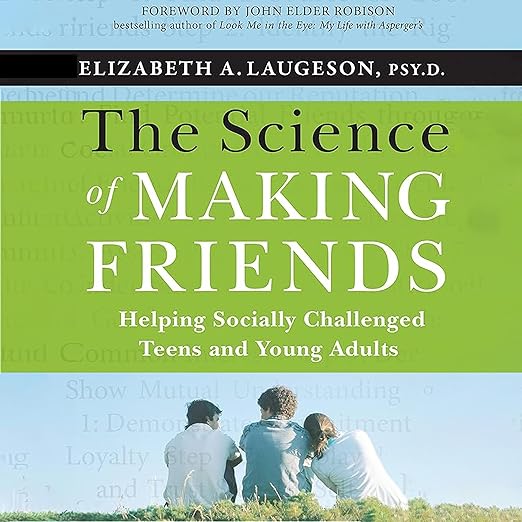
I was halfway through this book when I paused and thought about how strange social skills instruction actually is. We expect children to acquire the rules of conversation, friendship formation, and conflict navigation through osmosis, through watching adults and peers who may or may not be modeling the behavior we actually want. For neurotypical children, this informal acquisition mostly works. For teens and young adults with autism spectrum disorder, ADHD, bipolar disorder, or social anxiety, the rules are opaque and the stakes feel enormous, and no one is saying them out loud. Elizabeth Laugeson’s book says them out loud, explicitly and without embarrassment, and the results, based on her PEERS program at UCLA, are measurable.
The Science of Making Friends is not light reading. At fourteen hours, it covers a comprehensive curriculum: finding and choosing good friends, conversation basics, entering and exiting conversations, managing electronic communication, handling get-togethers, navigating conflict, addressing bullying and cyberbullying, and recovering from a damaged reputation. The table of contents is genuinely ambitious, and the book follows through on each chapter with the kind of specificity that only comes from a program that has been run with hundreds of actual teenagers in clinical settings.
The PEERS Clinical Foundation
Laugeson developed the PEERS program, the Program for the Education and Enrichment of Relational Skills, at the UCLA Semel Institute, and the book is an adaptation of that evidence-based curriculum for home use. Reviewer JJ describes running three of his children through all the lessons over a fourteen-week period and seeing tangible results, with the primary target being his thirteen-year-old son with Asperger-like symptoms. That fourteen-week arc is not incidental: the book is genuinely structured as a curriculum, not a narrative. Each chapter functions as a lesson with clear bulleted rules, role-playing exercises, and homework assignments designed to help the learner transfer skills to real environments.
That structure is both the book’s greatest strength and its most important limitation for the audiobook format. The bulleted rules and structured steps are most useful when you can return to them as reference points. In audio, they land once and keep moving. Listeners who want to apply the curriculum to a specific teenager will benefit from having the print or digital edition alongside the audio, or at minimum taking detailed notes on the chapter-by-chapter frameworks.
The Specific Rules of Social Interaction
What makes this book different from general social skills guidance is the level of specificity. Laugeson does not tell teens to be friendly and show interest in others. She tells them the exact steps of a conversational entry: finding an appropriate moment, using a relevant comment or question, reading the other person’s response, deciding whether to continue. She treats social interaction as a learnable system, because for teens who did not acquire it intuitively, that is exactly what it needs to be.
Reviewer MAnderson describes purchasing the book for a twelve-year-old daughter who was struggling with making and keeping friends, reading it first and then going through it with her. That two-phase approach, parent reads first then applies with the teen, is probably the most effective way to use this material as an audiobook, because it allows the parent to translate the framework into conversational guidance rather than assigning a dense curriculum listen directly to the teenager.
Carol Grace Anderson and the Demands of Curriculum Audio
Carol Grace Anderson reads with methodical clarity, which is appropriate for structured educational content. The bulleted lists and step-by-step frameworks that form the core of each chapter require a narration style that is organized and unhurried, and Anderson provides that. At fourteen hours, her consistency is valuable. There is no section where the narration loses coherence or pace. Reviewer PavoDive’s observation that the last few chapters feel less effective than the first eleven may reflect the underlying structure more than the narration, as the conflict and bullying chapters necessarily address situations that are harder to script than friendship initiation.
Who Will Use This Most Effectively
Parents and therapists working with teens and young adults with autism spectrum disorder, ADHD, social anxiety, or other conditions that affect social cognition will find this one of the most evidence-based resources available. The bonus content demonstrating right and wrong approaches to conversational entry, scheduling get-togethers, and conflict handling adds practical modeling that pure text cannot replicate. For direct use with a teenager, the structured format means the audio version is most effective when paired with print or digital access for reference. As a parent orientation, helping adults understand the framework before applying it with their teen, the audio format works well on its own.
Frequently Asked Questions
Is this book designed for parents to work through with their teenager, or is it something the teenager can engage with independently?
The book is primarily structured as a parent guide, with detailed chapter material designed for parents to understand and then convey to their teen through the role-playing and homework exercises. Teenagers with strong self-advocacy skills may engage with it independently, but the PEERS model it is based on relies on adult facilitation for best results.
The PEERS program is referenced throughout, is this an abridged version of the clinical curriculum, or does it capture the full program?
Laugeson describes this as an adaptation of the PEERS clinical curriculum for home use. It captures the core frameworks and skill progressions but is not identical to the supervised group format used in the clinic. Families who want the full clinical PEERS protocol can look into direct PEERS group programs, some of which are offered through university clinical centers.
At fourteen hours, is this a book to listen through once or return to chapter by chapter as specific situations arise?
Both uses are valid, but the chapter-by-chapter reference approach is more consistent with how the material is structured. Each chapter covers a discrete skill area with specific rules and steps, so returning to the conversation entry chapter before a social situation reinforces the practical application. An initial full listen to understand the scope, followed by chapter-specific returns, is probably the most effective approach.
Does the book address digital and social media communication as part of the social skills curriculum?
Yes. Chapter 6 is specifically dedicated to managing electronic communication, covering text messaging, social media etiquette, and the particular challenges of digital interaction for teens with social difficulties. This is one of the areas where the book’s clinical development process shows: the guidance reflects how teens actually communicate rather than relying on older models of peer interaction.