Quick Take
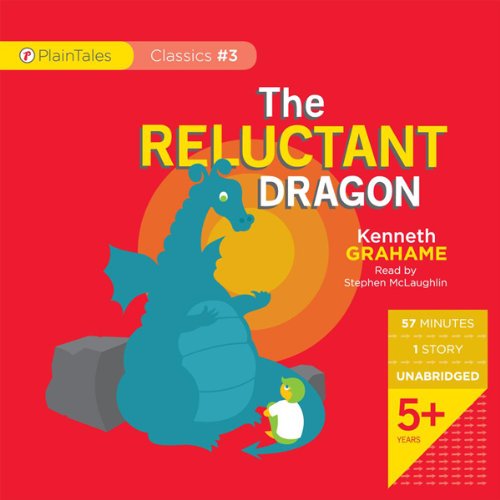
- Narration: Stephen McLaughlin handles Kenneth Grahame’s 1898 prose with clear diction and easy warmth, letting the dragon’s literary personality and the Boy’s calm wisdom carry their natural comedy.
- Themes: Peaceful coexistence versus expected violence, the gap between reputation and reality, finding friendship where conflict was scripted
- Mood: Gently subversive and charming, the feeling of a story that refuses to behave as expected
- Verdict: A proto-modern dragon story that prefigures most sympathetic-dragon narratives by a century, short, beautifully constructed, and a genuine pleasure in audio at under an hour.
One of my persistent interests as a critic is tracking the moment when a subgenre acquires its first truly definitive expression. For the sympathetic dragon story, that entire category of fantasy that gives us Toothless, Saphira, Eragon’s world, the origin is almost certainly Kenneth Grahame’s 1898 short story, originally a chapter in Dream Days. The Reluctant Dragon is not just historically significant. It is also, almost 130 years later, a better story than most of its descendants. At fifty-six minutes in audio, it’s the rare listening experience where the brevity itself is part of the pleasure.
The setup is quietly brilliant. A boy discovers an erudite, mushroom-loving dragon living in the hills above his village. They become friends immediately, the dragon recites poetry, prefers solitude, and has absolutely no interest in terrorizing anyone. The town, naturally, sends for St. George to kill the beast. What follows is not a fight but a negotiation, engineered by the Boy, that satisfies all social expectations while leaving everyone alive and considerably more comfortable with the situation. Grahame understood that the most interesting stories are not about violence overcoming evil but about intelligence preventing violence from being necessary in the first place.
The Dragon Who Refused His Own Story
Most modern sympathetic dragon narratives solve the problem by giving the dragon a tragic backstory or a moment of heroic self-sacrifice that earns their coexistence. Grahame’s dragon does not need either of these devices. He is simply a particular kind of creature, learned, lazy, fundamentally peaceable, who has been assigned a narrative role by social convention that does not suit him. The Boy’s achievement is not taming or reforming the dragon but recognizing from the start that no taming or reforming is necessary. The dragon is not a threat that becomes a friend; he was always a friend, trapped in a situation that expected him to be a threat.
Stephen McLaughlin’s narration holds this central dynamic with easy grace. The dragon’s literary pretensions and gentle pomposity could easily tip into caricature; McLaughlin keeps them warmly human, which is precisely right. One reviewer notes that every child should hear this story, and another, who read it as a parent, wishes they had known it when their sons were young. Both responses point to the same quality: this is a story that reads differently at different ages without losing coherence at any of them. The Boy’s wisdom is accessible to a ten-year-old and recognizable to an adult. The dragon’s literary vanity is funny to both. The St. George resolution is satisfying to whoever is listening.
Fifty-Six Minutes and Its Proper Weight
At fifty-six minutes, The Reluctant Dragon sits in an unusual category: longer than picture book audio, shorter than a standard middle-grade novel. It’s the length of a novella, which is what it is, and this length is exactly right for the story’s scope. The plot does not require more time; the characters are fully realized within their constraints; the ending arrives with the satisfaction of something concluded at its natural size rather than padded or truncated. McLaughlin’s pacing respects this, moving through the material without rushing and without dawdling.
The synopsis notes this is Grahame’s most famous short story and describes it as a prototype to most modern stories in which the dragon is a sympathetic character rather than a threat. That is an accurate and significant claim. The Reluctant Dragon belongs to the same category as The Wind in the Willows in its understanding that the best children’s literature is not really literature only for children. It is literature that children can access and adults can return to.
Who Should Listen and Who Should Skip
The Reluctant Dragon is suited for children ages six and up, though the story’s wit and subversive gentle logic may land more fully for listeners eight and older. Adults who encounter it for the first time will find it genuinely delightful. Families doing fantasy genre units, discussions of where dragon mythology comes from, or reading alongside other Grahame texts will find it a natural addition.
At fifty-six minutes, the only listeners who might want something different are those seeking a full-length novel. This is a complete story at its proper short-form length. Listeners who value that kind of disciplined brevity in storytelling will find it here in concentrated form.
Frequently Asked Questions
Is The Reluctant Dragon appropriate for a family listening experience, or is it better suited to older children?
It works across a wide family range. Children six and up can follow the story, and adults will find additional layers in the social commentary and Grahame’s gentle satire of convention. It’s genuinely one of those stories that different ages can enjoy simultaneously without anyone being bored or lost.
How does this 1898 original compare to the 1941 Walt Disney film adaptation of the same name?
The Disney film uses the basic characters and premise but significantly alters the story structure and tone. Grahame’s original is more quietly subversive, the resolution depends on intelligence and social maneuvering rather than action, while the film adds adventure and spectacle. The original stands as the purer version of the central idea.
Is Stephen McLaughlin’s narration of the Victorian-era prose accessible to modern young listeners?
McLaughlin’s clear diction and warm delivery make the late-Victorian language accessible without modernizing it into something it is not. Young listeners may encounter some unfamiliar vocabulary, which can become a natural conversation point. The story’s events are clear enough that language novelty enhances rather than obstructs enjoyment.
At 56 minutes, is The Reluctant Dragon long enough to be satisfying as a standalone listen?
Absolutely, it’s a complete novella at its proper length, not an abbreviated or truncated text. The story is fully realized within its scope. Listeners who prefer longer novels will need to look elsewhere, but those who value tight, perfectly calibrated storytelling will find the brevity a strength.