Quick Take
- Narration: Shane W. Evans, also the book’s illustrator, narrates his own visual art’s companion text with a quiet authority that serves the verse novel’s compressed emotional register.
- Themes: Survival through creative expression, displacement and the refugee experience in Darfur, literacy as a form of power and self-determination
- Mood: Spare and devastating, with moments of hard-won beauty that arrive with greater force for their rarity
- Verdict: A verse novel about the Darfur conflict told from a twelve-year-old Sudanese girl’s perspective, Evans’s narration and Pinkney’s language combine into something that holds its weight in the audio medium.
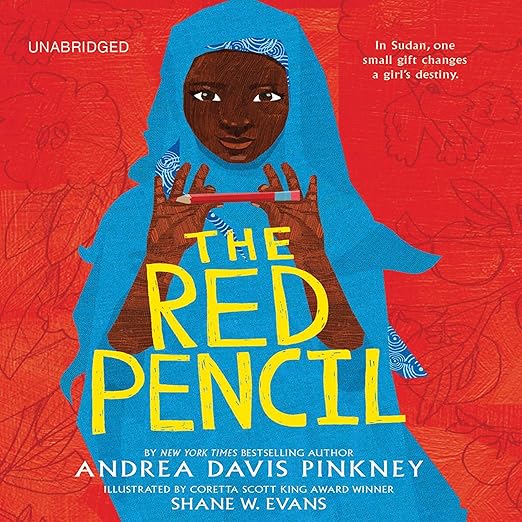
I did not approach this audiobook lightly. The Red Pencil is a verse novel told from the perspective of twelve-year-old Amira, a girl whose Sudanese village is destroyed by the Janjaweed militia, who survives the attack and makes the journey to a refugee camp, and who discovers in that camp that a simple red pencil can open a door she had not known was closed to her. Andrea Davis Pinkney is a Coretta Scott King Award winner. Shane W. Evans is also a Coretta Scott King Award winner. This book was made by two people who have both spent careers thinking carefully about how to tell stories of survival without exploitation, and that care is present in every line.
Shane W. Evans narrates, which raises the question of how a visual artist performs text on audio. The answer, here, is with exactly the restraint the material requires. Evans does not push the verse toward performance poetry. He reads it at the speed of comprehension, letting Pinkney’s lines land fully before moving to the next. For a verse novel, a format that can feel awkward in audio when narrators over-emote or under-serve the line breaks, this is the correct approach, and Evans’s familiarity with the work (he illustrated it) gives his delivery an informed quality that a hired narrator would need time to develop.
Before the Janjaweed: Life at Full Brightness
One of Pinkney’s most important structural choices is the amount of time she spends establishing Amira’s life before the attack. The reader learns Amira’s family, her friendships, her daily rhythms, the specific texture of her Sudanese village existence. This is not setup, it is the weight that makes what comes next unbearable in the right way.
The poem titled Fleeing, which one reviewer quotes with particular emphasis, citing the line about anguish unmovable like so many mud brick sacks, is devastating in Evans’s reading. But it only works as devastation because Pinkney has spent the preceding pages making us inhabit the life that is being lost. Evans reads those early, brighter poems with something that sounds like longing, as if he knows where the book is going and cannot quite keep that knowledge out of his voice.
The Gift in the Camp
At the refugee camp, a volunteer gives Amira a red pencil. The pencil becomes a key, though not to anything as simple as drawing. What the pencil opens is the possibility of literacy, of Amira learning to write, to form letters, to own language in a way that her village’s gender norms had not provided for her. Pinkney makes this development feel both practically significant and mythically resonant without forcing the mythology.
The verse form is particularly well-suited to this development. As Amira learns to form letters, the poems themselves reflect the building of language, short at first, then longer, then more complex. Whether this structural mirroring was Pinkney’s explicit design or an emergent quality of the verse form is unclear, but in Evans’s narration the effect is present and powerful. The poems do not feel like explanations of what is happening. They feel like what is happening.
What This Book Asks of Its Listeners
I want to be honest about the emotional demands of this audiobook. It is not a difficult listen in the sense of being dense or confusing. The verse is clear and accessible. But it asks its listeners to sit with genuine suffering, not sanitized historical distance, but the specific, human suffering of a fictional girl whose situation is drawn from documented experience. Several reviewers note that they came away from it thinking more carefully about their own circumstances and the world outside them. That is exactly what literature about atrocity is supposed to do.
For classroom contexts, the book is widely used in grades five through seven as part of units on Africa, global citizenship, and narrative witness. The verse form makes it approachable for a wide range of reading levels, and the emotional intelligence of the construction gives teachers real material to work with. The audio version makes it available to students who struggle with the physical page while fully preserving the impact of Pinkney’s language.
Who Should Listen
The Red Pencil is appropriate for listeners aged ten and up, with the caveat that the subject matter, militia attack, death, refugee camp conditions, is serious and requires adult accompaniment for younger listeners who may need context or conversation afterward. Those who seek out verse novels that carry the weight of real-world events will find this among the most accomplished examples in children’s literature. Adults who work in education or human rights will find it speaks across the age category it is marketed toward.
Frequently Asked Questions
Is Shane W. Evans’s narration different from what a professional voice actor might bring to this audiobook?
Evans is the illustrator of the book, and his narration carries the intimacy of someone deeply familiar with the work’s intent. He reads with restraint rather than performance, which is the right choice for verse prose about genuine atrocity. A voice actor might have more technical range; Evans has more specific knowledge of what the text is trying to do.
Is The Red Pencil appropriate for classroom use with fifth and sixth graders?
Yes, and it is widely used in exactly this context. The subject matter, the Darfur conflict, the Janjaweed militia, refugee camp conditions, requires contextualizing for this age group, but the verse form is accessible and the emotional intelligence of the construction gives classroom discussion strong footing. Multiple educators have recommended it for units on Africa, human rights, and narrative witness.
Does the verse novel format work in audio, or does it lose something without the visual experience of the page?
Verse novels in audio depend heavily on the narrator’s respect for line breaks and the rhythm of individual poems. Evans reads the text at comprehension speed with appropriate pauses, which preserves the verse structure effectively. The visual element lost is the interaction between Evans’s illustrations and Pinkney’s text, which is worth acknowledging, but the text stands on its own in this format.
How does The Red Pencil handle the violence of the Janjaweed attack, is it graphic?
Pinkney deliberately does not describe the violence in graphic detail. The attack is rendered through absence, aftermath, and the specific shock of what is gone rather than through explicit scenes of what happened. This is both an ethical choice and an effective literary one, the poems about what is lost are more devastating than description could be.