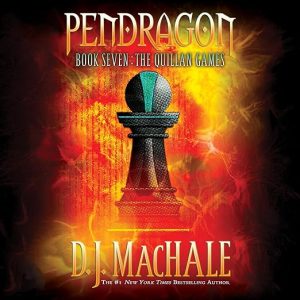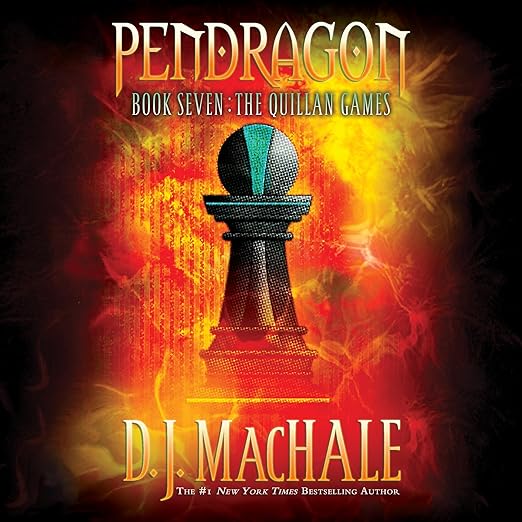
I was not a Pendragon reader growing up, which means I came to The Quillan Games as what the series calls a Second Earth native who arrived late. For context: the Pendragon series follows Bobby Pendragon, a seemingly ordinary teenager from suburban New Jersey who discovers he is a Traveler, someone who can move between different territories of a world called Halla, each with its own civilization and crisis. Bobby's mission is to prevent a being called Saint Dane from tipping each territory into collapse.
Book seven takes Bobby to Quillan, and I want to say first that MacHale's setup here is one of his best. The territory is not at war. It is not in environmental collapse. It has been pacified. The people of Quillan have surrendered control of their own future to a pair of game masters, Veego and LaBerge, who have reduced existence to a survival lottery. That is a darker premise than it sounds.
The Review
Veego and LaBerge host games that range from physical combat to computer-driven agility tests to obstacle courses designed to kill. The people of Quillan enter the games not out of ambition but necessity, the reward for winning is survival at a higher standard; the penalty for losing is death. MacHale is drawing on a tradition that Shirley Jackson established in The Lottery and that Suzanne Collins later brought to mainstream YA with The Hunger Games, but he gets there independently and with his own angle: the games are not about spectacle for an external audience. They are about the utter commodification of hope.
Bobby arrives on Quillan and quickly understands that he cannot rescue the territory from the outside. He has to enter the games himself, beat Veego and LaBerge at their own system, and dismantle the structure from within. That inside-out logic is one of MacHale's recurring thematic moves, and it works particularly well here because the games format creates natural structural momentum, each competition is its own micro-crisis with clear stakes.
Why Listen to The Quillan Games
William Dufris has been with this series since the beginning, and the difference between a narrator who has lived with a character across six books and one encountering a series cold is audible. Reviewer Dick Carlander noted that the character of Bobby Pendragon has "great dialogue" and well-defined secondary relationships, Dufris services all of it with the comfort of someone who knows exactly how Bobby's voice ages and shifts under pressure.
Reviewer Jarrod T. Thompson noted that familiar items from other territories in Halla appear in The Quillan Games, giving returning readers moments of resonance that function as earned rewards. That connective tissue, cross-territory references, character callbacks, is part of what makes a long series worth maintaining, and MacHale uses it without letting it overwhelm new readers who encounter Quillan without the full history.
The Caveats
At fifteen-plus hours, this is a substantial listen that benefits from engagement with the prior six volumes. That said, reviewer "sassycalam" returned to the series after years away and found that "Bobby's a good guy and his adventures are sometimes wild and crazy but always fun", which suggests the characterization is stable enough to survive a gap in readership. If you come in cold at book seven, the emotional texture will be thinner than MacHale intends, but the plot remains followable.
The adult reviewer who described preferring Pendragon to "the ministerial vampire series" and ranking it alongside The Hunger Games and Divergent is making a case that the series has more crossover appeal than its middle-grade shelving implies. That is accurate: the premise, the moral stakes, and the game theory of Quillan play at a level of abstraction that rewards adult readers.
The Right Listener for The Quillan Games
Essential listening for anyone already in the Pendragon series, this is one of the franchise's tightest and most thematically interesting entries, and skipping it creates a gap in the larger arc. For new listeners, start at The Merchant of Death. For adults who enjoy clean, morally serious speculative fiction that does not talk down to its audience, the Pendragon series as a whole is worth investigating, and book seven is a reasonable case for why.
Frequently Asked Questions
How does this book compare to The Hunger Games in the games-as-oppression genre?
MacHale arrived at a similar concept independently and from a different angle. The Quillan Games is about total social pacification rather than state spectacle, the games exist to manage a population rather than entertain one. The ethical architecture is distinct, and Bobby's inside-out solution has no direct parallel in Collins's trilogy.
Is William Dufris's narration consistent with the earlier Pendragon audiobooks?
Yes. Dufris has narrated the entire series and his performance here reflects years of familiarity with Bobby Pendragon's voice and emotional register. Long-time series listeners consistently cite his narration as a core part of the experience.
Is the content appropriate for middle-grade readers, or does The Quillan Games push into darker territory?
The games involve death and there is genuine violence, but MacHale handles it without graphic detail. It is darker in tone than the early Pendragon books but consistent with where the series was heading as Bobby's responsibilities grow. Most parents comfortable with the earlier volumes will find this entry appropriately calibrated.