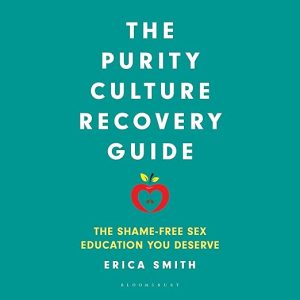
Writing about sex education with the kind of precision and warmth that actually reaches people who were taught to fear their own bodies is among the hardest things a non-fiction author can attempt. Erica Smith, with more than two decades of professional experience as a sex educator, knows exactly what she is doing with The Purity Culture Recovery Guide, and the audiobook format, narrated with calm authority by Patricia Rodriguez, makes this resource more accessible than it might have been in print alone.
Shame as Injury, Centered on Queer and Trans Experience
Purity culture, as Smith documents with precision, left a specific set of wounds in those raised within it: fear of intimacy, chronic shame about desire, painful or unsatisfying sexual experiences, and a persistent sense that something is fundamentally broken in the self. These are not vague feelings; they are documented patterns that Smith has worked with across thousands of clients and students over her career. Her approach is to treat them as injuries with traceable causes and learnable remedies rather than character flaws or spiritual failures, which is itself a significant reframing.
The framework Smith builds is inclusive by design. She explicitly centers women, queer, and trans people throughout the guide, whose experiences of purity culture were often the most harmful and the least publicly acknowledged. This is not a book that treats heterosexual cisgender experience as the default and appends notes for everyone else. It understands harm in its full range from the beginning, and that inclusive starting point is one of the reasons this guide will serve readers who might not initially see themselves in a purity culture framework but whose upbringings nevertheless produced shame around bodies and sexuality.
Rodriguez's Narration Carries Years of Clinical Experience
Smith's tone throughout is one of the book's genuine achievements. She is clear and direct without being clinical, warm without being saccharine, and honest about difficult topics without sensationalism. Patricia Rodriguez matches that tone in narration, reading this material as if she understands why it matters and wants the listener to feel that understanding as well.
The book draws on Smith's experience as a sex educator working directly with individuals and communities navigating these questions. That experiential foundation gives the practical sections a specificity and credibility that more academic treatments of the same topics sometimes lack.
Hearing a Calm Voice Say the Unspeakable
The audiobook format offers something that silent reading might not provide for some listeners: a voice. For people who grew up in environments where these topics were literally unspeakable, hearing a calm, knowledgeable narrator discuss bodies, desire, and consent without shame or judgment can itself contribute to the healing process. Rodriguez's measured, compassionate delivery serves that function across the full runtime.
Smith covers medically accurate information about bodies, birth control, pleasure, communication, consent, and abortion alongside affirming discussions of gender identity and sexuality. None of this content is presented as shocking or transgressive; it is presented as information people deserve to have, which is a quiet but significant reframing for listeners who were taught that such knowledge was itself dangerous or corrupting.
The practical tools Smith provides are concrete and usable. She offers frameworks for identifying and challenging damaging beliefs, exercises for setting boundaries, and guidance for building a sexual ethic based on respect and autonomy rather than fear and prohibition. These are not abstract aspirations but actual practices that listeners can begin implementing in their own lives while working through the audio.
For listeners who have sought out other healing resources and found them either too clinical or not specific enough to religious shame, Smith's combination of sex education expertise and purity culture literacy makes this audiobook unusually well-targeted to its intended audience.
Heavy Material, Best Taken in Sections
This audiobook is not a light listen. Smith covers trauma with genuine care, but the material itself can bring up difficult memories and feelings for listeners who lived through purity culture. Having support available, whether through a therapist, a trusted community, or simply the ability to pause and process, may be valuable for some listeners moving through the more demanding sections.
The book's focus on recovery means it assumes listeners are coming with some level of purity culture background and some readiness to engage with the healing work. Readers who did not grow up in that context may find some sections less directly applicable to their own experience, though the sex education content is useful and medically accurate regardless of background.
At over eight hours, this audiobook covers considerable ground. Some listeners will find it most valuable to move through in sections rather than straight through, pausing to reflect on and try the exercises Smith provides. The format rewards that kind of engaged, deliberate listening rather than background listening.
From Evangelical Upbringings to Clinical Practice
Adults who grew up in evangelical, fundamentalist, or other religiously conservative environments that promoted purity culture will find this audiobook a practical and compassionate resource. Smith's specific understanding of how these environments operate makes her guidance more precise than general self-help or general sex education materials, which often lack the specific cultural literacy required to address these particular wounds.
Queer and trans listeners who found purity culture especially harmful, whose sexuality and gender identity were explicitly condemned rather than merely repressed, will appreciate Smith's explicit centering of their experiences throughout the guide. This is not a book where their experiences are added as an afterthought.
Therapists, counselors, and educators who work with clients or students navigating purity culture recovery will find this a valuable resource to recommend and draw on in their practice. Smith's framework is trauma-informed, evidence-based, and clearly organized in ways that support both individual and group clinical use.
Is this audiobook only relevant for people raised in evangelical Christian environments?
No. Smith addresses purity culture as it appears across multiple religious and cultural contexts. Catholic, Mormon, Muslim, and other conservative religious backgrounds are also addressed meaningfully.
Does the audiobook include practical exercises or is it purely informational content?
Both. Smith provides concrete exercises for identifying damaging beliefs, setting boundaries, and building a new sexual ethic. The audiobook is both informational and actively practical throughout.
Is The Purity Culture Recovery Guide audiobook appropriate for teenagers still in religious environments?
It is written for adults navigating recovery, not teens still embedded in purity culture. The content is frank about sexuality. Parental discretion applies for younger listeners.