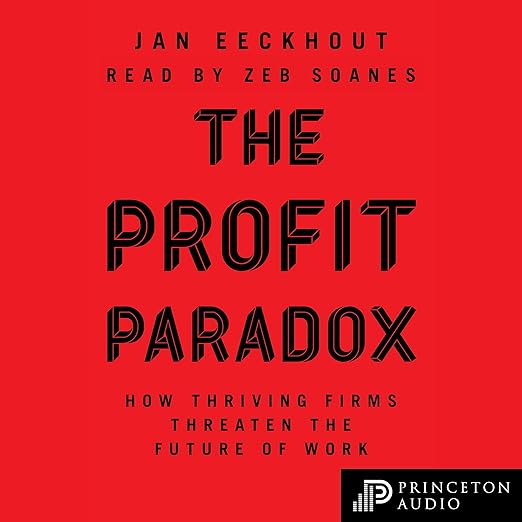
Why does a bottle of beer, or a prosthetic hip, keep costing more while the wages of the people making and selling them barely move? Jan Eeckhout's audiobook The Profit Paradox, narrated by Zeb Soanes across nearly eleven hours, builds its entire argument around that mismatch, tracing it back to a small number of companies that have quietly accumulated enough market power to set prices well above what real competition would allow.
Keeping the Argument From Floating Free
Eeckhout's central claim is that over the past forty years, a handful of what he calls superstar companies have captured most of the gains from new technology, not by passing efficiency savings on to consumers through lower prices, but by using that same technology to charge more. The result, per the synopsis, is unnecessarily high prices across ordinary goods, fewer startups able to compete, and stagnating wages for most workers even as productivity climbs.
What keeps this from reading as pure economic modeling is the structure Eeckhout chose: his own research sits alongside the actual stories of ordinary workers living inside the wage stagnation he is describing. That pairing of data and testimony is a deliberate choice meant to keep an argument about market concentration from floating free of the people it actually affects.
A Prosthetic Hip Is Not a Luxury
The synopsis's choice of a prosthetic hip as an example, alongside something as ordinary as a bottle of beer, is a deliberate escalation worth noticing: a prosthetic hip is not a discretionary purchase, it is essential medical equipment, and pricing it beyond fair competitive levels lands very differently than the same argument made about a luxury good. That example choice does real work in making an abstract market-power argument feel concrete and, for some listeners, personal.
Eeckhout frames this as a forty-year trend rather than a recent development, which reframes the book as much as economic history as it is current-events commentary. Treating market concentration as a slow-building, decades-long shift rather than a sudden crisis gives the argument more weight, since it asks listeners to reconsider trends they may have assumed were natural or inevitable rather than the product of specific, traceable policy and corporate choices.
When the Self-Correcting Mechanism Quietly Broke
Eeckhout's specific definition of market power is worth stating plainly: the ability of a company to set prices meaningfully above what a genuinely competitive market would allow, not simply being large or successful. That distinction matters throughout the book, since the argument is not against big companies as such, but against the absence of enough real competition to keep any company's pricing power in check.
The title's own paradox is worth spelling out directly: under ordinary competitive conditions, rising profit is supposed to attract new competitors, which then pushes prices back down and spreads gains more broadly. Eeckhout's argument is that this self-correcting mechanism has quietly broken in market after market, so profit keeps climbing precisely because the competitive discipline meant to check it no longer functions the way classical economics assumes it should.
The synopsis also warns of 'fewer start-ups that can compete,' a consequence worth separating from the wage-stagnation argument already covered: concentrated market power doesn't just squeeze existing workers, it raises the barrier for new companies even attempting to enter a market dominated by superstar firms, which chokes off the innovation competition is supposed to generate in the first place.
Soanes Arrives With No Confirmed Track Record
Zeb Soanes has no prior track record in these notes, so his fit here is assessed on genre grounds rather than a confirmed performance history. Economics arguments like this one need a narrator who can hold measured authority across dense reasoning without either over-dramatizing the stakes or draining the urgency from an argument the author clearly means as a warning, not a neutral survey.
Reviewer Amazon Customer calls the book a 'Masterpiece,' praising it as 'Clear, eloquent and powerful' in making its case, while Raoul Dexters' review, titled 'Page-Turner,' credits Eeckhout with covering 'a complicated matter' in a way that will reach 'a large audience.' Both point to the same underlying strength: an academic argument rendered legible without being watered down.
The synopsis raises stakes beyond individual consumer prices, warning that unchecked market power could eventually produce 'disastrous market corrections and political turmoil.' That escalation, from a grocery bill to systemic economic and political risk, is part of what gives the book its urgency, and it is worth knowing the argument is ultimately about stability at a national scale, not just fairness at the checkout counter.
A Spanish Review for an English-Only Audiobook
One review in the set, from Clara Lopez, is written entirely in Spanish, praising the book for showing how market economies need protection from the manipulations of dominant corporate power. That is worth noting honestly rather than skipping past: this book's argument has reached readers well beyond its original English-language audience, even though this particular audio edition is English only.
This is a book with a clear point of view, not a neutral survey of market structures. The synopsis itself calls it 'a provocative investigation,' and Eeckhout closes by offering 'concrete solutions' rather than stopping at diagnosis. Readers wanting a purely descriptive account of market power, without an argument for what should change, should know upfront that this book is built to persuade, not just inform.
Clara Lopez's Spanish-language review adds a specific, substantive point beyond simply confirming international reach: she argues the market economy needs protection from the manipulations of dominant corporate power, and specifically names reduced innovation, efficiency, wages, and employment as the resulting costs. That her summary lines up closely with the English-language reviews' praise suggests the book's core argument translates cleanly across audiences well beyond its original English readership.
The synopsis specifically promises stories of 'common workers throughout,' and that narrative device matters as much for the audio format as for the argument itself: individual case studies of real people navigating stagnant wages translate naturally to spoken narration in a way that a printed chart or regression table never could, giving the audiobook a genuine format advantage over the page for exactly this part of the book.
Checking Your Own Employer Against the Pattern
Readers of accessible, narrative-driven economics who want the stagnant-wages, rising-prices story explained through both data and individual cases will find this a strong fit, especially anyone who has felt the gap between corporate profit headlines and their own paycheck without having the framework to explain why.
Business readers curious whether their own employer fits the 'superstar company' pattern Eeckhout describes will find the book gives them a real framework for that kind of self-diagnosis, not just abstract industry-level statistics.
Anyone wanting dense academic modeling with full methodological transparency, or a strictly neutral account free of advocacy, should adjust expectations; Eeckhout is arguing a position throughout, and the book's persuasive intent shapes every chapter rather than sitting only in a closing call to action.
Does this audiobook offer solutions or just diagnose the problem?
Both. Eeckhout closes by proposing concrete fixes for restoring healthy market competition, not just cataloging the damage unchecked market power has done.
Do I need an economics background to follow this audiobook?
No. Raoul Dexters specifically praises Eeckhout for covering a complicated matter in simply written terms accessible to a large audience, and the book pairs data with individual worker stories to keep the argument grounded.
Who narrates The Profit Paradox audiobook?
Zeb Soanes narrates this nearly eleven-hour audiobook, his first appearance in AudiobookDaily's narrator coverage.